

Clinical Lens · Educational analysis
Psychosis Is Not a Verdict
Psychosis is a clinical description. “Not guilty by reason of lack of criminal responsibility” is a legal conclusion. The two can overlap, but one does not automatically establish the other.
The Lindsay Clancy case made that distinction visible. Experts could agree that serious mental illness existed and still disagree about diagnosis, timing, capacity, and the ultimate legal question. Understanding why requires separating symptoms from diagnoses—and diagnoses from legal standards.
First: What is psychosis?
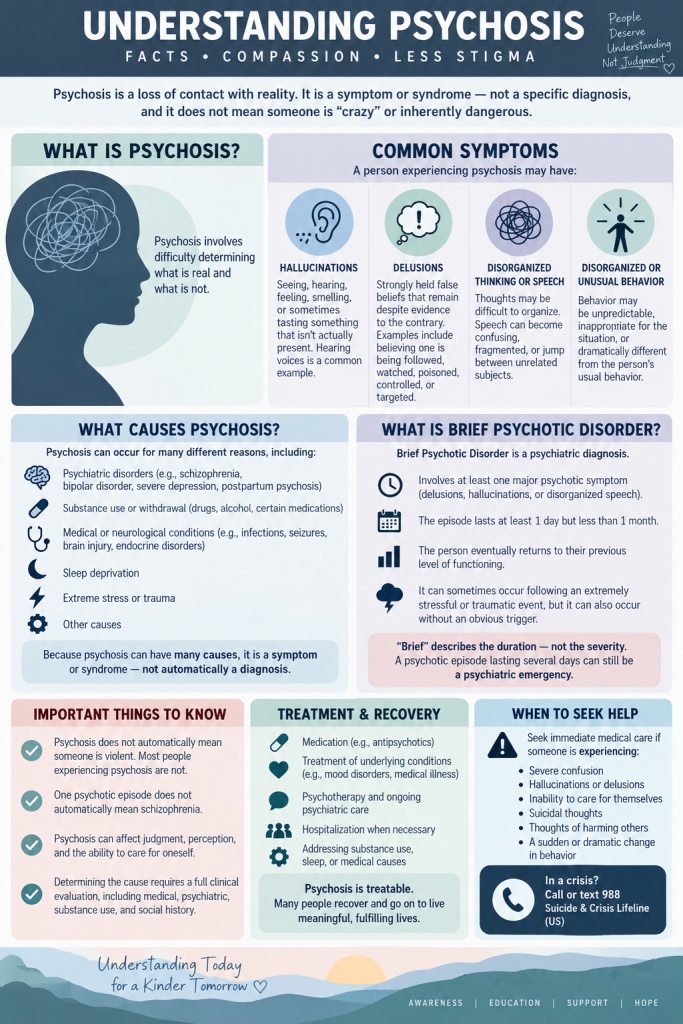
The National Institute of Mental Health describes psychosis as a collection of symptoms involving some loss of contact with reality. Common features include delusions, hallucinations, disorganized thinking or speech, and behavior that does not fit the situation. Psychosis can occur in several conditions, including bipolar disorder, severe depression, schizophrenia-spectrum disorders, substance-related states, and some medical conditions.
Psychosis is not one single diagnosis, and it does not look identical in every person. Symptoms can vary in intensity and may come and go. A person may have impaired reality testing in one area while still speaking coherently, performing familiar tasks, driving, sending a message, or following a sequence of actions.
Postpartum psychosis is a specific emergency
Postpartum psychosis is a rare, acute psychiatric emergency associated with the period after childbirth. ACOG materials estimate that it occurs in roughly 1 to 3 per 1,000 births. Symptoms may include delusions, hallucinations, severe mood disturbance, confusion, disorientation, agitation, and major disruption of sleep.
It is different from postpartum depression, although depression, mania, mixed mood symptoms, anxiety, and psychosis can overlap. Because risk can escalate quickly, suspected postpartum psychosis requires immediate psychiatric assessment and a safety plan for the parent and infant.
Psychosis can look more organized than people expect
Public discussions often rely on a false binary: a person was either visibly chaotic every moment, or the person could not have been psychotic. Clinical reality is more complicated.
- Hallucinations do not have to be continuous.
- Delusions may be internally consistent even when they are not grounded in reality.
- Routine or practiced skills may remain available.
- Speech can appear organized while a person’s interpretation of events is profoundly distorted.
- Behavior before or after an act can be relevant without conclusively proving the person’s mental state at the critical moment.
“Organized” behavior is evidence to examine, not a diagnosis. It may support competing interpretations depending on the full record.
Diagnosis, competency, and criminal responsibility are different questions
Diagnosis
What mental-health condition best explains the person’s symptoms over time? Diagnosis depends on history, examination, collateral records, symptom course, substance or medication effects, and differential diagnosis.
Competency to stand trial
Can the defendant understand the proceedings and assist counsel now? Competency concerns the present ability to participate in a case. It does not decide the person’s mental state at the time of the alleged offense.
Criminal responsibility
Under the Massachusetts standard used in the Clancy trial, the Commonwealth must prove that a defendant did not lack substantial capacity to appreciate the wrongfulness of the conduct or to conform the conduct to the requirements of law as a result of mental disease or defect.
A mental illness may be serious without satisfying that legal test. Conversely, a person does not need to be visibly disorganized in every moment for the legal question to remain contested.
What a medication timeline can—and cannot—tell us
A medication chronology can show the intensity of treatment, repeated efforts to address symptoms, and rapid changes that may matter clinically. It can help experts reconstruct sleep, mood, anxiety, adverse effects, and the evolution of symptoms.
But a list of prescriptions cannot establish causation by itself. It does not prove adherence, exact timing of every dose, individual metabolism, a particular side effect, or the person’s capacity during a later event. Even a medication detected in toxicology must be interpreted in context.
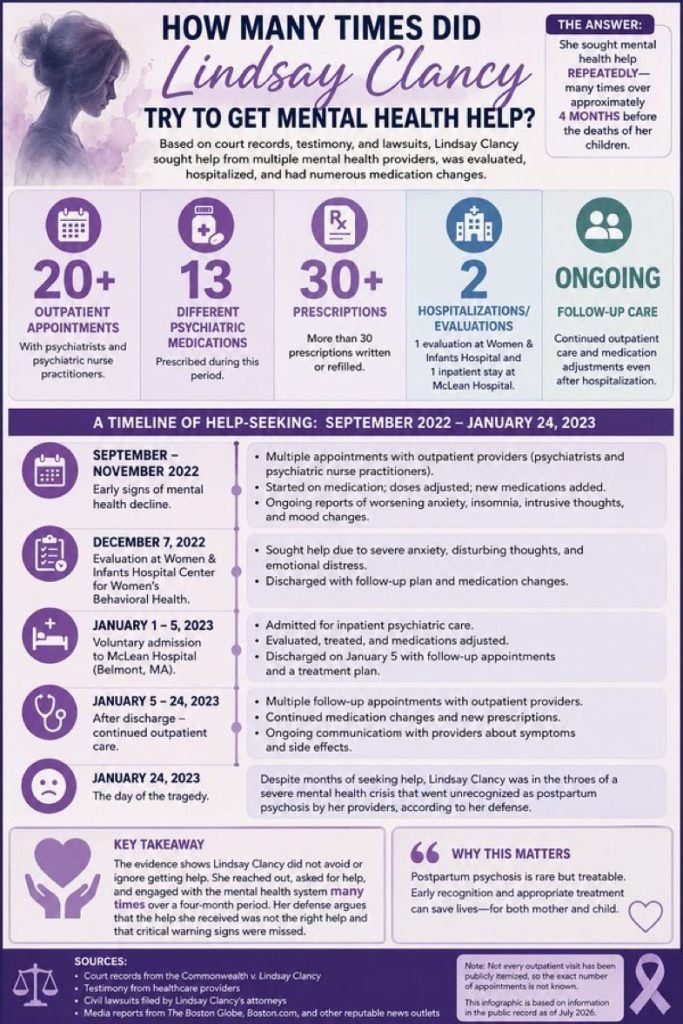
That is why the Clancy timeline belongs in the evidence review but should not be treated as a verdict. The defense argues that repeated medication changes and missed warning signs contributed to deterioration. Prosecutors disputed that explanation and argued the killings were intentional. Those are competing case theories, not settled clinical findings.
The Clancy record: agreement and disagreement
The defense’s post-mistrial filings state that all six forensic experts agreed Clancy suffered from a serious mental illness on January 24, 2023. According to those filings, the experts differed on diagnostic labels and on whether she retained the capacity required for criminal responsibility.
Defense experts described psychosis and lack of criminal responsibility. Prosecution experts offered different diagnostic and capacity opinions. The jury did not reach a unanimous verdict. None of those facts permits an outside observer to diagnose from social media clips, a single search history, one conversation, or one act of apparently purposeful behavior.
Five evidence rules for discussing psychosis
- Do not use “psychotic” as a synonym for violent, irrational, or evil.
- Do not assume functioning rules psychosis out. Ask what function, at what time, and in what domain.
- Do not confuse diagnosis with a legal verdict.
- Do not infer medication causation from a side-effect list.
- Follow the longitudinal record. Sleep, mood, treatment contacts, collateral reports, contemporaneous notes, and symptom change matter more than isolated impressions.
Why this matters beyond one case
Accurate language protects two groups at once: families facing psychiatric emergencies and victims whose cases deserve careful, evidence-based analysis. Compassion does not require abandoning accountability. Accountability does not require denying the reality of severe mental illness.
The work is to hold both truths long enough to examine the record.
Immediate help
Suspected postpartum psychosis requires urgent medical attention. In the United States, call or text 988 for crisis support. Call 911 or go to the nearest emergency department if there is immediate danger or a medical emergency.
Sources and further reading
- National Institute of Mental Health: Understanding Psychosis.
- American College of Obstetricians and Gynecologists: Summary of Perinatal Mental Health Conditions.
- ACOG Clinical Practice Guideline: Treatment and Management of Mental Health Conditions During Pregnancy and Postpartum.
- Massachusetts Model Jury Instructions: Criminal Responsibility.
- 988 Suicide & Crisis Lifeline.
This article is educational and is not medical or legal advice. It does not diagnose any person. In the Clancy case, charges and allegations remain pending unless resolved by a court.