

Originally published · Last reviewed

CONTENT NOTE: This article discusses homicide, sexual violence, torture, drugging, and mutilation. Jaded Evidence centers victims and distinguishes convictions, suspected links, and unresolved attribution.
Facts over speculation. Follow the evidence.
A Freeway Murder Pattern Hidden in Plain Sight
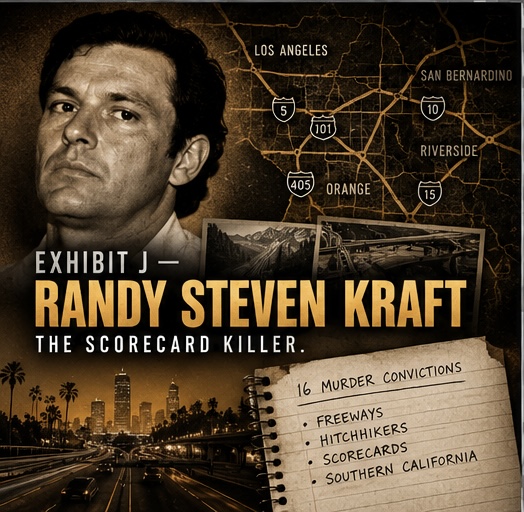
Randy Steven Kraft was convicted in California of murdering 16 young men between 1972 and 1983. Several victims were U.S. Marines. Many were found near freeways or roads, often after being drugged, restrained, sexually assaulted, strangled, or mutilated.
The case became known as the Scorecard Killer case because investigators recovered a cryptic handwritten list containing coded entries that prosecutors argued corresponded to individual victims.
The Victims
The California Supreme Court’s review of Kraft’s case documents 16 murder convictions involving young male victims, including Edward Daniel Moore, Ronald Gene Wiebe, Keith Daven Crotwell, Mark Howard Hall, Scott Michael Hughes, Roland Gerald Young, Richard Allen Keith, Keith Arthur Klingbeil, Michael Joseph Inderbieten, Donald Harold Crisel, Robert Wyatt Loggins Jr., Eric Herbert Church, Geoffrey Alan Nelson, Rodger James DeVaul Jr., Terry Lee Gambrel, and an unidentified victim known at trial as “John Doe Huntington Beach.”
The court noted that six of the victims were Marines.
The Arrest
Kraft was arrested in 1983 after California Highway Patrol officers stopped his vehicle.
Inside the car was the body of Terry Lee Gambrel, a 25-year-old Marine.
That traffic stop gave investigators an immediate homicide scene and opened the door to a much larger investigation.
The Scorecard
Police recovered a handwritten list from Kraft’s home containing dozens of cryptic entries.
Prosecutors argued that many entries corresponded to murder victims, locations, military status, or circumstances of the killings.
The document became one of the most famous pieces of evidence associated with the case.
But the scorecard should not be treated as a mathematically exact victim count. Some entries have never been conclusively matched to a known victim, and some suspected Kraft victims were never proven in court.
Physical Evidence
According to the California Supreme Court, physical evidence directly linked Kraft to eight of the murders for which he was convicted.
For the remaining cases, prosecutors relied on the similarities in modus operandi, victim characteristics, geographic patterns, and the scorecard entries.
This distinction is important because the prosecution did not rely on one single evidentiary theory across all 16 murders.
Methods Across the Series
The California Supreme Court summarized recurring features across the cases:
- many victims had alcohol and prescription drugs, often diazepam, in their systems,
- many showed ligature marks on the wrists,
- ligature strangulation was common,
- some victims were sexually assaulted or sexually mutilated,
- some bodies were left unclothed, and
- many bodies were dumped near freeways or roads.
Those similarities became critical in linking murders where direct physical evidence was limited.
Trial and Convictions
An Orange County jury convicted Kraft of 16 counts of first-degree murder, along with additional offenses including sodomy and mayhem.
The jury also found multiple special circumstances true and returned a death verdict.
In 1989, Kraft was sentenced to death.
California Supreme Court Review
In 2000, the California Supreme Court reviewed Kraft’s convictions and death sentence on automatic appeal.
The court affirmed the judgment in its entirety.
Current Status
Kraft was sentenced to death in 1989. California’s Governor announced on November 5, 2026 that he intended to commute the state’s death sentences to life without parole. The Governor’s Office says the commutations take effect only after the required legal steps. An individual commutation was unverified at this review.
Confirmed Versus Suspected Victims
In May 2025, Orange County and Oregon investigators announced the identification of Larry Eugene Parks, 30, whose remains were found in Oregon in 1980. His homicide remains an Oregon investigation. Authorities described Parks as a suspected victim, distinct from the 16 California convictions. Orange County Sheriff’s Department announcement.
Swipe horizontally to read the full table on smaller screens.
| Category | Status |
|---|---|
| 16 murder convictions | Established through the Orange County trial. |
| Additional suspected murders | Investigators have long examined many other cases for possible links to Kraft. |
| Scorecard entries | Potential references to victims or crimes, but not every entry has been conclusively identified. |
| Unmatched cases | Should remain separate from the judicially established victim count unless evidence supports attribution. |
What Authorities Knew — And When
1970s
Young men are found murdered near Southern California highways and roadways under recurring circumstances.
Late 1970s–early 1980s
Investigators begin recognizing similarities among cases involving young male victims, drugging, strangulation, sexual assault, and freeway disposal sites.
May 1983
Kraft is stopped by California Highway Patrol. Terry Lee Gambrel’s body is discovered in the vehicle.
1983 onward
Searches of Kraft’s home and belongings produce additional physical evidence and the cryptic scorecard.
1989
Kraft is convicted of 16 murders and sentenced to death.
2000
The California Supreme Court affirms the convictions and death sentence.
2026
The Governor announces a plan to commute California’s death sentences. Individual effective dates depend on completion of the required legal process.
The Freeway Geography
The Kraft case belongs in the California series partly because highways were not merely disposal locations.
Southern California’s freeway system gave an offender enormous mobility, anonymity, and access to transient populations.
Several victims were Marines or young men traveling through areas where hitchhiking and roadside movement were common.
The geography complicated recognition of the pattern because bodies could be found far from where victims were last seen.
The Victim-Count Problem
Kraft is often associated with much larger victim estimates than the 16 murders proven at trial.
Some estimates rely heavily on the scorecard, unsolved homicides, geographic similarities, or investigative theories.
Those possibilities matter, but they should not be collapsed into one number.
For Jaded Evidence, the language should remain precise:
16 murder convictions. Additional suspected victims. An unresolved scorecard. A total victim count that remains uncertain.
Jaded Evidence: Why This Case Matters
The Randy Kraft case demonstrates how one offender can exploit highways, transient populations, and jurisdictional boundaries.
It also demonstrates why physical evidence matters differently from pattern evidence.
Some murders were tied directly to Kraft through forensic evidence. Others were prosecuted through similarities in method and the scorecard.
That makes the case particularly useful for understanding how prosecutors build a serial-murder case when the evidence varies from victim to victim.
The scorecard made the case famous. The evidence made the convictions possible.
Sources & Further Reading
- California Supreme Court — People v. Kraft (2000)
- California Department of Corrections and Rehabilitation — Condemned Inmate List
- CDCR — Condemned Inmate Transfer Program
Jaded Evidence distinguishes convictions, suspected links, and unresolved scorecard entries. Suspected cases are not added to the confirmed count without evidentiary support.
Expanded Case Details
Case details: Randy Steven Kraft’s known series ran from the early 1970s until May 1983, primarily in Southern California, with suspected cases in Oregon and Michigan. He was convicted of sixteen murders. Victims were boys and young men, many connected to bars, hitchhiking or military communities.
MO and arrest: Kraft used alcohol and drugs to incapacitate victims, then restrained, sexually assaulted, tortured and strangled them before leaving bodies near freeways. Police stopped him for erratic driving on May 14, 1983, and found Terry Gambrel’s body in the passenger seat.
Psychiatric record: The trial did not produce an insanity verdict. Evidence supported organized planning and sexual-sadistic conduct; diagnostic claims outside the court record remain secondary.
Court and sentence: Orange County prosecutors tried the sixteen-murder capital case. Kraft was represented by appointed capital-defense lawyers through trial and decades of appeal. He was sentenced to death in 1989 and remains under a death judgment. Attorney names should be drawn from the controlling opinion before a definitive roster is published.
Potential victims: The “scorecard” and geographic comparisons have generated estimates exceeding 60, but entries are cryptic and not every suspected case is proven.
The Double Life
Kraft worked as a computer programmer, maintained a long-term relationship with Jeff Graves and participated in antiwar and political activity. Colleagues knew an educated technical professional while the freeway murders continued.
Leave a Reply