

Clinical Lens · Sexual Assault · Medical & Forensic Education
Sexual Assault: What It Is, What It Can Do, and What to Do Afterward
A trauma-informed clinical guide to consent and incapacitation, immediate medical care, forensic evidence collection, drug-facilitated assault, short- and long-term effects, reporting options and support.
Content note: This article discusses sexual assault, trauma, forensic examinations, pregnancy, sexually transmitted infections and mental-health effects. If you are in immediate danger or have a serious injury, call 911 or seek emergency care.
U.S. support: RAINN National Sexual Assault Hotline — 800-656-HOPE (4673). A local sexual-assault program or emergency department can also help locate a SANE/SAFE examiner.
Related investigation: This is a general clinical and forensic guide. It does not determine what occurred in any individual case. For the separate source-driven case investigation, see The Cornell Seven.
What sexual assault means
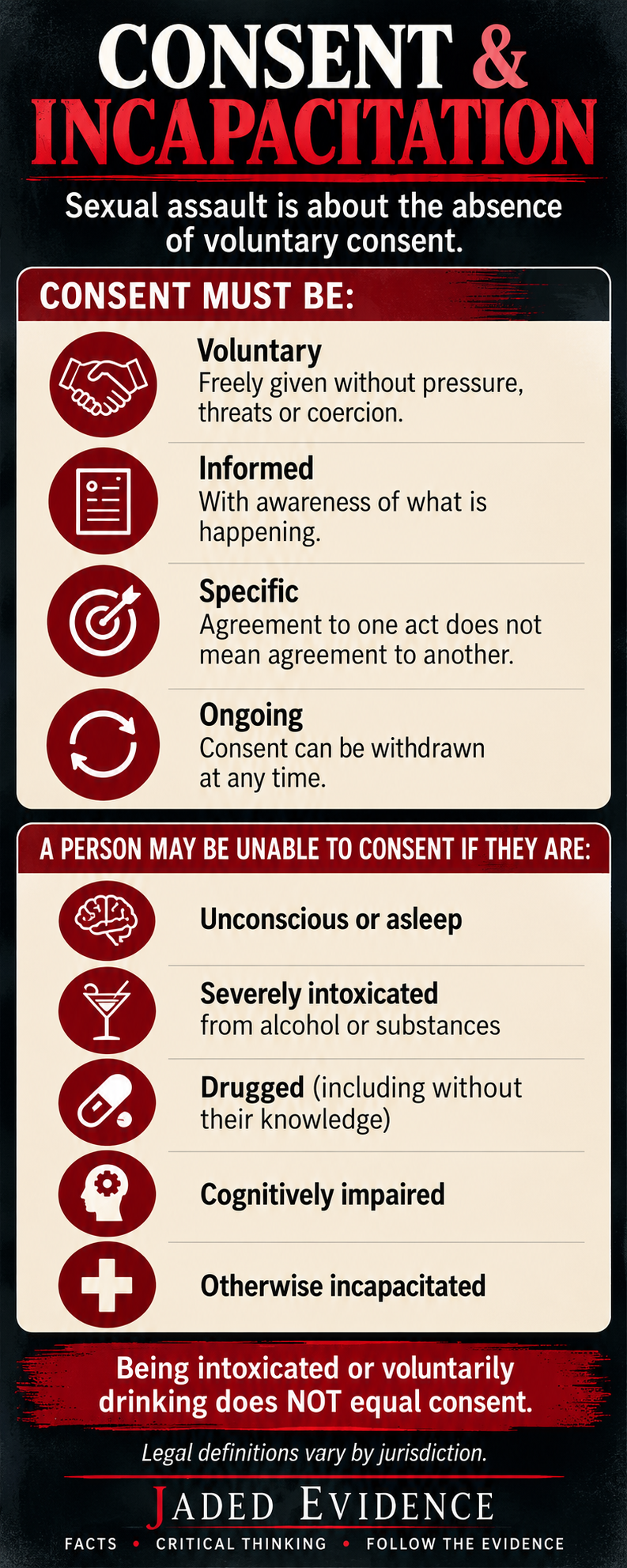
Sexual assault includes sexual contact or sexual acts that occur without legally valid consent. Depending on the jurisdiction, this can include unwanted sexual touching, attempted or completed penetration, forced oral sex, sexual acts obtained through threats or coercion, and sexual activity involving a person who is unable to consent.
Consent is not simply the absence of physical resistance. It should be voluntary and ongoing. Agreeing to one sexual activity does not automatically mean agreeing to another, and consent can be withdrawn. A person who is unconscious, asleep, severely intoxicated, drugged or otherwise incapacitated may be unable to provide legally valid consent. Exact legal definitions vary by jurisdiction.
Sexual assault is also a medical issue
Medical care can matter even when there are no obvious external injuries. Depending on what occurred, clinicians may evaluate for genital or other injuries, head or neck trauma, pregnancy risk, sexually transmitted infections, HIV exposure, drug-facilitated assault and acute psychological trauma. Strangulation, head trauma and severe intoxication deserve particular attention because significant injury may exist even when external findings are limited.
What to do after a recent sexual assault
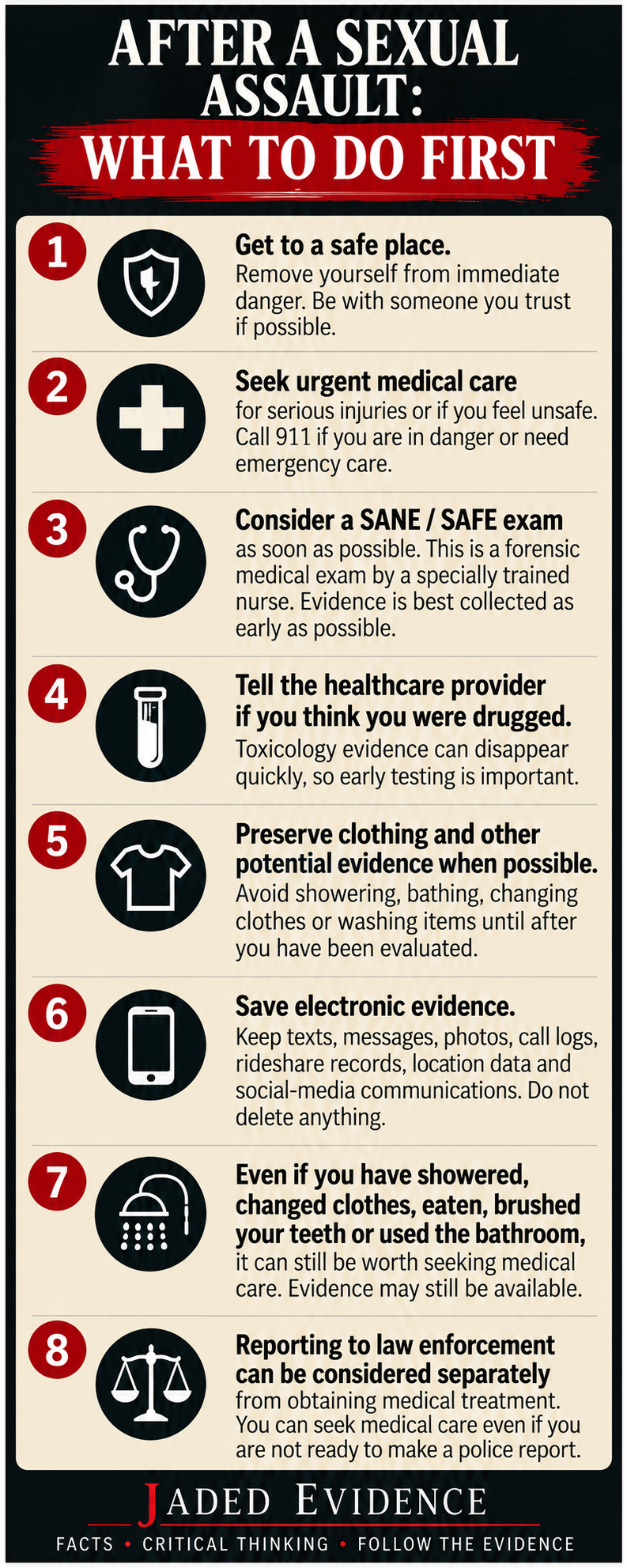
Safety and urgent medical needs come first. If possible, get to a safe place and consider being with someone you trust. Seek emergency care for serious bleeding, loss of consciousness, difficulty breathing, severe head or neck symptoms, seizures, suspected overdose, severe abdominal or pelvic pain, or suicidal thoughts or behavior.
A person can seek medical care even if they are not ready to make a police report. Reporting options and the rules for anonymous or delayed reporting vary by state and facility.
Why a SANE or SAFE exam matters
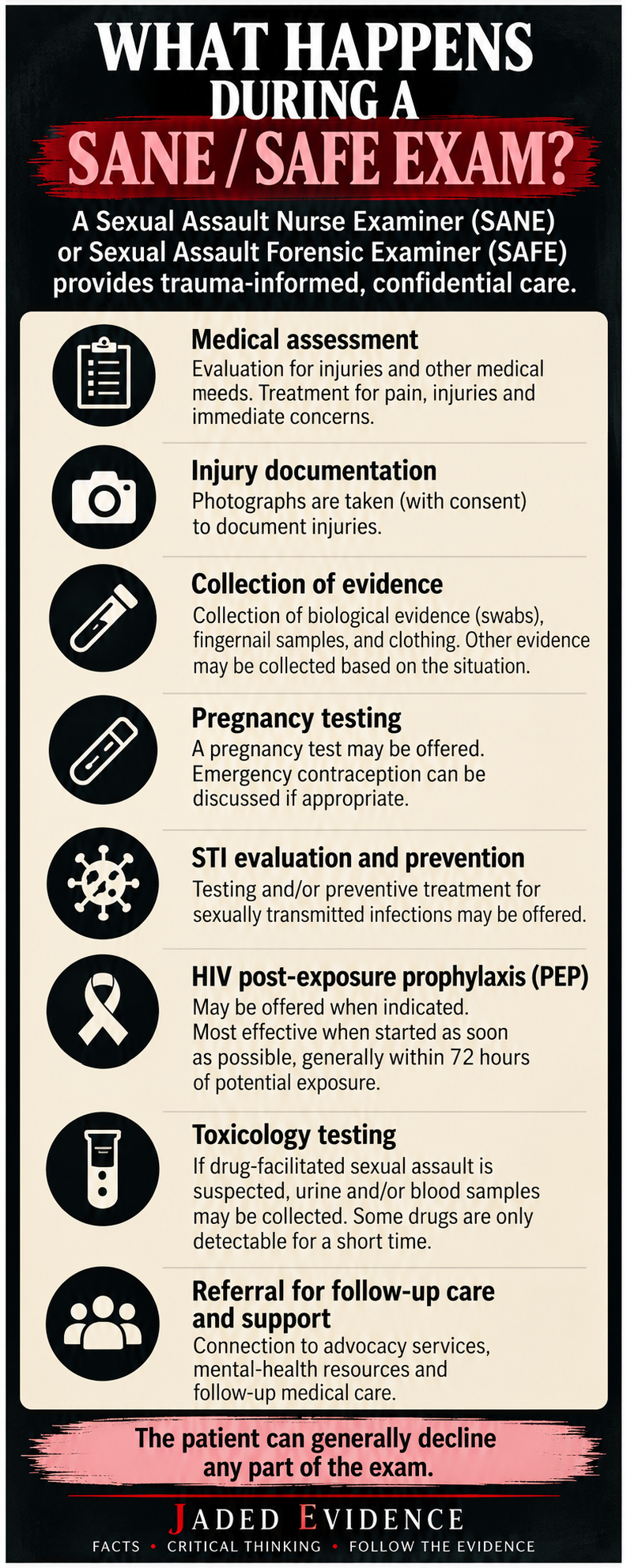
A Sexual Assault Nurse Examiner (SANE) or Sexual Assault Forensic Examiner (SAFE) is trained to provide trauma-informed medical care while collecting and documenting forensic evidence when the patient consents. The examination can include injury assessment, photographs, biological swabs, fingernail samples, clothing collection, pregnancy testing, STI evaluation, toxicology samples and referrals for follow-up care.
The patient generally controls the examination and can decline portions of it. Seeking a forensic examination does not require a person to know exactly what happened or to have decided immediately whether to participate in a criminal case.
Preserving forensic evidence
Forensic evidence is generally best collected as early as possible. If feasible, a person considering a forensic examination may avoid showering, bathing, changing clothing, brushing hair or using the restroom until evaluated. Clothing or other items that may contain biological evidence are generally preserved in paper rather than sealed plastic because trapped moisture can damage evidence.
But if you have already showered, changed clothes, eaten, brushed your teeth or used the bathroom, do not assume it is too late. Medical care may still be important, and useful forensic or documentary evidence may still exist. Collection windows differ by jurisdiction and evidence type.
Drug-facilitated sexual assault: timing can be critical
If someone becomes much more impaired than expected, has sudden severe sedation, confusion, memory loss, loss of consciousness or suspects that a substance was added to a drink, they should tell the medical team specifically that drug-facilitated sexual assault is a concern. Some substances may leave blood or urine relatively quickly, so early toxicology collection can matter.
Medical treatment that may be considered
- Pregnancy assessment and emergency contraception when pregnancy is possible.
- STI testing and/or preventive treatment depending on the exposure and clinical situation.
- Hepatitis B vaccination or prophylaxis when indicated.
- HIV post-exposure prophylaxis (PEP) when the exposure represents a meaningful HIV risk. CDC guidance recommends starting PEP as soon as possible and no later than 72 hours after exposure when indicated.
- Follow-up testing and medical care because some infections are not detectable immediately and some injuries or symptoms evolve over time.
Preserve electronic evidence too
Texts, direct messages, Snapchat or Instagram communications, photographs, videos, call logs, rideshare records, location data and other digital records can become important evidence. Avoid deleting or altering original material. Screenshots are useful, but investigators may also need the underlying device, metadata or account records.
Short-term and long-term effects
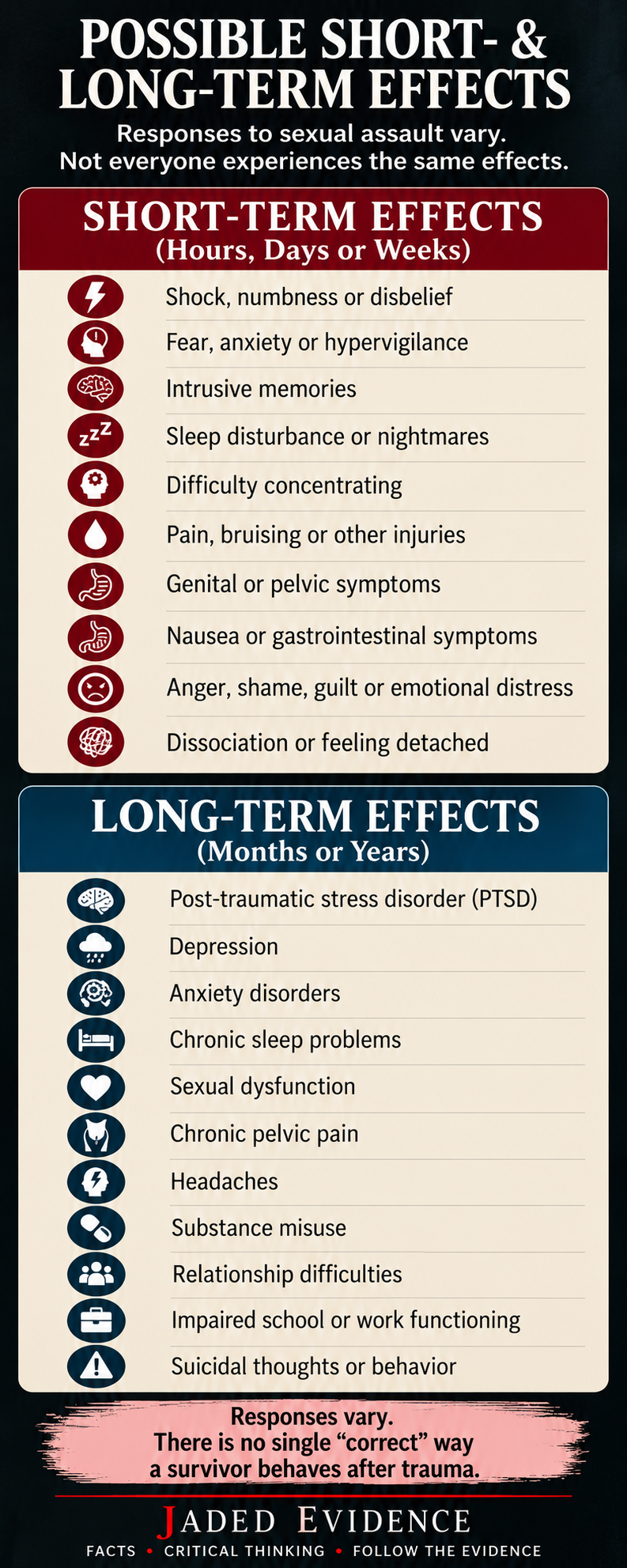
There is no single “correct” trauma response. In the hours, days or weeks after an assault, a person may experience shock, numbness, fear, hypervigilance, intrusive memories, insomnia, difficulty concentrating, pain, bruising, pelvic symptoms, gastrointestinal symptoms, anger, shame, guilt or dissociation. Other people may appear calm, continue working or socializing, or have difficulty recounting events in a linear way.
Longer-term effects can include post-traumatic stress disorder, depression, anxiety disorders, chronic sleep disturbance, sexual dysfunction, chronic pelvic pain, headaches, substance misuse, relationship difficulties and impaired school or occupational functioning. Some survivors experience suicidal thoughts or behavior. Not everyone develops these problems, and recovery trajectories vary substantially.
Trauma behavior is not a credibility test
People respond to trauma differently. Delayed reporting, fragmented recall, continuing to communicate with an alleged perpetrator, appearing emotionally flat, or remembering additional details later can occur after trauma. None of those behaviors automatically proves that an assault occurred, and none automatically disproves it. Investigations should examine the totality of the evidence rather than relying on stereotypes about how a “real” victim should behave.
Reducing risk without victim-blaming
Practical safety measures can include staying with trusted friends, planning transportation, watching drinks, sharing location with someone trusted, intervening when a friend appears unable to consent and seeking help when someone becomes unexpectedly impaired. Those measures may reduce some risks, but responsibility for an assault belongs to the person who commits it. Drinking alcohol, accepting a ride, going to someone’s home, flirting, wearing particular clothing, having prior consensual sex or initially consenting and later withdrawing consent does not make someone responsible for being assaulted.
Clinical and forensic sources
- CDC — Sexual Assault and Abuse and STIs: Adolescents and Adults
- CDC — 2025 nonoccupational HIV post-exposure prophylaxis recommendations
- RAINN — Getting a Sexual Assault Forensic Exam (SAFE)
- RAINN — DNA evidence: collection, testing and the law
Need help now?
RAINN National Sexual Assault Hotline: 800-656-HOPE (4673). If there is immediate danger or a medical emergency, call 911. If you are in the United States and experiencing a suicidal crisis, call or text 988.
This article is educational and is not a substitute for individualized medical or legal advice. Medical and forensic protocols, mandatory-reporting rules and legal definitions vary by jurisdiction.
Leave a Reply