
Jaded Evidence Deep Dive · Cornell University · Updated October 8, 2026
The Cornell Seven
A source-driven investigation into a former Cornell student’s allegations of sexual assault at the Chi Phi fraternity house, the evidence described in her civil complaint, Cornell’s disciplinary response, the original law-enforcement review, and the newly reopened criminal investigation.
Status: Civil lawsuit pending · Criminal investigation led by New York Attorney General Letitia James · Independent institutional review led by Sally Yates · No criminal charges announced in reporting reviewed through October 7
October 6–7, 2026: Latest Developments
Update checked October 8: The developments below concern reporting published October 6–7 and historical records. The civil lawsuit, criminal investigation and university disciplinary process remain separate.
Independent institutional review: Cornell’s October 7 FAQ says the trustees’ special committee retained Sally Yates and King & Spalding to review sexual-misconduct prevention and response, including whether Cornell followed its procedures in the Jane Doe matter. Cornell says the team will have access to relevant records subject to law and privacy requirements, and report to the special committee. This institutional review is separate from the Attorney General’s criminal investigation. Cornell’s official FAQ.
Original investigation disputed: Thomas Giuffra told the Associated Press that Jane Doe believed the criminal inquiry remained active after prosecutors declined charges. AP also reported Van Houten’s statement that he asked Cornell police to convey his decision but did not speak personally with Doe or her attorney. Cornell declined comment on the allegation, citing pending litigation. The notification records remain necessary to establish what Doe was told. Associated Press — October 7.
Newly published records: ABC News reviewed police-interview videos in which fraternity members described the encounter as consensual and officers questioned the basis for those accounts. ABC also published reporting from the university’s 12-day hearing, where Jane Doe and the respondents gave differing accounts. These are records of earlier proceedings, not testimony from a new criminal trial. The men deny wrongdoing. Police-interview reporting · University-hearing reporting.
Reported witness-pressure concerns: ABC News reported October 6 that 2024 police records contained a tip alleging Chi Phi leaders urged a potential witness to keep quiet to protect reputations. A student told investigators members met to align their accounts; a fraternity member described a routine chapter meeting and denied a dedicated meeting about the incident. ABC also reviewed post-suspension messages. These are disputed accounts and reported records, not a finding of obstruction or a criminal cover-up. Several accused men deny wrongdoing. ABC’s records reporting.
Reported threats: The New York Post reported October 7 that Jane Doe received threats demanding withdrawal of her lawsuit and that the communications were reported to police. A caller claimed a relationship to a defendant; that claim is unverified and does not establish the defendant’s involvement. Jaded Evidence has not reviewed an official incident report or a charging record concerning those threats. October 7 reporting.
Challenge to the special prosecutor: AP reports that one man named in the lawsuit filed a petition seeking Letitia James’s removal, alleging bias from a prior social-media post. This is a reported request, not a ruling removing her. October 7 legal-development reporting.
Moonies responds: Moonies denies unlawfully serving Jane Doe alcohol while she was underage. PEOPLE reported that the bar invoked wristband and underage-marking procedures and sought dismissal of the claims against it. Those are the bar’s positions; they do not resolve what happened that night. October 7 reporting.
Earlier oversight concerns: A published email excerpt attributed to a Cornell University police officer describes concerns about inconsistent enforcement of fraternity alcohol and event policies. It refers to a November 9, 2022 training discussion and an earlier, separate fraternity matter—not Jane Doe’s October 2024 allegations. The excerpt does not include full sender or date headers. The complete email, contemporaneous policies and enforcement records are needed to establish its provenance and assess the concerns. It does not establish that Cornell caused the alleged 2024 assault. Read the published excerpt.
Anonymity and reported online harassment: The Verge reported October 7 that online attempts to identify Jane Doe also exposed other women to harassment; her lawyers said three women were falsely identified. Jaded Evidence will preserve her pseudonym and omit purported identities, accounts, personal images and identifying details. Read the reporting.
Case status: Jane Doe’s civil claims remain allegations. Cornell says its disciplinary process resulted in expulsions and suspensions; university findings are not criminal convictions. The state-led criminal investigation remains separate. Reporting reviewed through October 7 announced no criminal charges or convictions arising from the alleged incident. Several accused individuals deny wrongdoing. The renewed investigation and institutional review do not establish guilt. Attorney General’s appointment statement · Executive Order 64 · Cornell FAQ.
October 1–2, 2026: Special Prosecutor Appointed
Gov. Kathy Hochul appointed New York Attorney General Letitia James as special prosecutor to lead the criminal investigation into the October 2024 Cornell sexual-assault allegations. James said her office would conduct a process guided by the facts and the law. Hochul publicly criticized aspects of the earlier Cornell Police and Tompkins County District Attorney handling. The appointment does not establish that any accused person committed a crime; it changes who is directing the renewed criminal investigation.
Read the primary records
Official special-prosecutor appointment: Download New York Executive Order 64 — October 1, 2026 (PDF, 2 pages) · Original government source. The order supersedes the local District Attorney’s authority for the covered matter and authorizes investigation and prosecution if warranted. It is an appointment order, not an investigative finding. Governor’s October 1 statement · Official October 2 remarks and media.
Civil complaint: Read the full 101-page Jane Doe v. Cornell University, Inc., et al. complaint.
Cornell Student Assembly: Read Resolution 17.
Important: A civil complaint contains allegations made by a plaintiff. Allegations are not findings of fact, and the individual defendants have not been criminally convicted in connection with these allegations.
Clinical companion: For a separate medical and forensic overview of sexual assault, consent, incapacitation, SANE/SAFE exams, evidence preservation and trauma effects, read Sexual Assault: A Clinical & Medical Guide.
The case in one paragraph
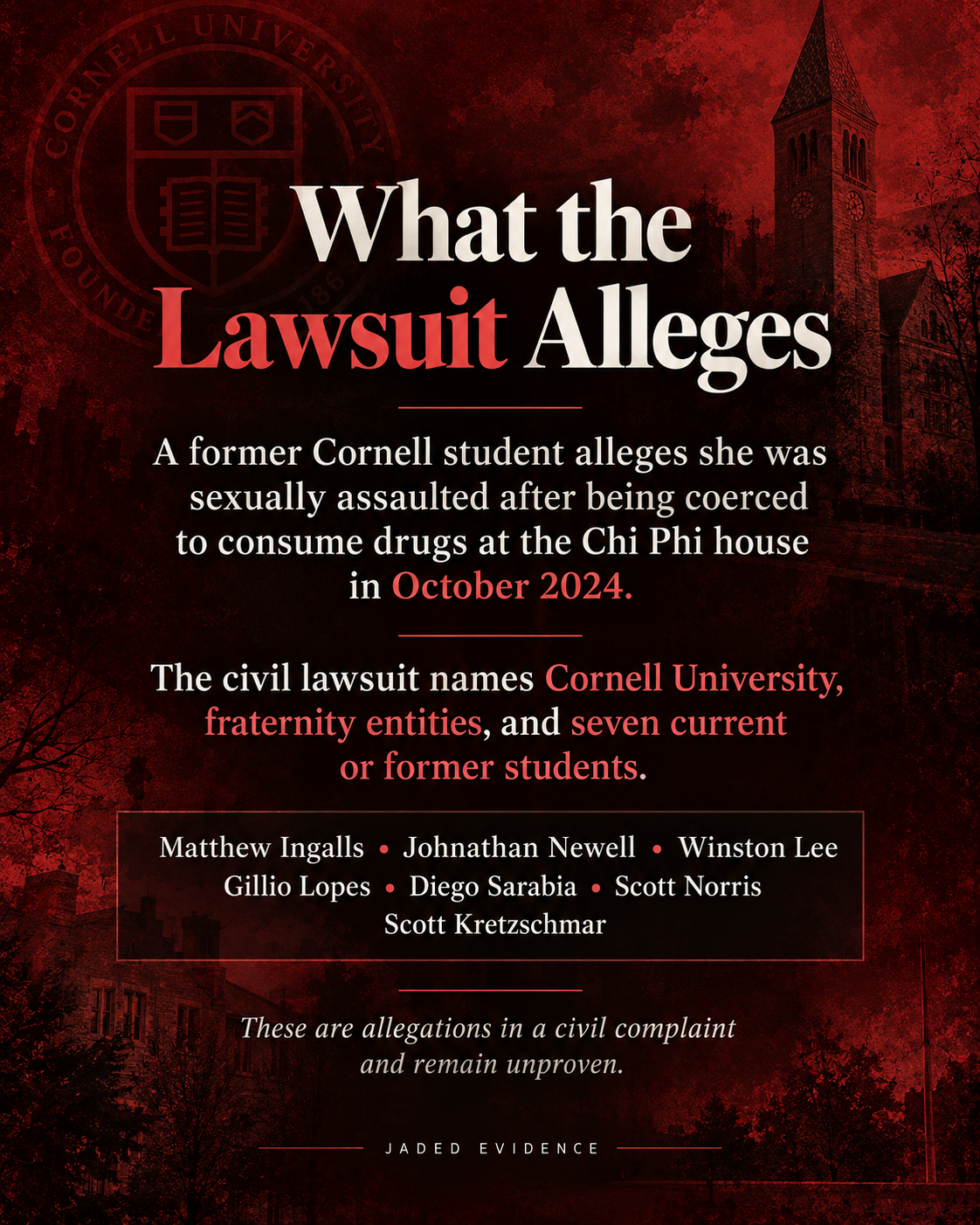
Jane Doe’s September 14, 2026 civil complaint alleges that on the night of October 19 into the morning of October 20, 2024, she arrived at Cornell’s Chi Phi house already intoxicated, was pressured to consume ketamine and other substances, and was subjected to nonconsensual sexual acts by multiple fraternity members. The complaint names Matthew Ingalls, Johnathan Newell, Winston Lee, Gillio Lopes, Diego Sarabia, Scott Norris and Scott Kretzschmar as individual defendants. It also names Cornell University, local and national Chi Phi entities, Tri Delta entities, Moonies Bar & Nightclub and others.
What the complaint alleges happened
- Before Chi Phi: Doe alleges she drank vodka at the Tri Delta house, went to Moonies around 9 p.m., then Lot 10, and left around 11 p.m. for Chi Phi.
- Arrival: The complaint says she was visibly intoxicated when she arrived and was given additional alcohol.
- Ketamine and other substances: The complaint alleges Ingalls and Newell pressured her to use a white powder represented as ketamine, along with marijuana and high-proof liquor.
- Initial alleged sexual acts: Doe alleges Ingalls and Newell engaged in sexual acts without her consent and that she physically pushed away later unwanted touching by Newell.
- Additional alleged conduct: The complaint alleges Lopes entered and participated in sexual activity without consent and that Sarabia later kissed Doe without consent.
- Snapchat message: The complaint reproduces an image it identifies as the “Chi Phi Actives” group chat and alleges Newell sent a message at approximately 1:42 a.m. advertising sexual access to Doe upstairs.
- Later period: The complaint alleges all seven men participated in conduct involving lines of ketamine placed on Doe’s body, and that Ingalls and Lee later took her into another room where the complaint alleges additional nonconsensual sexual acts occurred after she was completely incapacitated.
- End of the alleged assault: The complaint says the events concluded around 5:45 a.m. and Doe lost consciousness.
The seven men named in the civil complaint
Matthew Ingalls — alleged by Doe to have supplied alcohol/ketamine, participated in sexual acts she describes as nonconsensual, and later participated with Winston Lee after she says she was incapacitated.
Johnathan Newell — alleged to have supplied ketamine, participated in sexual acts, continued unwanted touching, and posted the 1:42 a.m. Snapchat message reproduced in the complaint.
Gillio Lopes — alleged to have entered the room, kissed Doe and participated in sexual activity she describes as nonconsensual.
Diego Sarabia — alleged to have kissed Doe without consent and later participated in the conduct involving ketamine on her body.
Winston Lee — alleged to have participated in the later sexual encounter with Ingalls after Doe says she was completely incapacitated.
Scott Norris and Scott Kretzschmar — alleged to have been present during the later group conduct involving ketamine on Doe’s body; the complaint’s reproduced Snapchat image also attributes chat responses to accounts bearing their names.
Legal status: These descriptions summarize allegations in the plaintiff’s complaint. They are not findings of guilt.
A date discrepancy that needs an answer
The civil complaint places the alleged assault on October 19–20, 2024. A 2024 Cornell Student Assembly Resolution 17, however, says the November 8 campus Crime Alert described an assault involving ketamine and other drugs on October 25, 2024 in the 100 block of Edgemoor Lane. Cornell’s later 2026 Student Assembly Resolution 15 identifies the Chi Phi report as occurring on October 19, 2024. We have not located a Cornell explanation for why the 2024 resolution used October 25. Jaded Evidence is therefore preserving the discrepancy in the source record rather than silently correcting it.
The Snapchat evidence
Page 27 of the complaint reproduces a photograph of a phone screen labeled “Chi Phi Actives.” The complaint attributes a 1:42 a.m. message to Newell and additional responses to other named accounts. Because this is evidence embedded in a civil pleading, important verification questions remain: who captured the image, when it was captured, whether the account names were authenticated, whether the full thread was preserved, and whether forensic extraction of the original device or Snapchat data exists.
Why the criminal investigation was reopened
Tompkins County District Attorney Matthew Van Houten reopened the criminal investigation in late September 2026 after renewed attention to the civil lawsuit and newly public information about Doe’s original interview with Cornell University Police. Before the state takeover, Reuters reported that Van Houten intended to present the matter to a grand jury. Executive Order 64 now gives the Attorney General authority to investigate and, if warranted, present evidence to a grand jury and prosecute; the earlier local prosecutor’s plan should not be treated as the current schedule. CBS New York separately reported that a transcript of Doe’s 2024 campus-police interview includes her saying she was “100% confident” she was raped; Van Houten told CBS he had never previously seen that transcript and had relied on a shorter signed statement provided to his office.
That creates a central investigative question: what information did Cornell University Police collect in 2024, what exactly was sent to the District Attorney, and why did the prosecutor apparently not receive the full interview transcript?
Cornell has said its police department provided the results of its investigation to the DA. CBS reported that Cornell also says CUPD provided a Snapchat screenshot in 2024. The Ithaca Police Department has said the alleged incident was not reported to its department.
Cornell’s internal disciplinary process
Cornell has said its Office of Civil Rights and student-conduct process investigated the allegations and that a trained hearing panel heard evidence over multiple days. According to CBS reporting on Cornell President Michael Kotlikoff’s September 29, 2026 meeting with student government, two accused students were expelled, two were suspended for at least two semesters, one had graduated before punishment could be imposed, and two were found not responsible for sexual misconduct. Cornell has not publicly mapped those outcomes to individual names.
The Chi Phi chapter was closed in 2024 and remains barred from Cornell. On October 6, Cornell’s trustees named Sally Yates to lead an independent review of its institutional response and broader prevention and response practices.

What we are investigating next
- The complete CUPD interview transcript and the six-page signed statement: what changed, what was omitted and why.
- Whether the seven accused students were interviewed by law enforcement in 2024.
- The origin, preservation and authentication of the Snapchat evidence.
- Whether toxicology, medical, injury or forensic evidence was collected.
- The discrepancy between October 19–20 and October 25.
- Which Cornell disciplinary outcome corresponds to which respondent, if that becomes lawfully public.
- Whether the state-led investigation results in a grand-jury presentation or criminal charges, and what records become publicly available.
- The independent review of Cornell’s handling of the report.
Selected reporting and official sources
- October 7, 2026 newsletter: JustInTheNickOfCrime — a secondary reporting roundup; individual developments above are checked against the linked underlying sources.
- Institutional position: Cornell FAQ — Cornell’s account of discipline, police/prosecutor communications and the independent review.
- State authority: Executive Order 64 and Attorney General appointment statement — primary records describing the state-led investigation, not findings of guilt.
- Disputed bar account: PEOPLE, October 7 — reports Moonies’ denial and dismissal request. The filed motion and complete bar records remain needed.
- Earlier oversight concern: Published police-email excerpt — refers to a 2022 discussion and a separate earlier matter. Full headers, policy versions and enforcement records remain needed for authentication and context.
- Threat and anonymity reporting: New York Post, October 7 and The Verge, October 7 — attributed reporting. Caller attribution and official threat records require independent confirmation; purported identities are omitted.
- Associated Press — report on the 2024 police interview transcript, reopened criminal investigation and Cornell’s independent review
- CBS New York — reporting on the 2024 CUPD interview transcript
- Cornell Student Assembly Resolution 15 (2026–2027) — institutional transparency and accountability
- The Cornell Daily Sun — Cornell’s public response to the civil lawsuit
Editorial standard: Jaded Evidence distinguishes allegations, documentary evidence, institutional findings and criminal findings. Reporting reviewed through October 7, 2026 announced no grand jury indictment or criminal conviction against the seven individual defendants. This page will be updated as primary records become available.