
CONTENT NOTE: This article discusses sexual assault, burglary, homicide, stalking, and victim trauma. Jaded Evidence centers survivors and victims and distinguishes charged crimes, admitted crimes, and investigative attribution.
Facts over speculation. Follow the evidence.
One Offender, Multiple Names, Decades of Fragmented Cases
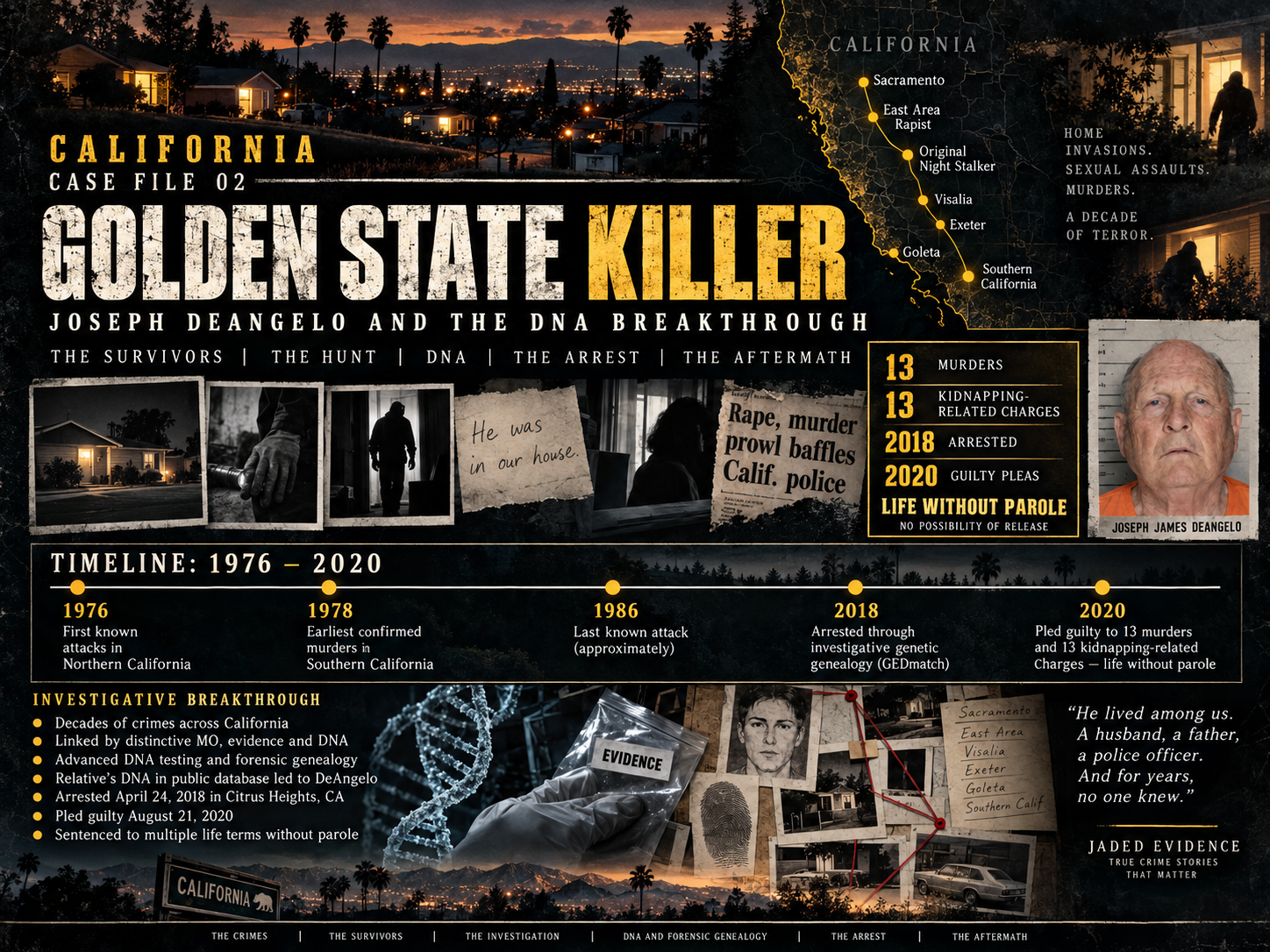
Before the crimes were linked under the name Golden State Killer, investigators knew the offender through different series and different jurisdictions: the Visalia Ransacker, the East Area Rapist, and the Original Night Stalker.
That fragmentation matters. For years, law enforcement agencies were investigating what appeared to be separate crime patterns occurring in different parts of California.
The man eventually identified as Joseph James DeAngelo Jr. was a former police officer who moved through communities where the crimes occurred.
The Scale of the Crime Series
The FBI described the offender as responsible for a long series of residential burglaries, sexual assaults, and murders between the mid-1970s and mid-1980s.
By the time the case was publicly consolidated, investigators attributed dozens of sexual assaults, more than one hundred burglaries, and multiple homicides to the same offender.
The final criminal case against DeAngelo ultimately involved 13 murders and 13 kidnappings, along with admissions to many additional uncharged sexual assaults and other crimes.
The East Area Rapist
Beginning in the Sacramento area in 1976, a masked intruder entered homes, stalked victims, and committed a series of sexual assaults.
The offender’s pattern evolved. Early attacks frequently involved women alone. Later attacks often involved couples, with male partners restrained while the offender assaulted women in the home.
Survivors described elaborate control tactics, threats, and extended periods in which the intruder moved through their homes.
The crimes created widespread fear throughout suburban Sacramento.
The Original Night Stalker Murders
Later, similar attacks occurred in Southern California, including murders of couples in their homes.
For years, those killings were investigated separately under the name Original Night Stalker.
DNA eventually demonstrated that the East Area Rapist and Original Night Stalker were the same offender.
That forensic link transformed several regional investigations into one serial case.
Why DNA Changed Everything
The Golden State Killer case is one of the clearest examples of evidence outlasting the limitations of its era.
Biological evidence collected from crime scenes was preserved for decades.
As DNA technology improved, investigators were able to connect crimes that had once been separated by geography and investigative labels.
But even after investigators had a DNA profile of the unknown offender, traditional law-enforcement databases did not provide a direct match.
Investigative Genetic Genealogy
In 2018, investigators used investigative genetic genealogy to generate family-tree leads from crime-scene DNA.
The process did not simply produce DeAngelo’s name from a database.
Instead, investigators used genetic relationships to identify possible family lines, built genealogical trees, narrowed candidates using age, sex, location, and history, and then conducted traditional investigative work to determine whether DeAngelo could be the offender.
Investigators then obtained discarded DNA associated with DeAngelo and compared it with crime-scene evidence.
The match gave authorities the probable cause they needed.
April 24, 2018
Joseph James DeAngelo Jr. was arrested at his home in Citrus Heights, California, on April 24, 2018.
The FBI later described the arrest as a landmark use of DNA investigative genealogy to narrow the suspect pool and identify the offender.
The Former Police Officer Factor
DeAngelo had worked as a police officer in Exeter and Auburn, California.
That history became one of the most discussed aspects of the case after his arrest.
It is relevant because law-enforcement training and familiarity with police procedures may have influenced how he avoided detection, but it should not be treated as proof of exactly what knowledge he used during individual crimes unless evidence supports the inference.
The 2020 Plea Agreement
In June 2020, DeAngelo pleaded guilty to 13 murders and 13 kidnapping-related charges.
As part of the agreement, he also admitted responsibility for numerous additional crimes that could no longer be prosecuted because of statutes of limitations.
The plea avoided a capital trial and guaranteed that DeAngelo would spend the remainder of his life in prison.
Sentencing
On August 21, 2020, DeAngelo was sentenced to multiple consecutive terms of life imprisonment without the possibility of parole.
Victim-impact statements were a major part of the sentencing proceedings. Survivors and family members described decades of fear, trauma, disrupted relationships, and the consequences of living without knowing who the offender was.
Confirmed, Charged, and Admitted
| Category | What It Means |
|---|---|
| 13 murders | Murders included in the final criminal prosecution and guilty pleas. |
| 13 kidnapping charges | Kidnapping-related counts included in the plea agreement. |
| Additional sexual assaults | Numerous crimes DeAngelo admitted during the plea proceedings but that were not separately prosecutable because of limitations periods. |
| Visalia Ransacker crimes | Earlier burglary and related offenses widely investigated in connection with DeAngelo; individual attribution should be stated carefully where not formally adjudicated. |
What Authorities Knew — And When
Mid-1970s
A prolific residential burglar operates in and around Visalia.
1976–1979
The East Area Rapist terrorizes Sacramento-area communities and later expands into other Northern California jurisdictions.
Late 1970s–1980s
Southern California investigators confront a series of violent home-invasion murders later attributed to the same offender.
DNA Era
Improved forensic testing links the Northern and Southern California crime series.
2016
The FBI and California law-enforcement partners renew the public search for the still-unidentified offender and offer a reward.
2018
Investigative genetic genealogy narrows the suspect pool to DeAngelo. DNA comparison confirms the investigative lead, and he is arrested.
2020
DeAngelo pleads guilty to 13 murders and 13 kidnappings and admits numerous additional crimes. He receives multiple life-without-parole sentences.
The Investigative Fragmentation Problem
This case demonstrates why serial crime can remain unsolved even when agencies possess important evidence.
Different jurisdictions used different offender labels.
Victims were attacked hundreds of miles apart.
Crime patterns evolved.
Database technology and interagency information sharing were far less sophisticated than they are today.
Only later did forensic DNA establish that several supposedly separate offenders were one person.
Why This Case Changed Cold-Case Investigation
DeAngelo’s identification became one of the most influential early examples of investigative genetic genealogy in criminal investigation.
Sacramento County’s Cold Case Science and Technology Unit now describes the Golden State Killer investigation as the first criminal case solved through investigative genealogy.
The method has since been used to identify suspects and unknown victims in cold cases around the country.
The Ethical Questions
Investigative genetic genealogy also created new privacy and policy questions.
A person who uploads DNA to a genealogy service may create investigative leads involving relatives who never submitted their own DNA.
That does not make the method inherently improper, but it does mean the technology sits at the intersection of forensic science, privacy, consent, database policy, and constitutional law.
Those issues deserve to be examined separately from the emotional appeal of solving horrific crimes.
Jaded Evidence: Why the Golden State Killer Case Matters
The Golden State Killer case is not simply a story about a serial offender finally being caught.
It is a story about survivors who waited decades for an identity.
It is about evidence preserved long enough for science to catch up.
It is about fragmented investigations becoming one case.
And it is about a forensic technique powerful enough to reopen thousands of cold cases while simultaneously raising questions about how genetic information should be used.
The breakthrough was not magic. It was preserved evidence, new science, painstaking genealogy, and traditional police work converging at the right moment.
Sources & Further Reading
- FBI — Cold Case Killer / East Area Rapist
- FBI History Timeline — DeAngelo Arrest
- Sacramento County District Attorney — Cold Case Science and Technology Unit
Jaded Evidence distinguishes guilty pleas, admitted conduct, forensic attribution, and crimes that were investigated but not individually adjudicated.
Leave a Reply