

REGION: Great Plains / Central U.S. — Kansas
CONTENT NOTE: This article discusses stalking, home invasion, strangulation, homicide, sexual violence, and crimes involving children.
Facts over speculation. Critical thinking. Follow the evidence.
Case Overview
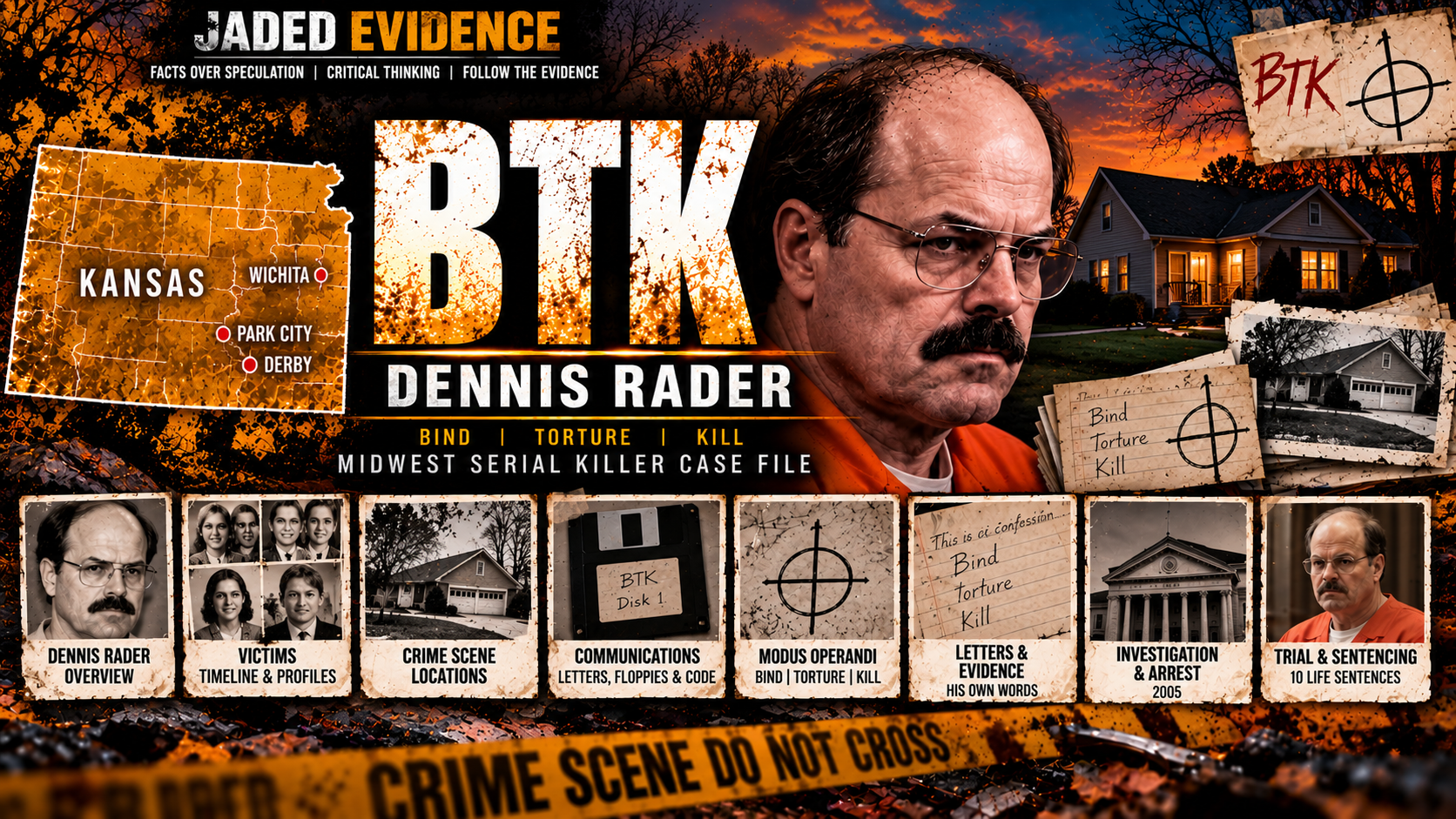
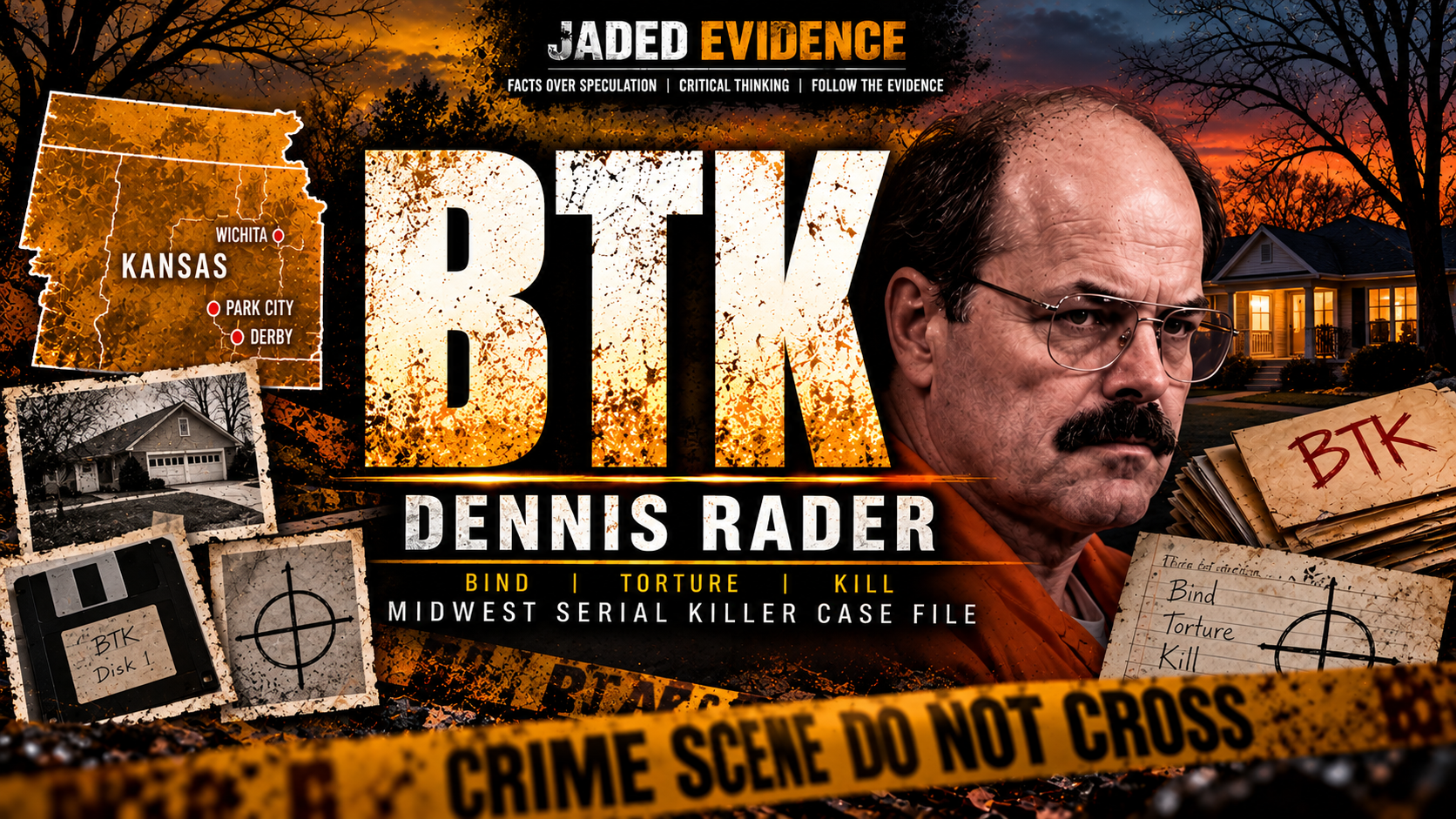
Dennis Rader murdered ten people in and around Wichita, Kansas, between 1974 and 1991. He called himself “BTK,” an abbreviation for “Bind, Torture, Kill.”
The Otero Family Murders
Rader’s first known murders were Joseph and Julie Otero and two of their children, Josephine and Joseph Jr., in January 1974. The crime established behavioral patterns investigators later connected to additional murders.
Communications With Police and Media
Rader repeatedly sought attention through letters and packages sent to media outlets and law enforcement. After years of silence, he resumed communicating in 2004, prompting a renewed multi-agency investigation.
The Floppy-Disk Mistake
In 2005, a computer disk Rader sent to a Wichita television station contained metadata that helped investigators identify “Dennis” and Christ Lutheran Church, where Rader served as congregation president. Investigators then used additional evidence, including DNA, to connect him to the crimes.
Guilty Plea and Sentencing
Rader pleaded guilty to ten counts of first-degree murder in 2005 and received ten consecutive life sentences.
Why This Case Matters
The BTK case is a landmark example of offender communication, cold-case persistence, behavioral evidence, and digital metadata becoming decisive in a decades-old investigation.
Known Victims
- Joseph Otero
- Julie Otero
- Joseph Otero Jr.
- Josephine Otero
- Kathryn Bright
- Shirley Vian
- Nancy Fox
- Marine Hedge
- Vicki Wegerle
- Dolores Davis
Survivor: Kevin Bright survived the 1974 attack in which his sister Kathryn was murdered.
Investigation Highlights
- Rader repeatedly communicated with police and media, providing self-authenticating details that were not public.
- His 2004–2005 return to letter-writing gave investigators a new opportunity to identify him.
- A floppy disk contained metadata pointing to “Dennis” and Christ Lutheran Church.
- Investigators obtained familial DNA evidence through a warrant and compared it with biological evidence from the Wegerle scene before arresting Rader.
Psychiatric and Psychological Record
Rader was competent to plead guilty. A court-appointed psychiatrist has been reported as diagnosing narcissistic personality disorder; other evaluators and researchers have described additional obsessive-compulsive and antisocial traits. These personality findings should not be confused with psychosis or legal insanity.
Modus Operandi vs. Signature
Modus operandi: Surveillance and stalking, home entry, victim control, binding, strangulation or suffocation, and efforts to avoid detection.
Signature: Rader’s self-created “BTK” identity, elaborate bondage fantasies, photography, souvenirs, repeated communications, and staging/sexualized control went beyond what was necessary to kill and are classic signature-like behaviors.
Leave a Reply