

CONTENT NOTE: This article discusses kidnapping, sexual violence, homicide, torture, and crimes against women, men, and children. Jaded Evidence distinguishes proven convictions, attributed crimes, and unresolved victim-count questions.
Facts over speculation. Follow the evidence.
A Case Built Around a Remote Property
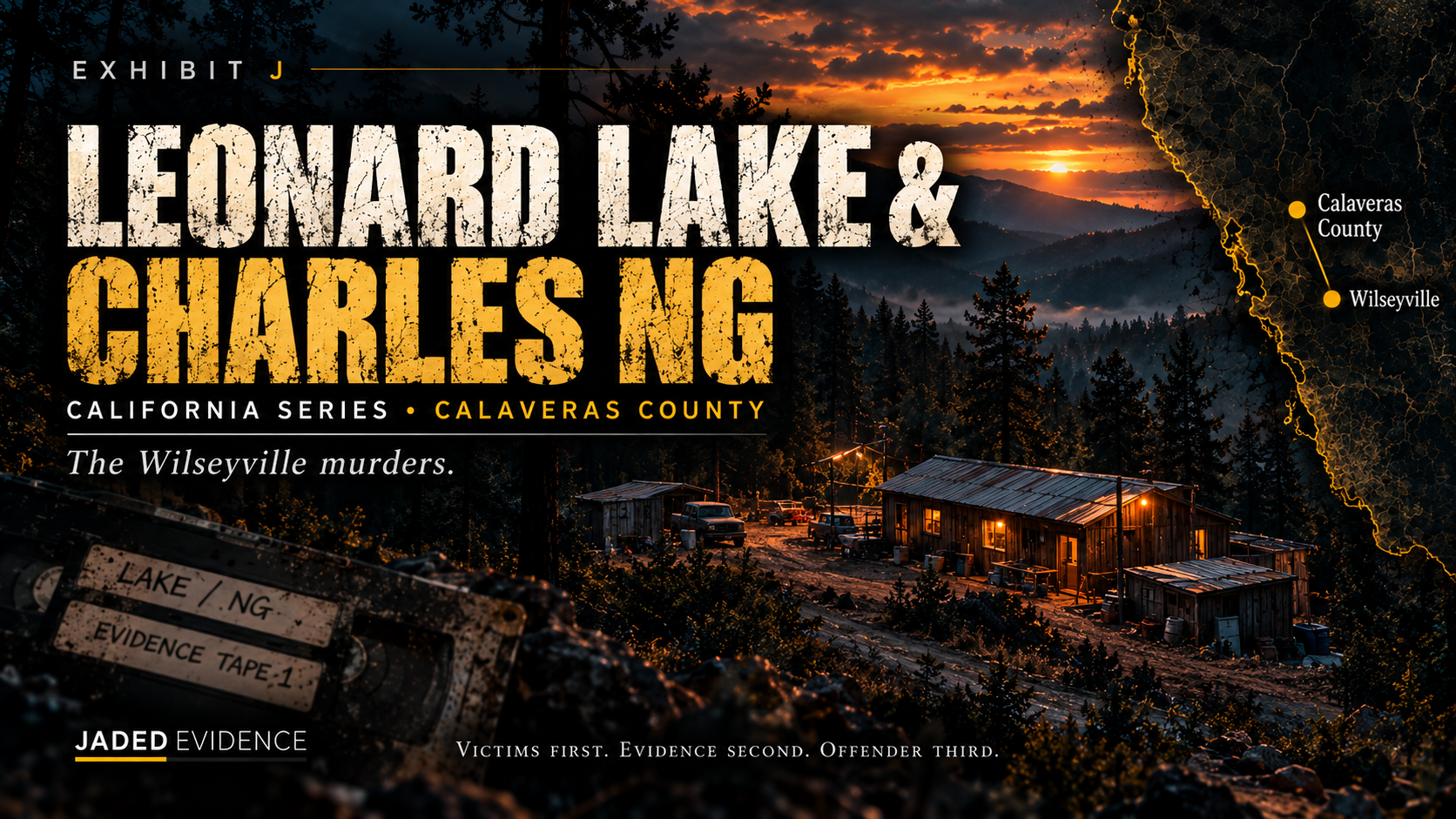
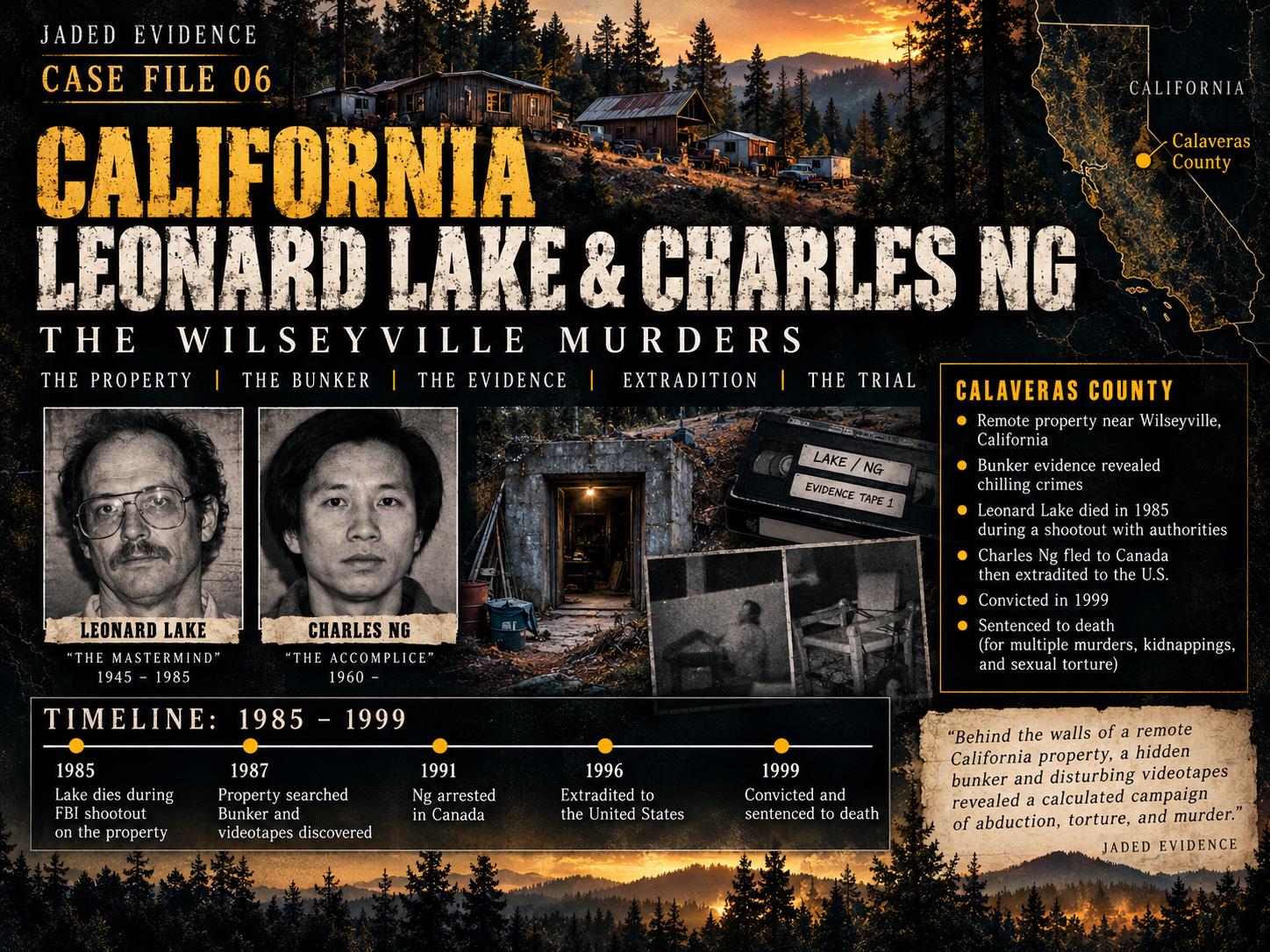
In the mid-1980s, investigators uncovered one of California’s most disturbing serial-murder cases at a remote property near Wilseyville in Calaveras County.
The men at the center of the case were Leonard Lake and Charles Ng.
The property contained a concealed bunker, weapons, personal belongings tied to missing people, and videotaped material that became some of the most important evidence in the case.
The Victims
The murders attributed to Lake and Ng involved women, men, and children.
That is important because this case did not revolve around a single narrow victim profile.
Some victims were people known to the offenders. Others were linked through relationships, family units, or circumstances that placed them in the offenders’ orbit.
Several victims disappeared together, which later helped investigators reconstruct the broader pattern.
The Wilseyville Bunker
The bunker at the property became central to the prosecution narrative.
Investigators found evidence indicating that victims had been confined there.
Videotapes recorded by the offenders showed women being held against their will and became crucial evidence of planning, domination, and the conditions under which victims were detained.
For Jaded Evidence, the existence of the tapes matters evidentially. The details do not need to be sensationalized beyond what is necessary to understand the crimes and prosecution.
Leonard Lake’s Death
Lake never stood trial.
After being detained in 1985 following an investigation involving stolen property and identity issues, he ingested cyanide and died shortly afterward.
His death meant there would never be a criminal trial testing all of the evidence against him.
That distinction is important. Many murders are strongly attributed to Lake based on physical evidence, recordings, writings, and links to Ng, but he was never convicted in court.
Charles Ng Flees
Ng fled the United States after Lake’s detention.
He was later arrested in Canada.
His extradition to the United States became a prolonged legal battle, in part because Canada opposed extradition in cases where the death penalty could be imposed.
After years of litigation, Ng was eventually returned to California to face prosecution.
The Trial
Ng was tried in Orange County after the case was moved from Calaveras County because of extensive pretrial publicity.
Prosecutors relied on physical evidence, videotapes, property linked to victims, witness testimony, and the broader reconstruction of the Wilseyville crimes.
In 1999, Ng was convicted of multiple murders.
He was sentenced to death.
Why the Victim Count Is Complicated
The total number of victims attributed to Lake and Ng has varied across sources for decades.
That is partly because:
- some victims were definitively tied to the property or evidence,
- some remains were recovered in fragmented condition,
- some missing persons were strongly suspected but not conclusively identified,
- Lake died before trial, and
- Ng was prosecuted for a specific set of murders rather than every suspected disappearance.
For Jaded Evidence, the safest structure is to distinguish:
| Category | Status |
|---|---|
| Ng murder convictions | Murders established through the 1999 criminal trial. |
| Murders strongly attributed to Lake and Ng | Cases supported by physical, documentary, or circumstantial evidence but not always individually adjudicated against both men. |
| Possible additional victims | Disappearances or remains investigated for connection but not definitively established. |
The Evidence Cache
The Wilseyville property yielded a large volume of physical evidence.
Investigators recovered belongings associated with missing victims, weapons, documents, photographs, tapes, and human remains.
The case became one of those investigations in which the crime scene was not a single location tied to one homicide. The property itself functioned as an evidentiary archive linking multiple victims and multiple crimes.
The Videotapes
The videotaped material is among the most infamous elements of the case.
But from an evidentiary standpoint, the significance is straightforward:
the recordings documented confinement, coercion, planning, and the presence of victims at the property.
That made them far more than disturbing artifacts. They were direct evidence.
What Authorities Knew — And When
Early 1980s
People connected to Lake and Ng begin disappearing under circumstances that are not immediately recognized as one serial pattern.
1985
Lake is detained after an investigation involving stolen property and identity issues. Evidence quickly points authorities toward the Wilseyville property.
1985
Searches of the property uncover the bunker, personal belongings, tapes, and human remains.
1985
Lake dies after ingesting cyanide, eliminating the possibility of a criminal trial against him.
Mid-1980s
Ng is arrested in Canada and begins years of extradition litigation.
1990s
Ng is returned to California and eventually tried.
1999
Ng is convicted of multiple murders and sentenced to death.
The Death-Penalty Context
Ng’s case became intertwined with international extradition law because Canada’s courts scrutinized whether he could be sent to a jurisdiction where he faced execution.
The case therefore sits at the intersection of serial-homicide prosecution and international human-rights law.
That legal fight delayed the California prosecution for years.
The Remote-Property Advantage
The Wilseyville case also illustrates how geography can facilitate prolonged offending.
A remote property can reduce witness traffic, limit visibility, and provide space to hide evidence.
That does not make the location itself suspicious. But once investigators identified the property, the isolation helped explain how so much evidence had remained concealed.
The Mythology Problem
Lake and Ng have generated decades of sensational retellings.
The bunker, recordings, writings, and unknown victim count make the case easy to turn into horror-story material.
But the stronger evidentiary story is about documentation.
The case was not built on rumor.
Investigators found a property filled with evidence tied to missing people.
That distinction matters.
Jaded Evidence: Why This Case Belongs in the California Series
The Lake and Ng case adds a different investigative model to the California arc.
Zodiac is an unsolved identity case.
Golden State Killer is a forensic-genealogy case.
Richard Ramirez is a fingerprint and public-manhunt case.
Grim Sleeper is a familial-DNA case.
William Suff is a marginalized-victim serial-homicide case.
Lake and Ng are different again: a remote property became the physical archive that connected multiple victims and exposed the broader series.
Sometimes a serial case is solved by a suspect. Sometimes by DNA. Sometimes by a survivor. And sometimes by the place where the evidence was hidden.
Sources & Further Reading
- California Department of Corrections and Rehabilitation — Condemned Inmate List
- California Supreme Court — People v. Ng
Jaded Evidence distinguishes court-proven murders, crimes strongly attributed through evidence, and unresolved or suspected victim connections. Lake’s death before trial is treated separately from Ng’s convictions.
Leave a Reply