

Active case · Frankfort, Illinois · Updated October 5, 2026
Corie Walsh: The Death of Barrett Walsh and the Psychosis Defense
A two-year-old child is dead. His mother faces three first-degree murder counts. Her attorneys say she experienced a psychotic episode. Prosecutors point to statements, conduct, and her intense interest in the Lindsay Clancy trial.
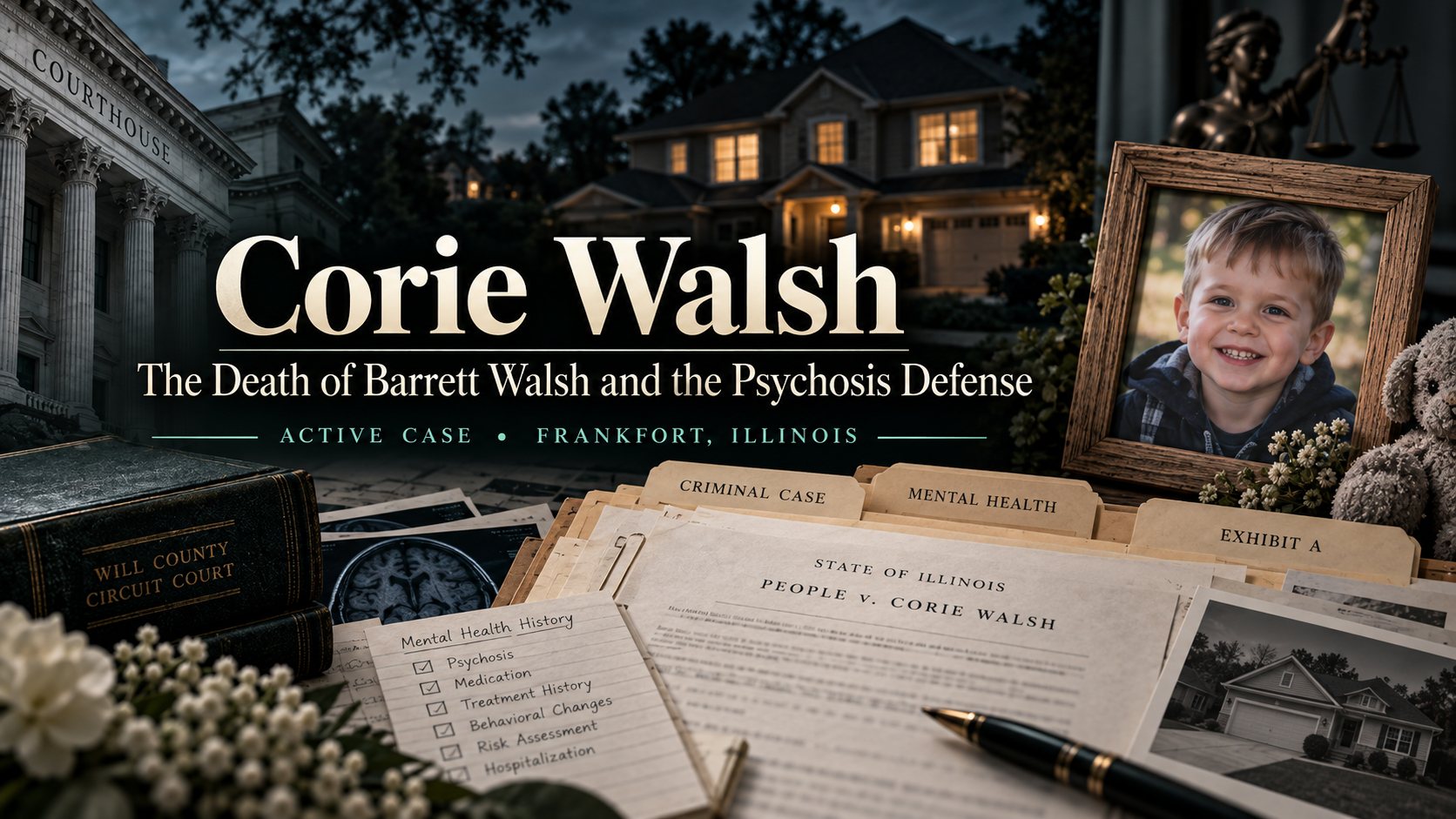
Current status: Corie A. Walsh has pleaded not guilty to three counts of first-degree murder in the September 1 death of her two-year-old son, Barrett “Bear” Walsh. She remains detained. Her next court date is scheduled for October 26, 2026.
What happened on September 1
According to prosecutors and court records described by multiple news organizations, a neighbor found Barrett unresponsive in the basement of the Walsh home and attempted CPR. Authorities say he died from asphyxia associated with ligature compression. Walsh was found elsewhere in the home with injuries described as self-inflicted and non-life-threatening.
The statements attributed to Walsh
Prosecutors allege Walsh made statements suggesting she believed Barrett was the “devil” or “anti-Christ.” Those statements are highly relevant to both the prosecution’s reconstruction of events and the defense’s claim that she was experiencing psychosis. They are not, by themselves, a medical diagnosis or a legal finding of insanity.
The Lindsay Clancy connection
Prosecutors say Walsh had become “very invested” in the Lindsay Clancy case and was discussing it with friends only hours before Barrett was found. That timing is noteworthy, but there is currently no established evidence that the Clancy case caused Walsh’s alleged conduct or that this was a “copycat” crime. Jaded Evidence will not treat correlation as causation.
The defense position
Walsh’s attorneys have publicly argued that she experienced a psychotic episode and should receive psychiatric treatment. Attorney Andrea Lyon is part of the defense team. The court has nevertheless ordered Walsh detained while the case proceeds.
Clinical Lens: psychosis is not the same as a legal defense
Psychosis is a clinical syndrome involving impaired reality testing and may include delusions, hallucinations, disorganized thinking, or severe behavioral disturbance. A criminal-responsibility defense asks a different question: whether the defendant met the specific legal standard in the jurisdiction at the time of the alleged offense.
A person can have a genuine psychotic disorder and still be legally responsible. Conversely, evidence of bizarre or delusional beliefs may become highly relevant if the jurisdiction’s insanity standard focuses on the defendant’s ability to appreciate the criminality or wrongfulness of conduct. The legal test, not the diagnostic label alone, controls.
Why three murder counts for one death?
Multiple murder counts involving one victim often represent alternative statutory theories rather than three separate deaths. Illinois charging documents will be important for identifying the precise theories alleged. At conviction or sentencing, merger and double-jeopardy principles generally prevent multiple punishments for the same homicide based solely on alternative theories, but the exact treatment depends on the counts and verdicts.
October 5 case status
Walsh remains detained after pleading not guilty on September 24 to three counts of first-degree murder. Her next reported court date is October 26. No public court ruling has established a psychiatric diagnosis or legal insanity defense at this stage. Her attorneys have described the episode as psychotic; prosecutors rely on the alleged statements, scene evidence and surrounding conduct as the criminal case proceeds.
The reported Lindsay Clancy connection should be handled narrowly. Court filings say Walsh had been discussing the Clancy trial with friends only hours before Barrett was found, but that temporal association does not establish causation, imitation or a shared diagnosis. Any comparison should focus on documented symptoms, jurisdiction-specific criminal-responsibility law and admissible evidence—not social-media shorthand.
What we are tracking
- The indictment and exact statutory theories behind the three first-degree murder counts.
- Any competency evaluation or request for inpatient psychiatric placement.
- Whether the defense formally raises insanity or another mental-state defense.
- Medical and psychiatric records disclosed in litigation.
- Statements, digital evidence, and messages regarding the Lindsay Clancy trial.
- Any evidence concerning prior psychiatric symptoms, treatment, sleep disruption, medications, or postpartum status—without assuming causation.
Sources
- CBS Chicago — September 24, 2026 plea hearing
- CBS Chicago — detention hearing
- Associated Press — prosecutors’ allegations concerning the Lindsay Clancy case
- NBC Chicago — charging details and defense position
Charges are allegations. Corie Walsh is presumed innocent unless and until proven guilty. Clinical terms are not legal conclusions, and public reporting cannot substitute for a complete psychiatric evaluation.