


News Update | October 9, 2026
Reporting and analysis by Jaded Evidence.
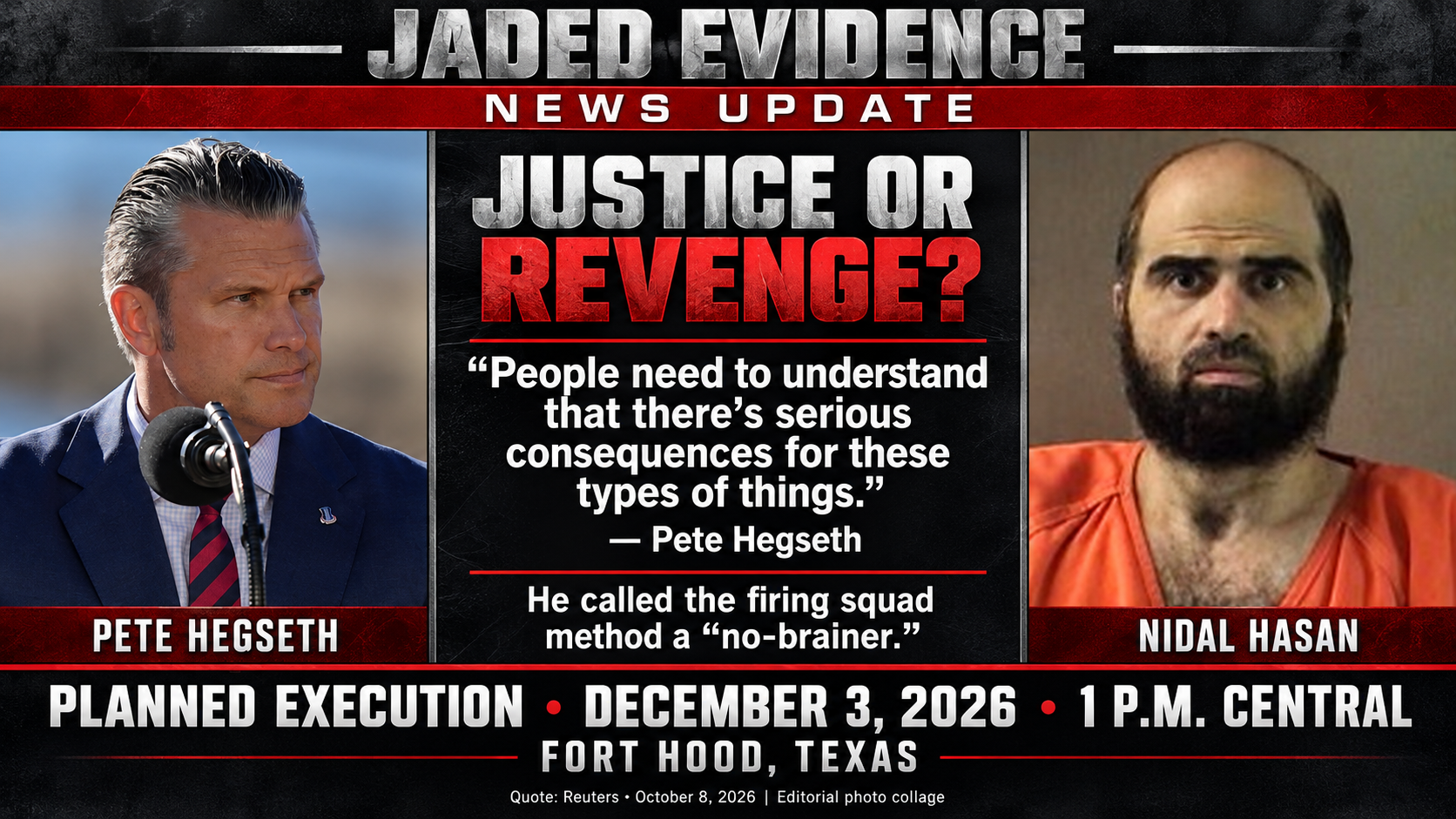
The Pentagon has announced plans to livestream the firing squad execution of Nidal Malik Hasan, the former Army psychiatrist convicted of the 2009 Fort Hood mass shooting. His execution is scheduled for December 3, 2026, at Fort Hood, Texas, at approximately 1 p.m. Central / 2 p.m. Eastern. Officials have not yet announced the broadcast platform or full viewing arrangements. This remains a planned execution and broadcast. [1]
The announcement raises two separate questions: Does the death sentence serve justice? And what does broadcasting the death add to that justice?
The crime behind the sentence
On November 5, 2009, Hasan entered the crowded Soldier Readiness Processing Center at Fort Hood and opened fire with a semiautomatic handgun. The military appellate opinion describes a planned attack, including advance preparation and repeated visits to the center. He pursued fleeing soldiers and exchanged gunfire with responding officers before being shot and taken into custody. [2]
He killed 13 people. An important distinction in the court record: Hasan shot and wounded 31 others, but was convicted of 32 attempted premeditated murders because he also fired at an officer who was not struck. The number of attempted-murder convictions should not automatically be reported as the number of people wounded by gunfire. [2]
Hasan represented himself at trial and acknowledged being the shooter. The court-martial convicted him of 13 counts of premeditated murder and 32 counts of attempted premeditated murder. On August 28, 2013, he was sentenced to death, dismissal from military service, and forfeiture of all pay and allowances. [2] [3]
These are established convictions. The debate concerns the punishment and its public presentation.
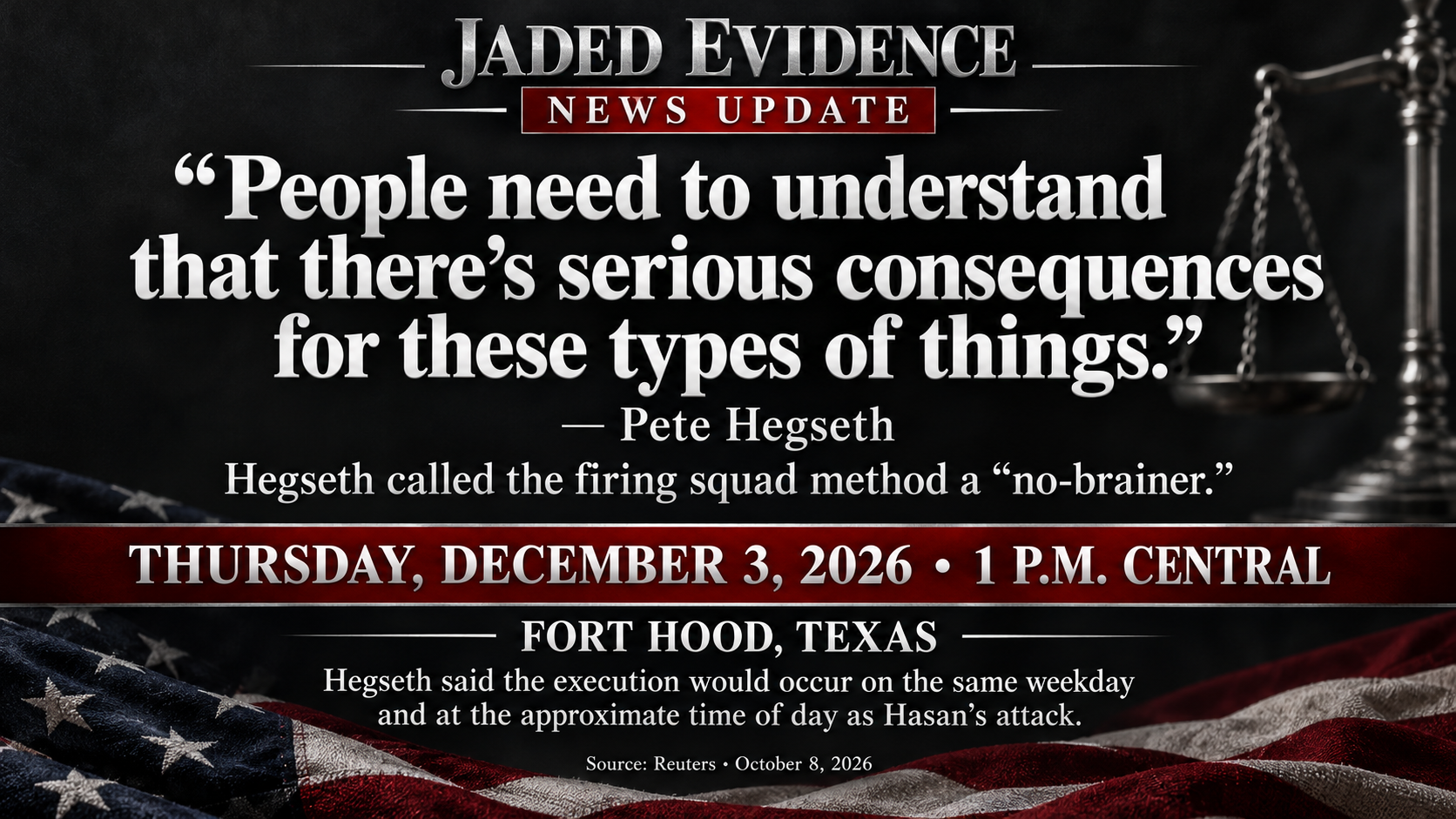
“People need to understand that there’s serious consequences for these types of things,” Hegseth said. He described the firing squad method as a “no-brainer” and said the execution would take place on the same weekday and at the approximate time of day as Hasan’s attack. [1]
How a firing squad works
A firing squad execution uses multiple designated shooters who fire at the condemned person under an established protocol. Procedures differ between jurisdictions; there is no single universal arrangement.
For example, South Carolina’s published protocol describes a prisoner restrained in a chair with a hood over the head and an aiming point placed over the heart. Three designated employees fire rifles, all containing live ammunition. A physician then examines the prisoner and determines whether death has occurred. That is South Carolina’s protocol, and should not be presented as the confirmed procedure for Hasan’s military execution. [4]
The familiar claim that “one shooter always has a blank” is therefore inaccurate. Some historical procedures included blanks, while South Carolina specifies live ammunition in every rifle. The Army’s 1944 military execution manual described a larger firing party and the use of some blank ammunition. That historical manual does not establish the precise procedure the military will use in December 2026. [4] [5]
What law permits an execution to be livestreamed?
The answer requires separating permission to execute, permission to witness, and permission to broadcast.
Military law requires presidential approval before a court-martial death sentence can be carried out. The current provision appears in Article 57 of the Uniform Code of Military Justice, 10 U.S.C. § 857(a)(3). That provision addresses approval of the death sentence; it does not expressly authorize an internet broadcast. [6]
There is a significant, but limited, remote-viewing precedent. In 2001, the Justice Department authorized approved Oklahoma City bombing survivors and victims’ relatives to watch Timothy McVeigh’s execution through secure closed-circuit television. Access was restricted, and recording devices were prohibited specifically to prevent the transmission from being recorded or made public. This established a controlled viewing arrangement for victims—not an unrestricted public livestream. [7]
A request for a public internet broadcast went the other way. In Entertainment Network, Inc. v. Lappin, 134 F. Supp. 2d 1002 (S.D. Ind. 2001), a federal district court rejected a media company’s challenge seeking to videotape and webcast McVeigh’s execution. The decision did not recognize a First Amendment entitlement to film and broadcast the execution. It concerned a civilian federal prison, rather than a military execution. [8]
Civilian federal execution regulations also generally prohibit photographic, visual, or audio recording under 28 C.F.R. § 26.4(f), subject to the regulation’s opening exception for a contrary court order. These Bureau of Prisons procedures should not automatically be treated as the rules governing Hasan’s military execution. [9]
Historically, the Army’s 1944 manual allowed the responsible officer to designate an execution as public or private, while restricting photographs and motion pictures to official purposes. Public attendance and official documentation were distinct from worldwide broadcasting. Again, this is historical context, not proof of current livestream authority. [5]
As of this update, our review has not identified a publicly released statute, military regulation, or court order specifically authorizing the announced unrestricted internet broadcast. That finding does not establish that the proposal is necessarily unlawful. It means the announcement should not be described as a settled legal entitlement to livestream an execution.
The argument for justice and transparency
Supporters can argue that deliberately murdering 13 people warrants the most severe punishment available. From that perspective, carrying out the sentence represents proportionate accountability through the legal system.
Retribution, as a theory of punishment, concerns a deserved consequence governed by law. Revenge seeks satisfaction through another person’s suffering. Strong anger can accompany either; anger alone does not tell us which principle is driving the response.
The strongest argument for broadcasting is transparency: If the government takes a life on the public’s behalf, should the public be able to confront what that punishment actually entails? Supporters may argue that a visible execution permits scrutiny and prevents society from distancing itself from the consequences of its policies.
The argument that broadcasting crosses into revenge
Critics can support accountability while questioning what a worldwide audience adds to the sentence. Does the broadcast expose government conduct to scrutiny, or invite people to celebrate a killing?
Those purposes deserve separate evaluation. A lawful punishment does not automatically make every way of presenting it ethically justified.
A livestream also creates the possibility of footage being clipped, replayed, monetized, or used as propaganda. The perpetrator could receive renewed attention while the victims become background to the spectacle.
Claims that broadcasting an execution will prevent future violence need evidence. An emotionally powerful event is not, by itself, proof of deterrence.
The victims cannot be reduced to one viewpoint
Survivors and bereaved families may disagree about the death penalty, the broadcast, and whether they want to watch. Supporting a sentence does not necessarily mean supporting its livestream. We should neither assume unanimity nor promise that witnessing death will provide “closure.”
Hasan’s crimes deserve unequivocal condemnation. Examining the government’s response does not diminish that condemnation.
What public purpose would this livestream serve—and what safeguards would keep transparency from becoming entertainment?
Would you support the execution, the livestream, both, or neither—and why?
Jaded Evidence | Facts over Speculation. Critical Thinking. Follow the Evidence.
Sources and records
[1] Reuters, October 8, 2026 — announced execution and livestream
[2] U.S. Court of Appeals for the Armed Forces — United States v. Hasan
[3] U.S. Army — Hasan sentenced to death, August 28, 2013
[4] South Carolina Department of Corrections — published firing squad overview
[5] Historical War Department manual — Procedure for Military Executions, June 12, 1944
[6] 10 U.S.C. § 857 — current Article 57, UCMJ
[7] Justice Department — restricted McVeigh closed-circuit viewing arrangements, April 19, 2001
[8] Entertainment Network, Inc. v. Lappin, 134 F. Supp. 2d 1002 (S.D. Ind. 2001) — court opinion
[9] 28 C.F.R. § 26.4 — civilian federal execution procedures
Source note: The cited 1944 manual is a historical record. South Carolina’s protocol is a jurisdiction-specific example. Neither is represented here as the confirmed protocol for Hasan’s scheduled execution. The justice-versus-revenge discussion is editorial analysis.
Leave a Reply