


CONTENT NOTE: This article discusses abduction, sexual violence, homicide, crimes against minors, and postmortem abuse. Jaded Evidence centers the victims and distinguishes convictions, confessions, suspected links, and unresolved cases.
Facts over speculation. Follow the evidence.
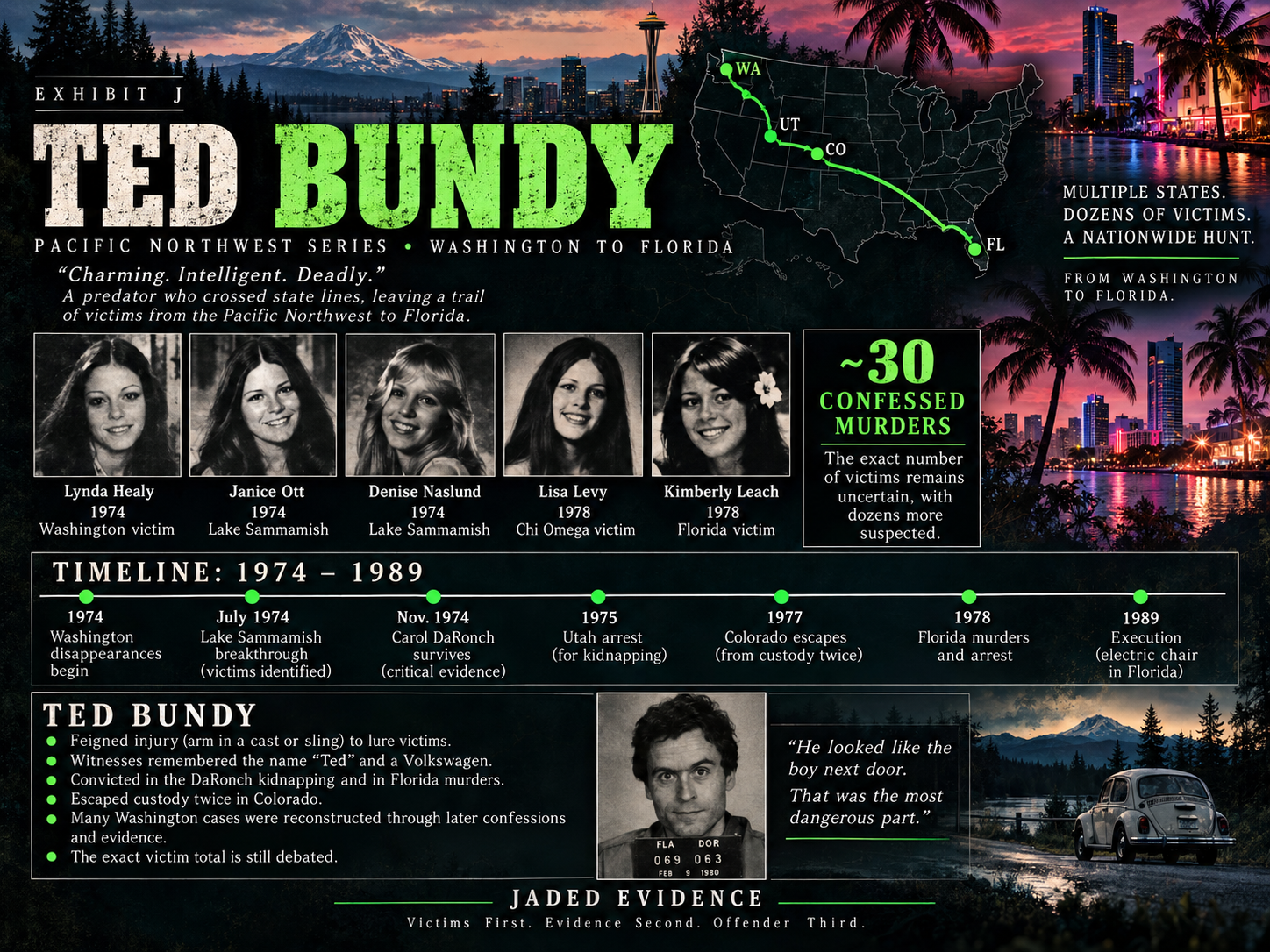
Before the Name Became Infamous, Washington Was Looking for “Ted”
Long before Ted Bundy became one of the most recognizable names in American true crime, women were disappearing across Washington State.
In 1974, investigators were trying to understand whether a series of missing young women were connected. Then, on July 14, two women vanished from Lake Sammamish State Park in broad daylight. Witnesses remembered an apparently injured man who introduced himself as “Ted” and asked women for help loading a sailboat onto a Volkswagen Beetle.
That was one of the rare moments in serial-murder history when the public was unknowingly interacting with the offender while the crimes were still unfolding.
The Washington Victims
Karen Sparks — January 4, 1974
Karen Sparks survived a brutal attack in Seattle’s University District. She suffered severe injuries and spent months recovering. Her case is important because it shows the violence associated with Bundy before the first Washington disappearance publicly linked to him.
Lynda Ann Healy — January 31, 1974
Lynda Healy, 21, disappeared from her basement bedroom in Seattle’s University District. She was a University of Washington student and radio ski reporter. Her remains were later recovered from Taylor Mountain. Bundy ultimately confessed to killing her.
Donna Gail Manson — March 12, 1974
Donna Manson, 19, disappeared from The Evergreen State College in Olympia while walking to a concert. Bundy later confessed to her killing, but her remains have never been recovered.
Susan Elaine Rancourt — April 17, 1974
Susan Rancourt, 18, disappeared from Central Washington State College in Ellensburg. Witnesses had reported an injured-looking man asking women for assistance. Her remains were later recovered from Taylor Mountain.
Roberta Kathleen Parks — May 6, 1974
Roberta Parks, 22, disappeared from Oregon State University in Corvallis. Her remains were later found at Taylor Mountain in Washington. Bundy confessed to killing her.
Brenda Carol Ball — June 1, 1974
Brenda Ball, 22, was last seen at a tavern in Burien. Her remains were later found at Taylor Mountain.
Georgann Hawkins — June 11, 1974
Georgann Hawkins, 18, disappeared near the University of Washington after leaving her sorority house. Bundy confessed to killing her. Her remains have never been conclusively recovered.
Janice Ott and Denise Naslund — July 14, 1974
Janice Ott, 23, and Denise Naslund, 19, disappeared separately from Lake Sammamish State Park on the same day. Witnesses described a man calling himself “Ted,” wearing an arm sling or appearing injured, and asking women for help with a sailboat.
Their remains were later found near Issaquah.
This was the point at which the name Ted, the Volkswagen, and the pattern of approaches became central investigative clues.
The Lake Sammamish Breakthrough
The Lake Sammamish disappearances changed the investigation because police suddenly had something they had lacked: multiple eyewitness accounts from the same location on the same day.
Witnesses described a man named Ted. They described his appearance. They described his vehicle. A composite sketch was released.
Bundy’s name was eventually submitted to law enforcement by people who knew him.
But at that stage, being named as a possible suspect was not the same as having enough evidence to arrest him.
How Bundy Slipped Through the Net
Bundy did not look like the popular stereotype of a serial offender. He was educated, politically active, socially connected, and capable of appearing helpful and respectable.
That public presentation mattered because investigators were receiving large numbers of tips. A person named Ted who drove a Volkswagen was not, by itself, enough to establish probable cause.
Bundy also moved across jurisdictions. By late 1974, he had relocated to Utah, which meant Washington investigators were now dealing with a suspect whose crimes were crossing state lines.
Utah: A Survivor Changes the Case
On November 8, 1974, Carol DaRonch survived an attempted abduction in Utah.
Her survival became one of the most important pieces of evidence in Bundy’s prosecution history because she could identify him and describe the method he used to lure women.
Bundy was later convicted in Utah for DaRonch’s kidnapping.
Colorado and the Escapes
Bundy was later charged in Colorado in the murder of Caryn Campbell.
While facing prosecution there, he escaped custody not once, but twice.
The second escape in December 1977 became catastrophic. Bundy fled Colorado and eventually reached Florida.
Florida: Chi Omega
In January 1978, Bundy entered the Chi Omega sorority house near Florida State University in Tallahassee.
He killed Margaret Bowman and Lisa Levy and attacked other women inside the house.
He was later convicted in Florida and sentenced to death.
He was also convicted in the abduction and murder of 12-year-old Kimberly Leach.
The Evidence
The Bundy case was prosecuted before modern DNA profiling became routine. Investigators relied on combinations of eyewitness identification, physical evidence, vehicle evidence, circumstantial evidence, forensic comparisons available at the time, and Bundy’s own later statements.
Some forms of forensic evidence used in the Florida case—particularly bite-mark comparison—have since become controversial and are viewed much more critically by modern forensic science.
That makes Bundy an important historical case for understanding how forensic standards evolve.
Confirmed, Confessed, and Suspected Victims
Bundy confessed to approximately 30 murders before his execution, but the exact number of victims remains uncertain.
That distinction matters.
| Category | Meaning |
|---|---|
| Convicted cases | Murders and crimes for which Bundy was formally convicted in court. |
| Confessed murders | Killings Bundy admitted shortly before execution. |
| Suspected victims | Disappearances or murders investigators examined for possible connections but that were never established in court. |
| Excluded cases | Cases once attributed to Bundy that were later ruled out, sometimes through DNA. |
The Ann Marie Burr Question
One of the longest-running unresolved questions involves Ann Marie Burr, an 8-year-old Tacoma girl who disappeared in 1961.
Bundy lived nearby as a teenager. Over the years, investigators and writers examined him as a possible suspect.
But the evidence has never established that Bundy killed Ann Marie Burr. Bundy denied responsibility, and the case remains unresolved.
For Jaded Evidence, she should be treated as a possible investigated connection—not included in Bundy’s confirmed victim count.
Washington’s Cases Were Never Prosecuted
One of the unusual features of the Bundy story is that many of the Washington murders most associated with him never went to trial.
Bundy was ultimately convicted in Utah and Florida. The Washington cases were largely reconstructed through investigation, recovered remains, circumstantial evidence, and Bundy’s later confessions.
That means the phrase “Bundy victim” can represent very different evidentiary categories depending on the individual case.
What Authorities Knew — And When
January–June 1974
Women disappear from campuses and communities across Washington. Investigators begin comparing cases.
July 14, 1974
Janice Ott and Denise Naslund disappear from Lake Sammamish. Multiple witnesses remember a man named Ted and a Volkswagen.
Late 1974
Bundy relocates to Utah. Similar disappearances and attacks occur there.
November 1974
Carol DaRonch survives an abduction attempt and later identifies Bundy.
1975
Bundy is arrested in Utah. Evidence found in his vehicle and witness information increase investigators’ focus on him.
1976
He is convicted in Utah for the DaRonch kidnapping.
1977
Bundy escapes custody twice in Colorado.
1978
After fleeing to Florida, he commits the Chi Omega attacks and later kills Kimberly Leach. He is arrested in Pensacola.
1979–1980
Florida juries convict Bundy in the Chi Omega murders and Kimberly Leach murder.
1989
In the days before execution, Bundy gives investigators additional confessions and details regarding numerous murders. He is executed in Florida on January 24, 1989.
The Myth Problem
Ted Bundy is often described using words like “brilliant,” “charming,” or “master manipulator.” Those descriptions can obscure the more useful evidentiary reality.
He was repeatedly noticed.
Witnesses saw him.
People gave his name to police.
A survivor identified him.
He was arrested.
He escaped custody twice.
His ability to continue offending was not evidence of supernatural criminal genius. It reflected a combination of mobility, deception, jurisdictional fragmentation, evidentiary limitations, institutional mistakes, and opportunities he exploited.
Jaded Evidence: Why This Case Still Matters
The Bundy case is not important because Bundy became famous.
It is important because the case exposes how serial crimes can remain fragmented when victims disappear across jurisdictions, how survivor testimony can transform an investigation, how forensic science changes over time, and how media fascination can eventually eclipse the people who were harmed.
The real story is not how one man became infamous.
It is how investigators eventually learned that women disappearing in Washington, Utah, Colorado, and Florida were part of the same pattern—and how much damage occurred before those pieces came together.
Sources & Further Reading
- HistoryLink — Ted Bundy and the Washington Cases
- HistoryLink — Detective Robert Keppel
- FBI — Seattle Field Office History
Jaded Evidence distinguishes convictions, confessions, suspected links, and cases later excluded by forensic evidence. Inclusion in a suspect list does not establish responsibility.
Leave a Reply