

CONTENT NOTE: This article discusses homicide, sexual violence, sex work, and victim exploitation. Jaded Evidence centers the victims and distinguishes convictions, admissions, investigative theories, and unresolved questions.
Facts over speculation. Follow the evidence.
Spokane Was Living With Its Own Serial Killer
While western Washington was still associated with the Green River murders, another series of killings was unfolding hundreds of miles east in and around Spokane.
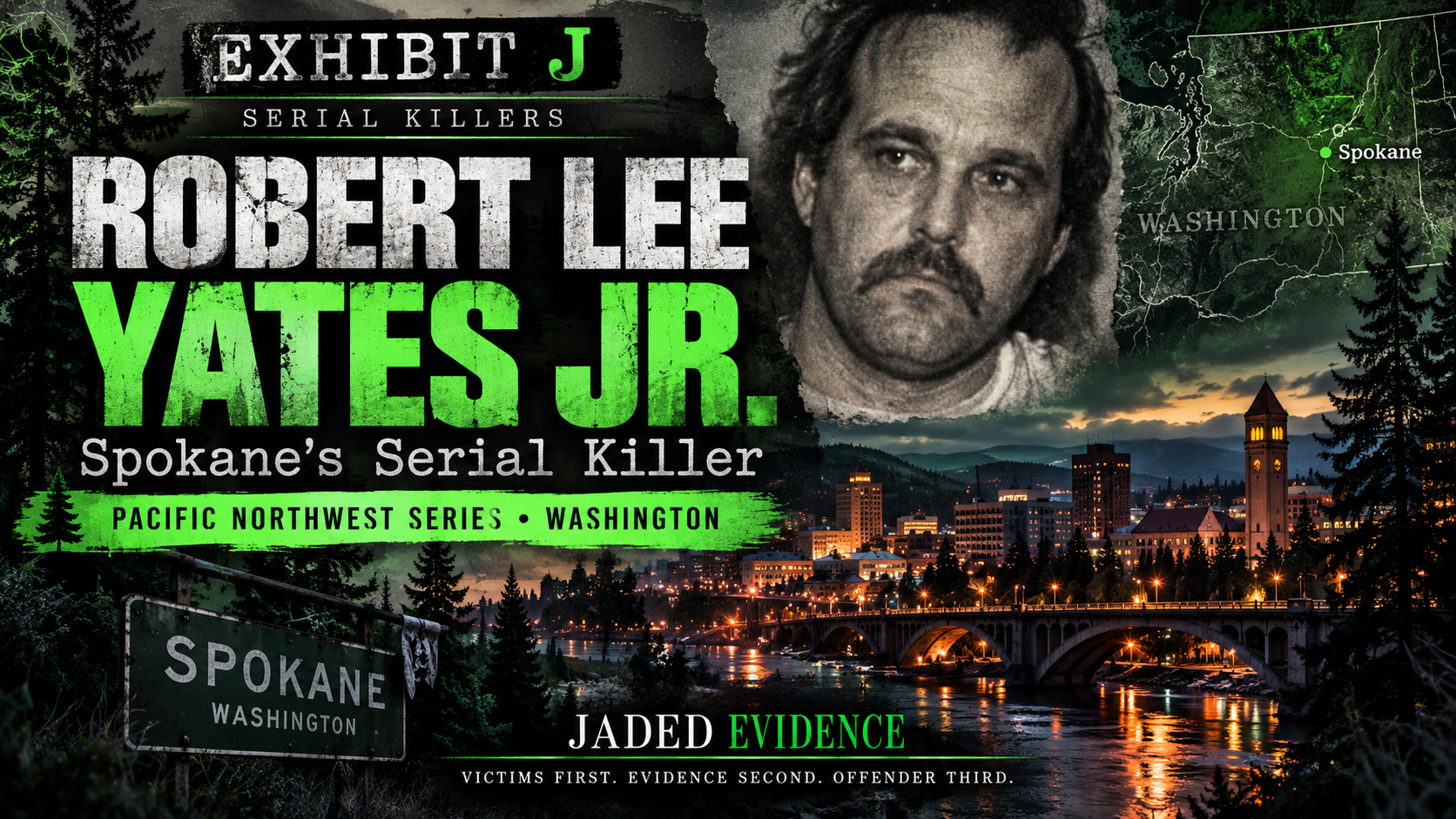
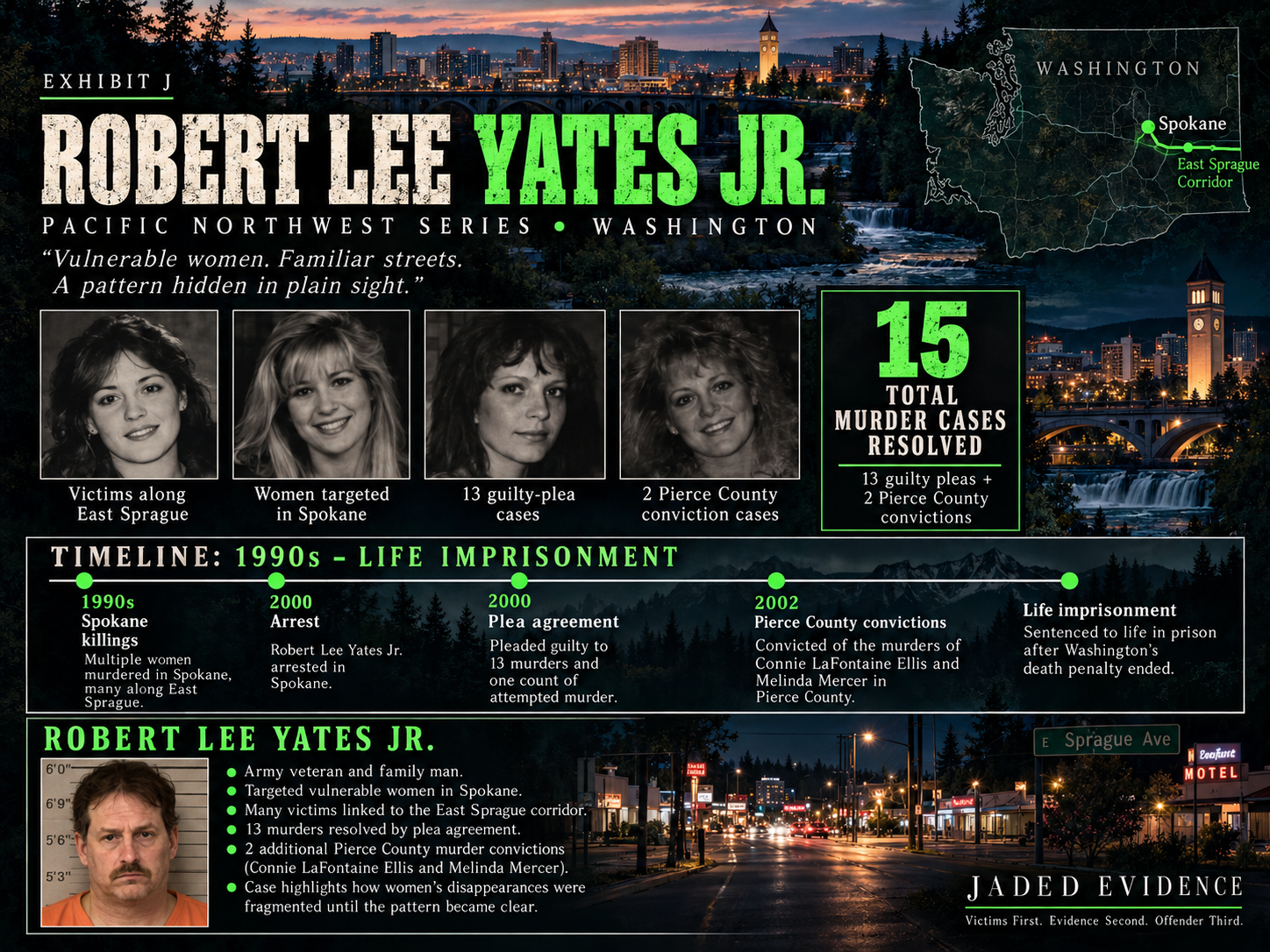
The offender was Robert Lee Yates Jr., an Army veteran and family man whose outwardly conventional life stood in stark contrast to the crimes investigators eventually tied to him.
Many of the women he targeted were involved in sex work, particularly around Spokane’s East Sprague Avenue corridor. That vulnerability became part of the investigative story because women in that community recognized something dangerous was happening long before the killer was identified.
The Victims Were Not Background Characters
The Yates case is often reduced to a body count. That is exactly what this series is designed to avoid.
The women who disappeared and were killed had families, histories, relationships, and identities beyond the circumstances that made them vulnerable to Yates. Their occupations and struggles may help explain how he accessed them, but they do not define them.
As fear grew among women working along East Sprague Avenue, local outreach workers described a community that understood someone was targeting them even while investigators were still trying to identify the offender.
A Pattern Emerges
During the 1990s, women began disappearing from Spokane and surrounding areas. Their bodies were recovered in multiple locations, often with evidence suggesting a recurring offender.
Investigators eventually focused on similarities involving victim circumstances, geography, forensic evidence, and Yates’s access to the women.
The investigation became one of the most significant serial-homicide cases in Washington State outside the Green River investigation.
How Yates Was Identified
The investigation narrowed through conventional police work combined with forensic evidence and the reconstruction of Yates’s movements.
Once investigators connected him to one victim, the scope expanded. Search warrants and forensic examination of his property and vehicles produced additional evidence.
The case illustrates a recurring pattern in serial investigations: the breakthrough in one homicide can suddenly make previously disconnected files look very different.
The Spokane Plea Agreement
In 2000, Spokane County prosecutors reached a plea agreement with Yates.
He pleaded guilty to 13 murder charges arising from killings in Spokane County, Walla Walla County, and Skagit County. He also pleaded guilty to an attempted murder.
In exchange, prosecutors in those counties did not seek the death penalty.
Yates received a sentence totaling 408 years.
Pierce County Refused to Join the Deal
Pierce County made a different decision.
Prosecutors there separately charged Yates with the aggravated first-degree murders of Connie LaFontaine Ellis and Melinda Mercer.
In 2002, a jury convicted him of both murders and he was sentenced to death.
The Washington Supreme Court later affirmed those convictions and the death sentence. Washington subsequently abolished capital punishment, leaving Yates to serve life imprisonment.
Why the Plea Structure Matters
The Yates case is a useful example of how jurisdiction changes prosecution strategy.
Several counties accepted a global resolution that guaranteed Yates would never be released and allowed investigators to close multiple homicide cases without separate capital trials.
Pierce County chose instead to prosecute its two cases independently.
That means Yates’s criminal record is not one single prosecution. It is the product of different prosecutorial decisions across different Washington jurisdictions.
Confirmed Versus Suspected
| Category | What It Means |
|---|---|
| 13 guilty pleas | Murders resolved through the 2000 multi-county plea agreement. |
| 2 Pierce County convictions | Connie LaFontaine Ellis and Melinda Mercer — separately prosecuted and convicted in 2002. |
| Attempted murder | Also included in the Spokane County plea resolution. |
| Additional suspected cases | Cases investigated for possible connections should remain separate unless supported by sufficient evidence. |
What Authorities Knew — And When
1990s
Women associated with Spokane’s sex-work corridor disappear and are found murdered. Fear grows within the community.
Late 1990s
Investigators increasingly recognize a serial pattern and begin connecting previously separate cases.
2000
Yates is arrested, and forensic evidence expands the investigation. He ultimately pleads guilty to 13 murders and attempted murder in a multi-county agreement.
2002
Pierce County separately prosecutes Yates for the murders of Connie LaFontaine Ellis and Melinda Mercer. He is convicted of both.
Later appellate litigation
Yates repeatedly challenges aspects of his convictions and sentences. Washington appellate courts uphold the murder convictions.
The East Sprague Avenue Context
One of the most important parts of this case is the community Yates targeted.
Many women working along East Sprague Avenue were living with poverty, addiction, unstable housing, abusive relationships, or other forms of vulnerability. Some carried weapons or took other precautions because they believed someone was killing women they knew.
That should not be translated into the phrase “high-risk victim” without explanation.
The risk came from the offender and from structural vulnerability—not from the value of the women’s lives.
The Military and Family-Man Narrative
Yates’s military service, marriage, children, employment, and suburban life repeatedly appear in descriptions of the case because they contradicted the public stereotype of what a serial killer was supposed to look like.
But an offender’s ability to maintain ordinary social roles does not negate the evidence of his crimes.
For Jaded Evidence, the relevant question is not how “normal” Yates appeared. It is how his routine life allowed him to move through the community without attracting the level of suspicion people later imagined should have been obvious.
Jaded Evidence: Why This Case Belongs in the Pacific Northwest Series
The Robert Yates case belongs beside Highway 20, Green River, and Ted Bundy because it reveals another recurring Pacific Northwest theme:
Women can disappear inside familiar landscapes while their cases remain fragmented until evidence finally forces investigators to see the larger pattern.
And like the Green River case, the Yates investigation requires us to look closely at how offenders exploited women whose disappearances they believed would receive less public attention.
Sources & Further Reading
Jaded Evidence distinguishes guilty pleas, jury convictions, admissions, suspected links, and unresolved cases. A suspected connection is not treated as established fact.
Leave a Reply