
CONTENT NOTE: This article discusses homicide, sexual violence, exploitation, missing persons, and crimes against minors. Jaded Evidence centers the victims and distinguishes proven facts, admissions, investigative theories, and unresolved cases.
Facts over speculation. Follow the evidence.
Washington Lived With This Case for Nearly Two Decades
For people who lived in Washington State during the 1980s and 1990s, the Green River Killer was not a historical true-crime case. It was an active threat unfolding in real time.
Women and girls disappeared from Pacific Highway South, the Sea-Tac area, Seattle, and communities throughout King County. Bodies were recovered from the Green River, wooded areas, ravines, roadsides, and remote dumping grounds. News reports repeated the same unnerving reality for years: someone was killing women, and police had not been able to stop him.
The man eventually identified as the killer was Gary Leon Ridgway, a longtime King County resident and truck painter who had repeatedly driven the same roads, solicited sex workers, and lived within the geography of the investigation.
Jaded Evidence note: I grew up in Washington State while the Green River Killer was active. This was not a case I first encountered years later in a documentary. For people living there, it unfolded in real time — in local news reports, warnings, conversations, and the repeated discovery that another woman had disappeared or been found dead.
The Case Begins
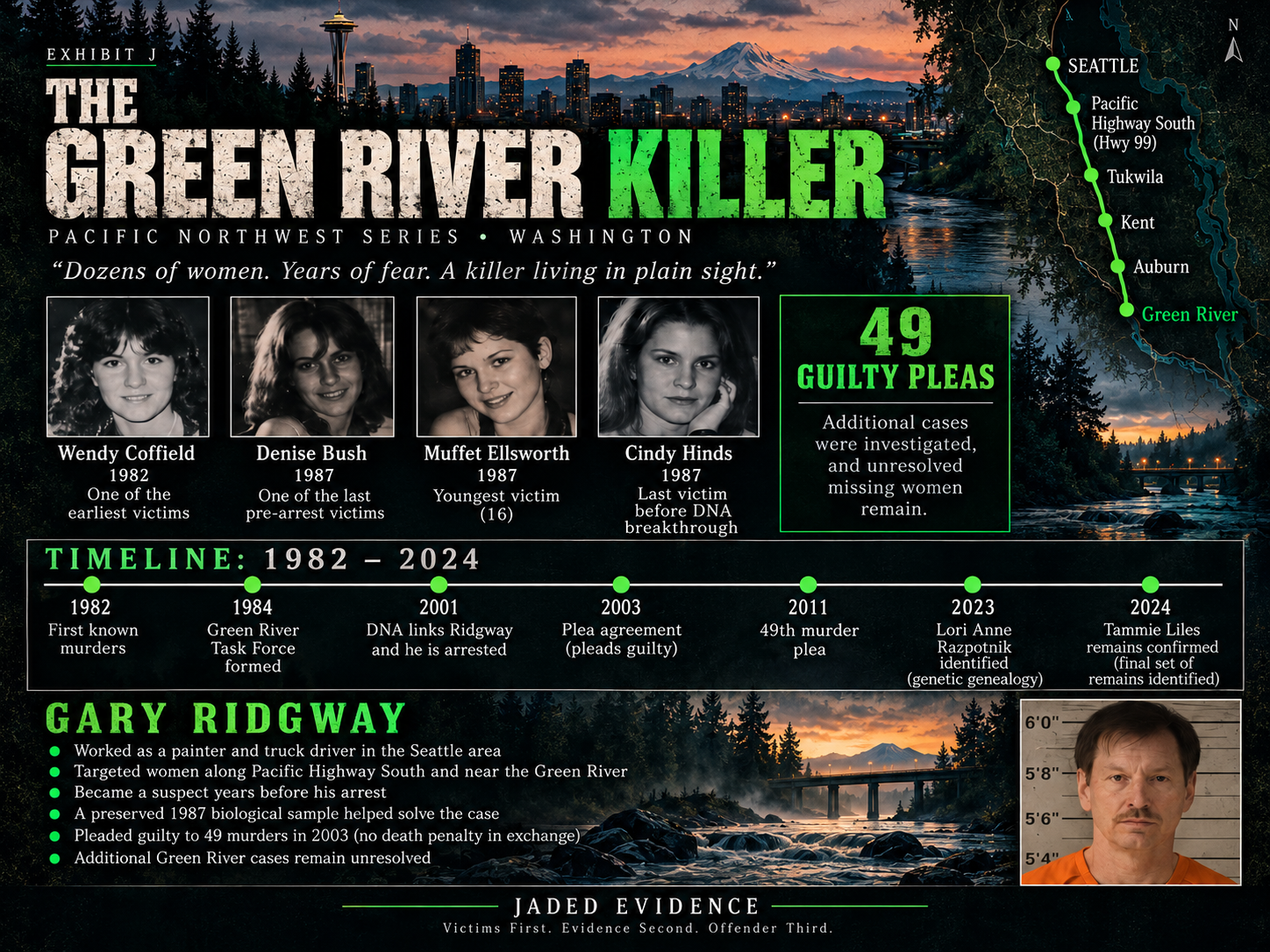
On July 15, 1982, the body of 16-year-old Wendy Lee Coffield was found in the Green River near Kent. Within weeks, the bodies of Debra Lynn Bonner, Marcia Faye Chapman, Opal Charmaine Mills and Cynthia Jean Hinds were also discovered in or near the river.
Authorities realized they were dealing with a serial murderer. The investigation would become one of the largest and longest serial-homicide investigations in American history.
Why Pacific Highway South Matters
Many victims were young women and teenage girls who spent time along the Highway 99/Pacific Highway South corridor near Sea-Tac. Some were involved in sex work. Some were runaways. Some were living unstable lives. Those circumstances made them vulnerable not only to Ridgway, but also to a system that did not always respond to their disappearances with the urgency their families deserved.
Ridgway exploited that vulnerability deliberately. He later acknowledged targeting women he believed could disappear without generating immediate attention.
That is a central fact of this case: the victims were not “high risk” because of who they were. Ridgway selected circumstances he believed would reduce his own risk of detection.
The Green River Task Force
As the body count rose, King County created the Green River Task Force. Detectives coordinated across jurisdictions, processed enormous numbers of tips, examined vehicles, interviewed witnesses, tracked sex-work activity, and investigated thousands of potential suspects.
Among those suspects was Gary Ridgway.
He was interviewed during the investigation years before his arrest. In 1987, investigators obtained biological samples from him. At the time, forensic technology could not establish the evidentiary link investigators would later need.
That preserved sample became crucial.
1980s: Ridgway Was Already on the Radar
Ridgway did not emerge suddenly in 2001. Investigators had encountered him years earlier. He was known to frequent the Pacific Highway South prostitution corridor and had contact with law enforcement during the active investigation.
This makes the Green River case particularly useful for examining the difference between having a suspect and having legally sufficient evidence to arrest and convict that suspect.
Suspicion was not enough. Investigators needed a forensic bridge between Ridgway and the women.
The DNA Breakthrough
By 2001, DNA technology had advanced far beyond what investigators had available when Ridgway’s biological samples were originally collected.
Forensic testing linked Ridgway to evidence associated with multiple victims.
On November 30, 2001, Gary Ridgway was arrested.
The FBI later described the arrest as the result of DNA positively identifying Ridgway in connection with a victim. The breakthrough transformed a decades-old suspect into a prosecutable defendant.
The Charges Expand
Ridgway was initially charged with several murders. Additional charges followed as prosecutors continued assembling evidence.
Then came one of the most consequential prosecutorial decisions in modern serial-murder history.
The Plea Deal
In 2003, King County prosecutors agreed not to seek the death penalty if Ridgway pleaded guilty to every murder he had committed in King County and cooperated fully with investigators.
The agreement required him to provide complete and truthful information, answer investigators’ questions, identify victims and dumping locations, and assist authorities in resolving cases that otherwise might never have been solved.
On November 5, 2003, Ridgway pleaded guilty to 48 counts of aggravated first-degree murder.
He was sentenced to life imprisonment without the possibility of parole.
The 49th Murder
The number later increased.
Ridgway eventually pleaded guilty to a 49th murder, bringing his formal guilty-plea total to 49.
That number should not automatically be treated as his complete victim count. Ridgway gave varying estimates of how many women he killed, and investigators have continued examining additional disappearances and unsolved homicides for possible connections.
Known Victims, Unresolved Questions
King County’s current Green River homicide page continues to list known victims while also identifying women whose disappearances remain unresolved.
Three women remain on the official Green River Homicides list as missing and uncharged:
- Kassee Ann Lee, 16 — last seen August 28, 1982 near South 200th Street and 30th Avenue South.
- Kelly Kay McGinnis, 18 — last seen June 28, 1983 near South 216th Street and Pacific Highway South.
- Patricia Ann Osborn, 19 — last seen October 28, 1983 after leaving an area near North 115th Street and Aurora Avenue North in Seattle.
Ridgway was not charged in their disappearances. Their placement on the official case list means their cases remain part of the broader Green River investigation, not that his responsibility has been judicially established.
Forensic Genealogy Gives Victims Their Names Back
The investigation did not end with Ridgway’s conviction.
Modern forensic DNA and genetic genealogy have allowed authorities to identify remains that were nameless for decades.
In 2023, remains long known as “Bones 17” were identified as Lori Anne Razpotnik, a 15-year-old who disappeared in 1982.
In January 2024, another set of unidentified remains known as “Bones 20” was confirmed as belonging to Tammie Liles, who was 16 when she disappeared. Liles had already been identified from a separate set of remains years earlier; the newer DNA work established that the previously unidentified remains were also hers.
Those identifications matter because serial-murder statistics can reduce people to numbers. Forensic genealogy reverses that process. A number becomes a name again.
Why the Investigation Is Still Not Truly Over
In September 2024, Ridgway was temporarily transferred back to King County while detectives investigated information he provided about possible additional victim remains.
Later reporting indicated that investigators searched multiple locations but did not recover new remains.
The episode illustrates a persistent problem investigators face with serial offenders who become informants about their own crimes: some information may be genuine, some may be mistaken after decades, and some may be manipulation.
The absence of a recovery does not establish which explanation applies.
Confirmed Versus Claimed Versus Suspected
| Category | What It Means |
|---|---|
| 49 guilty pleas | Murders for which Ridgway formally accepted criminal responsibility in court. |
| Additional admissions | Killings Ridgway claimed or discussed that may not have resulted in charges. |
| Green River missing-person cases | Cases investigated in connection with the Green River series but not necessarily proven to be Ridgway victims. |
| Other unsolved homicides | Cases evaluated for possible similarities or geographic connections. A possible link is not proof. |
What Authorities Knew — And When
1982
Multiple women are found dead in and near the Green River. Investigators recognize a serial-homicide pattern.
1983–1984
The investigation expands rapidly. More victims are discovered in wooded and remote locations throughout King County.
1980s
Ridgway enters the investigative universe. Detectives interview him and eventually obtain biological samples.
1987
Investigators preserve biological evidence from Ridgway. Technology at the time cannot provide the definitive connection later obtained through DNA analysis.
2001
Advances in forensic testing connect Ridgway to victim evidence. He is arrested November 30.
2003
Ridgway enters a cooperation agreement and pleads guilty to 48 murders.
2011
He pleads guilty to a 49th murder.
2023–2024
Forensic genealogy helps identify additional victim remains, including Lori Anne Razpotnik and the remains known as Bones 20, confirmed as Tammie Liles.
September 2024
Investigators bring Ridgway back to King County while evaluating possible additional burial locations. Searches do not produce newly recovered remains.
The Investigative-Failure Question
It is easy to look backward at the case and ask why police did not arrest Ridgway earlier.
The more useful question is more precise:
At each stage, what evidence actually existed, what could investigators legally prove, what information was fragmented across jurisdictions, and which opportunities were truly missed?
The Green River investigation included genuine forensic limitations of its era, enormous investigative volume, jurisdictional complexity, and decisions that deserve scrutiny.
Those issues should be separated rather than collapsed into the simplistic statement that police “knew it was him.”
Victim Vulnerability and Institutional Blind Spots
Many victims were sex workers, runaways, teenagers, or women experiencing unstable housing and substance use.
Those circumstances affected how quickly disappearances were recognized, reported, connected, and investigated.
Ridgway understood that.
This is one of the most important lessons in the case: serial offenders may deliberately select victims whom they believe institutions and the public will notice less.
A victim’s occupation, addiction history, housing status, criminal record, or family conflict never makes her disappearance less important.
The Geography of the Case
The Green River murders cannot be understood without geography.
Key locations include:
- Pacific Highway South / Highway 99
- Sea-Tac and south King County
- Kent
- The Green River
- Auburn
- Wooded and rural dumping areas throughout King County
- Sites outside King County and, in some cases, outside Washington where remains associated with victims were recovered
Ridgway’s familiarity with these areas allowed him to move between populated corridors and secluded disposal sites while remaining within a landscape he knew well.
Jaded Evidence: What This Case Is Really About
Gary Ridgway matters because he committed the crimes.
But he should not dominate the story.
The Green River case is also about dozens of women whose lives were repeatedly described through the circumstances in which they were vulnerable rather than through who they were.
It is about families who waited years or decades for answers.
It is about detectives trying to solve murders with forensic tools that had not yet caught up to the evidence sitting in their property rooms.
It is about why biological evidence must be preserved.
It is about why missing-person reports involving marginalized women cannot be treated as disposable.
And it is about an uncomfortable reality:
Sometimes the evidence that solves a case already exists. Science simply has not caught up with it yet.
Sources & Further Reading
- King County Sheriff’s Office — Green River Homicides Investigation
- FBI — Seattle Field Office History
- HistoryLink — Green River Killer Case
- HistoryLink — Gary Ridgway Pleads Guilty
Jaded Evidence distinguishes convictions, guilty pleas, admissions, suspected links, and unresolved cases. Inclusion in an investigative list does not establish criminal responsibility.
Leave a Reply