

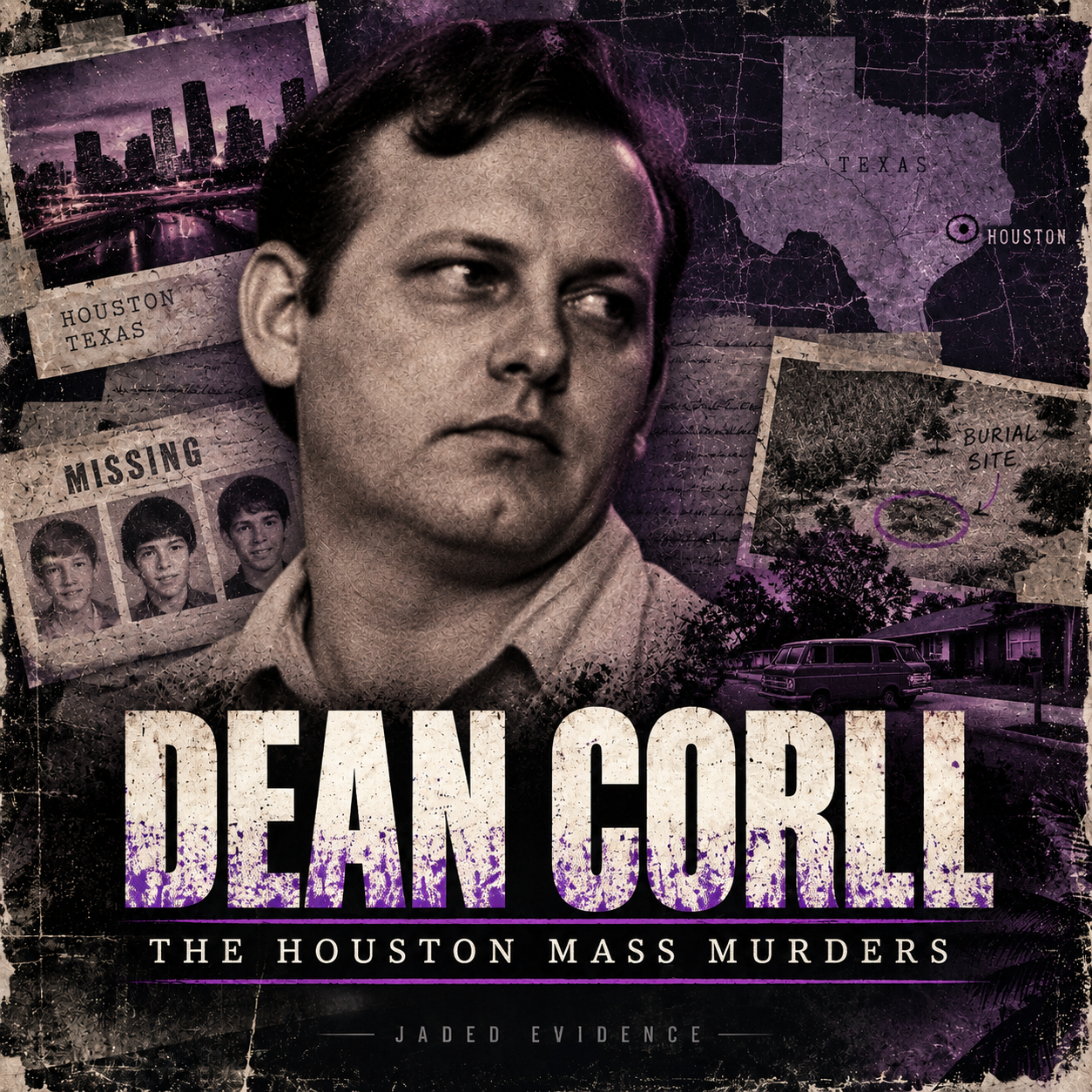

REGION: South / Southeast — Texas
CONTENT NOTE: This article discusses child and adolescent murder, sexual violence, abduction, torture, and concealment of remains.
Victims first. Evidence second. Offender third.
Case Overview
Dean Corll, with teenage accomplices David Brooks and Elmer Wayne Henley, abducted and murdered numerous boys and young men in the Houston area during the early 1970s.
How the Case Broke
The crimes were exposed in 1973 after Henley shot and killed Corll and then led police to burial sites containing multiple victims.
Victim Identification
The case became one of the largest serial-murder investigations in U.S. history at the time and raised enduring questions about missed disappearances and unidentified victims.
Why This Case Matters
The Houston Mass Murders demonstrate how repeated disappearances of young people can fail to trigger a coordinated response until an offender network is exposed from within.
Known Victims
The known victim list includes 28 identified boys and young men plus one still-unidentified victim often called “Swimsuit Boy.”
- Jeffrey Konen
- James Glass
- Danny Yates
- Donald Waldrop
- Jerry Waldrop
- Randall Lee Harvey
- David Hilligiest
- Gregory Malley Winkle
- Ruben Watson Haney
- Frank Aguirre
- Mark Scott
- Johnny Delome
- Billy Baulch Jr.
- Steven Sickman
- Roy Bunton
- Wally Jay Simoneaux
- Richard Hembree
- Willard Branch
- Richard Kepner
- Joseph Lyles
- William Lawrence
- Raymond Blackburn
- Homer Garcia
- John Sellars
- Michael Baulch
- Marty Jones
- Charles Cobble
- James Dreymala
- Unidentified “Swimsuit Boy”
Investigation Highlights
- The case broke on August 8, 1973, when Elmer Wayne Henley shot Corll during a confrontation and then told police about the murders.
- Henley and David Brooks led investigators to multiple burial locations, including Corll’s boat shed, High Island, and the Lake Sam Rayburn area.
- Recovery of remains transformed a series of missing-person reports into one of the largest serial-homicide investigations in U.S. history at that time.
- DNA and renewed forensic work decades later corrected several victim identifications and continue to matter in the remaining unidentified case.
Psychiatric and Psychological Record
Corll died before arrest, trial, or a formal forensic psychiatric evaluation. Claims that he had a specific psychiatric disorder are therefore retrospective speculation unless tied to a documented pre-death medical record. His behavior can be described behaviorally—sexual sadism, coercive control, prolonged captivity, and organized concealment—without inventing a diagnosis.
Modus Operandi vs. Signature
Modus operandi: Recruitment or luring of adolescent boys and young men, often with help from accomplices; restraint; sexual assault; killing by strangulation or shooting; and concealed burial at recurring sites.
Signature-like behavior: Prolonged restraint and torture, use of a restraint board and handcuffs/cords, and repeated sexualized control went beyond what was necessary simply to kill and are better understood as signature-like behavioral elements.
Leave a Reply