


CONTENT NOTE: This article discusses homicide, sexual violence, sex work, and the targeting of vulnerable women. Jaded Evidence centers victims and distinguishes convictions, suspected links, and unresolved cases.
Facts over speculation. Follow the evidence.
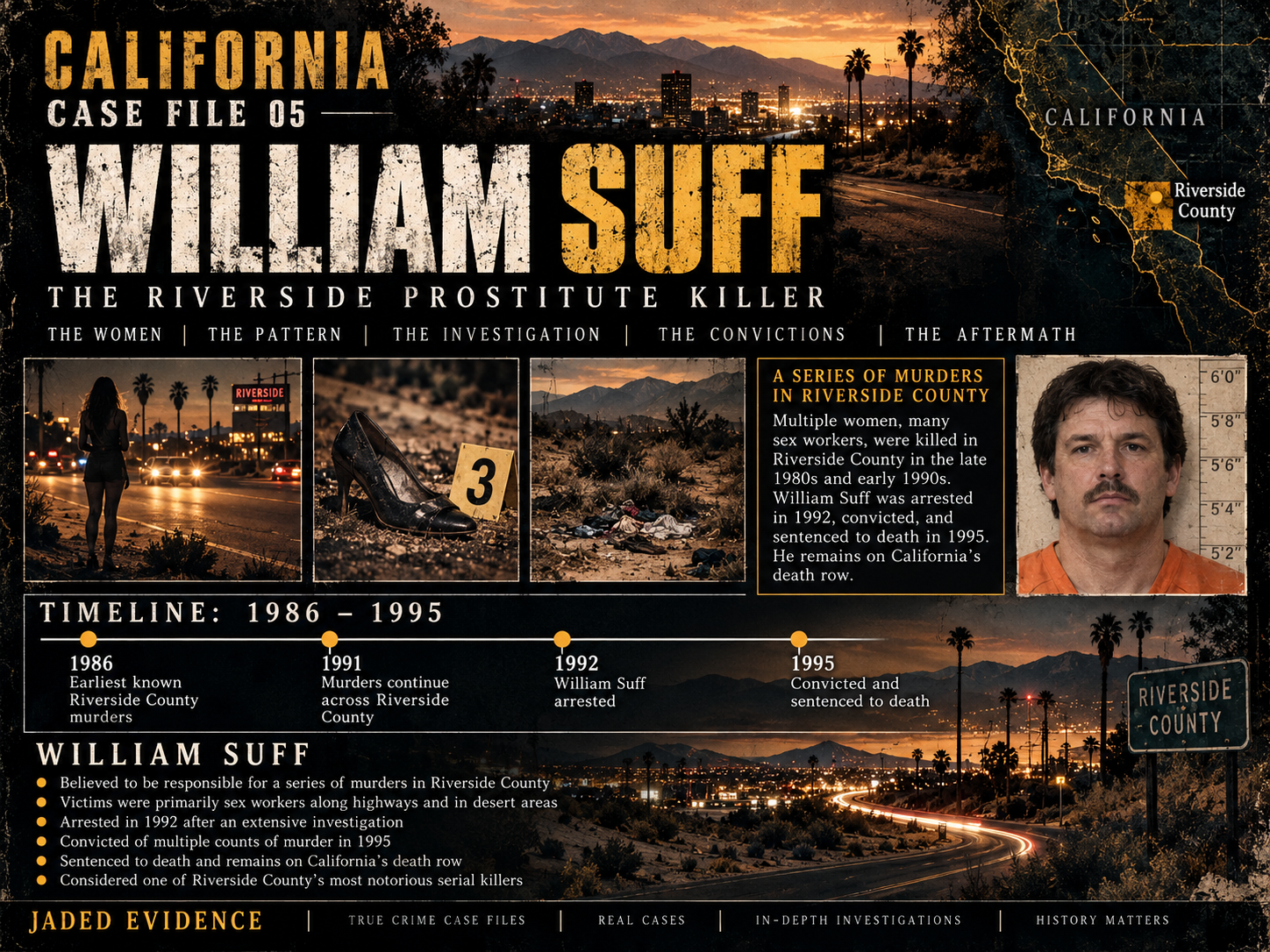
Riverside County’s Serial-Murder Case
William Lester Suff became one of Southern California’s most notorious serial murderers after a series of killings in Riverside County during the late 1980s and early 1990s.
Many of the victims were women involved in sex work or living with instability, addiction, or poverty. Their circumstances made them more accessible to an offender and, at times, less visible to institutions and the public.
Suff was ultimately convicted of multiple murders and sentenced to death in California.
The Victims
The women killed in the Riverside series were often reduced in media accounts to labels based on occupation or lifestyle.
For Jaded Evidence, that framing is not enough.
The relevant question is not why the women were vulnerable. It is how Suff exploited that vulnerability and how long it took investigators to recognize the pattern connecting their deaths.
A Pattern Across Riverside County
Victims were found in and around Riverside County, often in locations connected to roads, industrial areas, fields, or isolated stretches where bodies could be left without immediate discovery.
Investigators gradually recognized similarities in victim circumstances, geography, cause of death, and evidence suggesting that one offender might be responsible for multiple killings.
The Earlier Texas Case
Before the California murders, Suff had already been convicted in Texas in connection with the death of his infant daughter.
That history later became part of public scrutiny surrounding the California case because it raised questions about how an offender with a serious prior violent conviction was able to return to the community and later become linked to additional murders.
The Texas case and the California serial-murder prosecution should be treated as separate legal events rather than folded together into one victim count.
How the Investigation Closed In
By the early 1990s, law enforcement had begun connecting multiple Riverside-area homicides and focusing on Suff.
Investigators used witness information, vehicle evidence, physical and forensic evidence, and the reconstruction of Suff’s movements.
The case became another example of a serial investigation in which no single clue solved everything. Instead, multiple pieces of evidence accumulated until investigators had enough to arrest and prosecute.
Arrest and Prosecution
Suff was arrested in 1992.
He was later tried in Riverside County and convicted of multiple murders.
In 1995, he was sentenced to death.
California prison records continue to list William Suff among condemned inmates, reflecting that the death sentence remains part of his case history even though California has not carried out an execution since 2006 and currently operates under an executive moratorium. The legal status of individual death judgments should therefore be distinguished from whether an execution is presently scheduled.
Confirmed Versus Suspected
| Category | How Jaded Evidence Treats It |
|---|---|
| California murder convictions | Murders proven in Riverside County court. |
| Earlier Texas child-death case | A separate conviction predating the California serial-murder case. |
| Additional suspected victims | Cases investigated for possible connections but not automatically added to the judicially established count. |
| Unresolved homicides | Cases that may share geography or victim characteristics but require independent evidence before attribution. |
What Authorities Knew — And When
Earlier years
Suff’s criminal history already included a serious Texas conviction involving the death of his infant daughter.
Late 1980s
Women begin turning up dead in Riverside County under circumstances that eventually suggest a serial pattern.
1990–1991
The number of linked cases grows and investigators increasingly focus on commonalities among victims and crime scenes.
1992
Suff is arrested.
1995
He is sentenced to death following his Riverside County murder convictions.
Today
Suff remains listed by the California Department of Corrections and Rehabilitation among condemned inmates. His case therefore remains legally active in the sense that the death judgment still exists, even though California’s broader execution policy has changed.
The Marginalized-Victim Question
Like the Green River and Grim Sleeper cases, the Suff investigation raises a recurring issue in serial homicide:
What happens when an offender deliberately chooses victims whose disappearances and deaths may receive less immediate attention?
Many women in these cases were living in circumstances that made contact with strangers more likely and made disappearance easier to misinterpret as voluntary.
Those conditions created opportunity for the offender. They did not make the women responsible for the risk.
Why the “Prostitute Killer” Label Is Problematic
The label attached to Suff reflects a media convention rather than a victim-centered description.
It defines the case through the victims’ occupation instead of the offender’s conduct.
For historical recognition and searchability, Jaded Evidence may note that Suff has been called the “Riverside Prostitute Killer,” but the article itself should continue to use the women’s names and the Riverside serial-murder case whenever possible.
Jaded Evidence: What This Case Adds to the California Series
Suff’s case reinforces a pattern already visible in Green River and Grim Sleeper:
serial offenders frequently exploit social marginalization.
The common thread is not that the victims were “high risk.”
The common thread is that offenders recognized which victims society was most likely to overlook.
Sources & Further Reading
Jaded Evidence distinguishes convictions, suspected links, and unresolved cases. Similar victim characteristics or geography alone do not establish attribution.
Leave a Reply