

CONTENT NOTE: This article discusses homicide, sexual assault, home invasion, burglary, and attacks on children and adults. Jaded Evidence centers victims and survivors and distinguishes charged crimes, convictions, and suspected links.
Facts over speculation. Follow the evidence.
Southern California Under Siege
In 1984 and 1985, a series of home-invasion attacks across Southern California created one of the most intense public manhunts in the state’s history.
The offender attacked at night, entered homes, assaulted and murdered victims of different ages, and moved across jurisdictions. Because the crimes did not initially fit one narrow victim profile, investigators were slower to recognize the full scope of the pattern.
The man eventually identified as Richard Ramirez became known in the media as the Night Stalker.
The Victims Did Not Fit a Single Profile
One of the most important investigative features of the case was the wide range of victims.
Ramirez attacked men and women, younger and older adults, and children. Some victims were killed, some survived severe assaults, and others were sexually assaulted or robbed.
That variability made the crime series harder to categorize than cases in which an offender repeatedly selected victims with highly similar characteristics.
The Crime Pattern
The attacks were typically committed at night in residential settings. Ramirez used firearms, knives, blunt-force weapons, ligatures, and objects found inside homes.
He frequently burglarized residences and sometimes forced victims to surrender money or valuables.
Investigators also documented satanic symbols and statements at some scenes, details that received enormous media attention and later became part of the mythology surrounding the offender.
For Jaded Evidence, those details matter only to the extent that they are supported by the record and relevant to the crimes. They should not be allowed to turn the case into supernatural theater.
A Multi-Jurisdiction Investigation
Ramirez’s attacks occurred across multiple Southern California communities and law-enforcement jurisdictions.
That fragmentation created familiar serial-case problems: different agencies held pieces of the same pattern, and evidence had to be compared across city and county lines.
Eventually, ballistic evidence, shoe impressions, witness descriptions, survivor accounts, stolen-property evidence, and fingerprint work helped investigators connect the series.
The Fingerprint Breakthrough
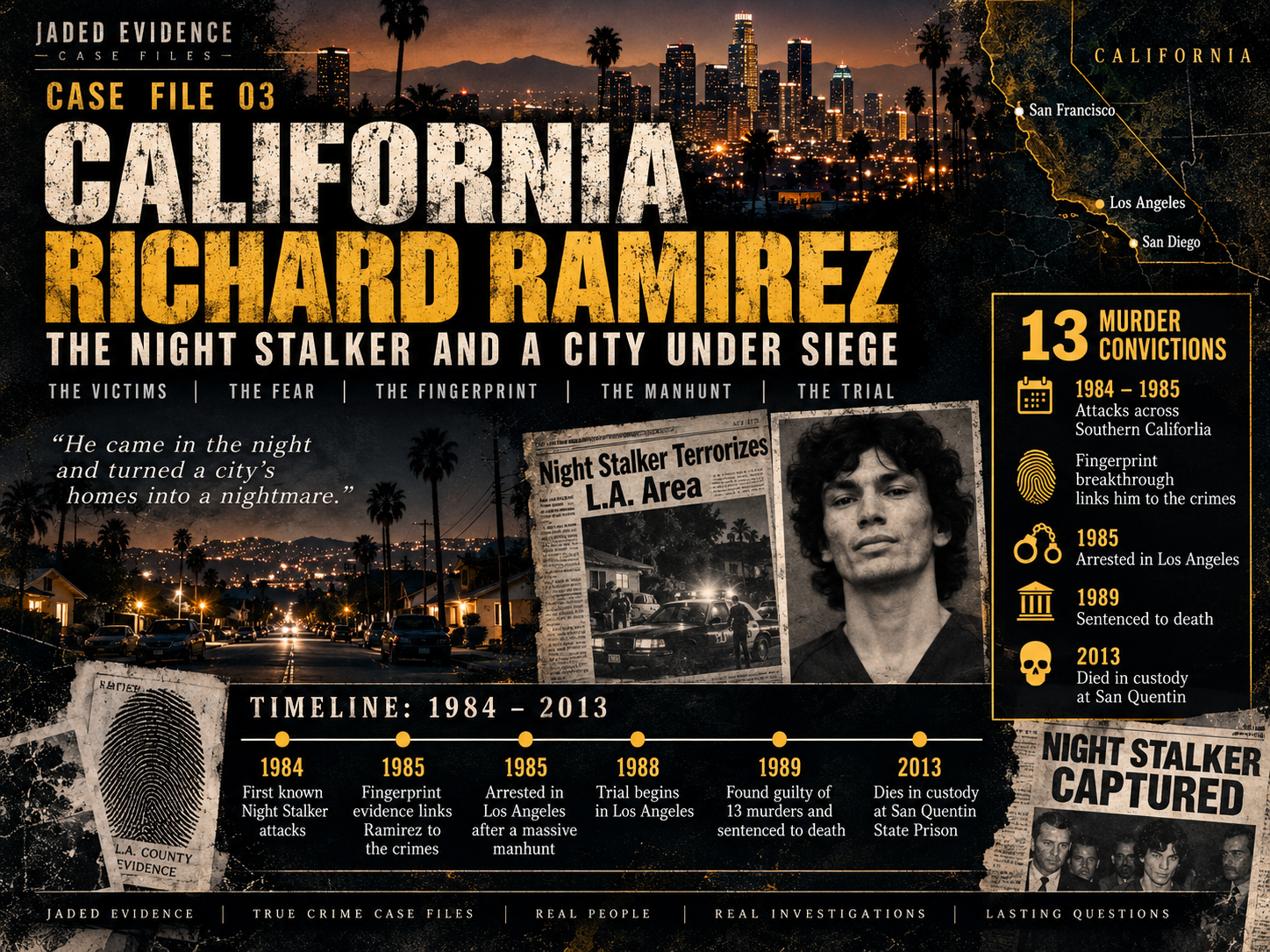
A critical breakthrough came when investigators recovered a usable fingerprint from a stolen vehicle linked to the case.
The print was compared through California’s developing automated fingerprint system and matched to Richard Ramirez, who already had a criminal record.
That identification transformed an unknown serial offender into a named fugitive.
The Public Manhunt
On August 31, 1985, authorities publicly released Ramirez’s name and photograph.
The response was immediate.
Ramirez returned to Los Angeles after traveling outside the city and realized his image was everywhere. Residents recognized him as he moved through East Los Angeles.
After a chase through residential streets, community members restrained him until police arrived.
The arrest became one of the most dramatic examples of a serial-killer manhunt ending through public recognition.
Trial
Ramirez went on trial in Los Angeles County in 1988.
The prosecution presented evidence tying him to a large number of attacks, including survivor testimony, fingerprint evidence, firearms evidence, stolen property, and other forensic and circumstantial evidence.
In 1989, the jury convicted him of 13 murders along with multiple counts of attempted murder, sexual assault, burglary, and other offenses.
He was sentenced to death.
The Courtroom Persona
Ramirez’s courtroom behavior became a major part of public fascination with the case.
He displayed occult imagery, made provocative gestures and statements, and appeared to cultivate an image designed to shock.
That behavior received enormous media attention.
But theatrics should not be confused with evidence.
The case against Ramirez rested on witnesses, physical evidence, forensic comparisons, and the reconstruction of his movements—not on the image he created for cameras.
DNA and Later Case Review
As forensic science improved, investigators revisited evidence from older crimes for possible connections to Ramirez.
Some cases previously suspected of being linked to him were later re-evaluated through DNA and other evidence.
This is another reason serial-offender victim counts should be handled carefully: early investigative suspicion may later be strengthened, weakened, or eliminated by new forensic testing.
Confirmed Versus Suspected
| Category | How Jaded Evidence Treats It |
|---|---|
| 13 murder convictions | Murders established through the Los Angeles County trial and verdicts. |
| Other convicted offenses | Attempted murders, sexual assaults, burglaries, and related crimes established in court. |
| Later investigated cases | Older crimes examined for possible Ramirez involvement after his identification. |
| Excluded or unsupported theories | Cases should not be included simply because they resemble the Night Stalker pattern. |
What Authorities Knew — And When
1984
Early attacks occur in Southern California, but investigators do not yet understand them as one unified serial pattern.
Spring–Summer 1985
The number of attacks increases. Survivors provide descriptions, agencies begin sharing information, and the media increasingly refers to a single serial offender.
August 1985
Fingerprint evidence identifies Richard Ramirez.
August 31, 1985
Authorities release his identity publicly. Residents recognize and help restrain him in East Los Angeles.
1988–1989
Ramirez is tried and convicted on 13 murder counts and numerous additional violent offenses.
Later decades
DNA and cold-case review continue to clarify whether older unsolved crimes should or should not be attributed to him.
The Media Mythology Problem
The Night Stalker case became inseparable from sensational headlines.
Satanic imagery, Ramirez’s courtroom behavior, his appearance, and his statements generated a level of fascination that often overshadowed the victims.
That fascination can distort the record by making the offender seem more mysterious or powerful than the evidence supports.
The actual story is more important: a mobile home-invasion offender crossed jurisdictions, attacked people who did not fit a single demographic profile, left forensic evidence, and was ultimately identified through conventional investigative work and fingerprint technology.
The Survivors Matter
Several victims survived Ramirez’s attacks and provided information that helped investigators understand his behavior, appearance, and methods.
Survivor testimony is not a side note in this case. It is part of the evidentiary spine.
As with Carol DaRonch in the Bundy investigation and Marlene Gabrielsen in the Highway 20 story, surviving victims can fundamentally change what investigators know about an offender.
Death in Custody
Ramirez remained on California’s death row for decades while appeals continued.
He died in custody in 2013 before his sentence could be carried out.
Jaded Evidence: What the Night Stalker Case Actually Shows
The case is often remembered for fear, satanic imagery, and a dramatic arrest.
But its investigative value is broader.
It shows how difficult it can be to recognize one offender when victims vary widely.
It shows why agencies must compare physical evidence across jurisdictional boundaries.
It shows the value of survivor accounts.
And it shows how a single forensic identification—in this case, a fingerprint—can collapse a sprawling serial investigation into one named suspect.
The mythology made Richard Ramirez famous. The evidence caught him.
Sources & Further Reading
- Los Angeles Times — Ramirez Convictions
- California Department of Corrections and Rehabilitation — Richard Ramirez Death in Custody
Jaded Evidence distinguishes court-proven crimes, later investigative review, and unsupported claims. Similarity alone is not proof of attribution.
Leave a Reply