
CONTENT NOTE: This article discusses sexual assault, child sexual abuse, homicide, and missing persons. The focus is on the victims, the evidence, and the investigative record—not on glorifying the offender.
Facts over speculation. Follow the evidence.
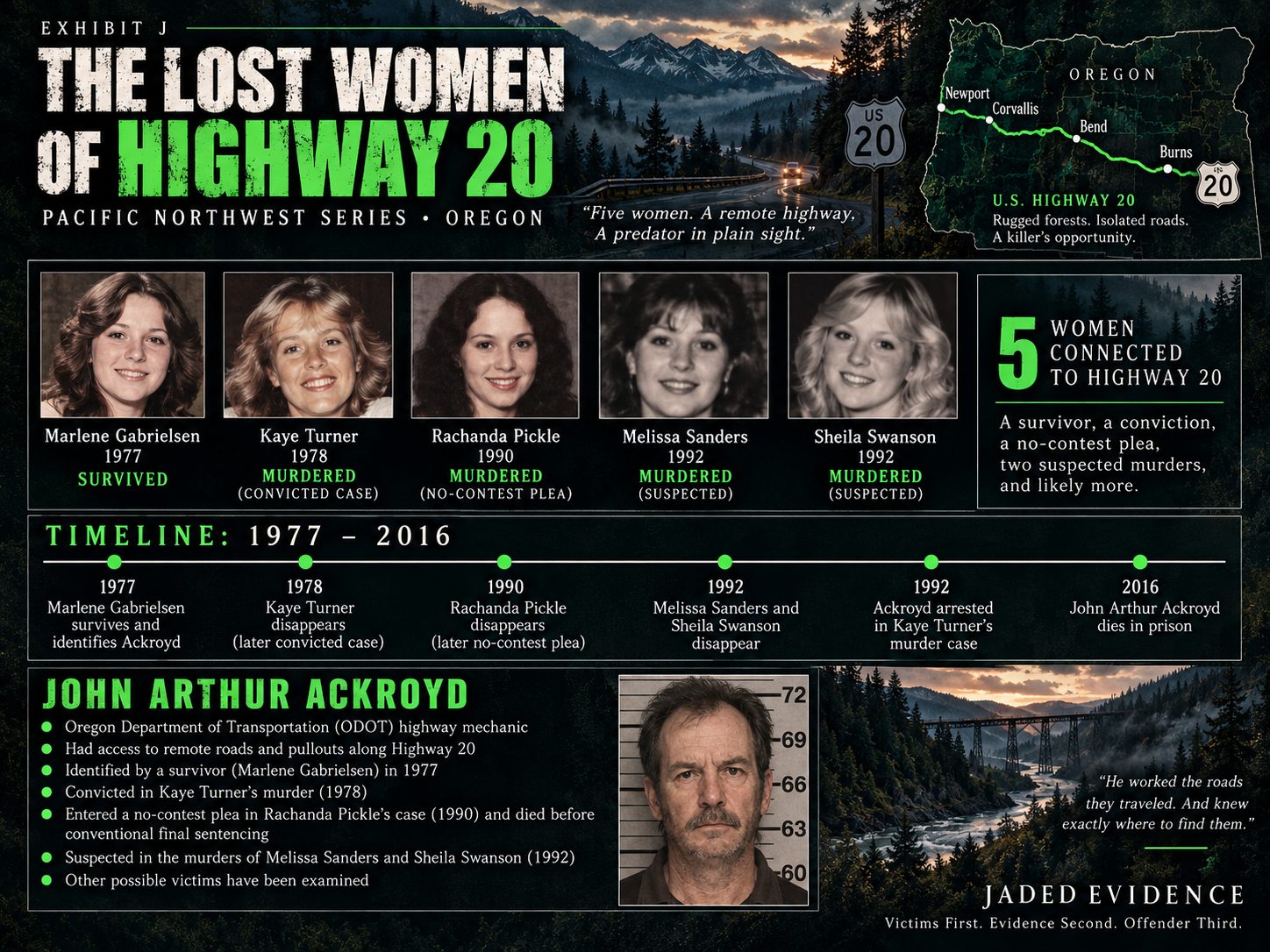
Five Women. One Highway. Decades of Warning Signs.
U.S. Highway 20 cuts across Oregon from the high desert and Cascade Mountains through the Willamette Valley to the Pacific coast. Along part of that route, beginning in the late 1970s, a series of women and girls were attacked, disappeared, or were murdered.
One man connected the cases: John Arthur Ackroyd, an Oregon Department of Transportation highway mechanic whose work placed him on remote roads, forest routes, maintenance compounds, and isolated stretches of Highway 20.
Ackroyd was ultimately convicted of murdering Kaye Turner. He later entered a no-contest plea in connection with the death of his 13-year-old stepdaughter, Rachanda Pickle. Investigators also developed a case tying him to the murders of teenagers Melissa Sanders and Sheila Swanson, but he died before that case could be presented for prosecution.
And before any of them, there was Marlene Gabrielsen—a survivor who reported Ackroyd after a 1977 sexual assault.
The central question in this story is not simply, “Who was John Ackroyd?” It is: How many opportunities were there to stop him?
The Women
Marlene Gabrielsen — 1977
Marlene Gabrielsen was 20 years old when she encountered Ackroyd near Sisters, Oregon, in 1977. She later reported that he abducted and raped her in an isolated area. She survived, escaped, and went to law enforcement.
Her account is crucial because it represents the earliest known warning in the record later reconstructed by The Oregonian/OregonLive. Gabrielsen identified Ackroyd decades before investigators recognized the broader pattern surrounding him.
The case did not result in a prosecution. Ackroyd remained free.
Kaye Turner — December 24, 1978
Kaye Jean Turner, 35, disappeared on Christmas Eve 1978 while jogging near Camp Sherman in central Oregon. She had gone out for a morning run while vacationing with her husband and friends and never returned.
Ackroyd came to investigators’ attention early. He worked in the area, knew the roads intimately, and gave shifting accounts of what he had seen that morning. Months later, he helped direct searchers toward an area where evidence connected to Turner was recovered.
The investigation stretched on for years. Eventually, investigators returned to the case, and Ackroyd was arrested in 1992. He was convicted of Turner’s murder in 1993 and sentenced to life in prison.
Another man, Roger Dale Beck, was also convicted in connection with Turner’s killing.
Rachanda Lea Pickle — July 10, 1990
Rachanda Pickle was 13 years old when she disappeared from the Oregon Department of Transportation compound at Santiam Junction, where she lived with her mother and stepfather, John Ackroyd.
Ackroyd was the last known person to see Rachanda alive.
Over time, investigators uncovered evidence that Rachanda had been sexually abused before she disappeared. Witness accounts and forensic evidence changed the character of the case from that of a missing child to a suspected homicide.
In 2013, Ackroyd was indicted for Rachanda’s murder. He entered a no-contest plea under an unusual agreement in which he promised never to pursue parole on his existing sentence. The plea proceedings were sealed. Sentencing was suspended indefinitely, and because Ackroyd died in 2016 before final disposition, the murder charge did not result in a conventional judgment of conviction.
That distinction matters. A no-contest plea is highly significant, but it is not accurate to describe the Rachanda case exactly the same way as the Turner conviction.
Rachanda’s remains have never been recovered.
Melissa Sanders and Sheila Swanson — 1992
Melissa Sanders, 17, and Sheila Swanson, 19, disappeared in May 1992 after leaving a family camping trip near the Oregon coast.
The teenagers knew Ackroyd. According to later investigative reporting, they had encountered him before, including through the social circles around Lebanon and Sweet Home.
Their bodies were found months later off a remote logging road.
Years afterward, cold-case investigators reconstructed Ackroyd’s movements, interviewed former highway workers, and located witnesses who recalled seeing him around the time of the murders with blood on his arms. Investigators developed a theory that Ackroyd encountered Melissa and Sheila after they left the campground, offered them a ride, and took them into the forest.
By 2016, investigators believed they had assembled enough evidence to present the double homicide to a grand jury.
Ackroyd died before that could happen.
Therefore, Melissa Sanders and Sheila Swanson should be described as suspected victims linked to Ackroyd—not as murders for which he was convicted.
Timeline
| Year | Victim / Event | Status |
|---|---|---|
| 1977 | Marlene Gabrielsen reports being abducted and raped by Ackroyd. | Survived; no prosecution resulted. |
| 1978 | Kaye Turner disappears while jogging near Camp Sherman. | Homicide. |
| 1990 | Rachanda Pickle, 13, disappears from Santiam Junction. | Missing; presumed homicide. |
| 1992 | Melissa Sanders and Sheila Swanson disappear after leaving a coastal camping trip. | Bodies later recovered; homicides. |
| 1992 | Ackroyd is arrested in the Kaye Turner case. | Prosecution begins. |
| 1993 | Ackroyd is convicted of murdering Kaye Turner. | Life sentence. |
| 2013 | Ackroyd is indicted in Rachanda Pickle’s murder and enters a no-contest plea. | Sentencing suspended; agreement sealed. |
| 2016 | Cold-case investigators prepare the Sanders/Swanson case for grand-jury presentation. | Ackroyd dies before prosecution. |
| 2016 | John Ackroyd dies in Oregon State Penitentiary. | Additional cases remain unresolved. |
What Authorities Knew — And When They Knew It
This is the part of the Highway 20 story that deserves as much attention as Ackroyd himself.
1977: A survivor names him.
Marlene Gabrielsen survived an assault and identified Ackroyd. The allegation did not lead to charges.
1978: A woman disappears inside his geographic world.
Kaye Turner vanished from an area Ackroyd knew through his highway work. Investigators questioned him early, and his statements would later become increasingly important.
1979 and after: The Turner investigation produces troubling clues.
Evidence emerged that kept Ackroyd in investigators’ orbit, but the case did not immediately result in an arrest.
1990: His 13-year-old stepdaughter disappears.
Rachanda vanished from the remote highway compound where Ackroyd lived and worked. He was the last known person to see her alive.
1992: Investigators are closing in on Ackroyd for Turner.
At approximately the same period that the Turner investigation was intensifying, Melissa Sanders and Sheila Swanson disappeared.
Decades later: Investigators reconstruct the pattern.
Cold-case investigators returned to old reports, tracked down former highway employees, re-interviewed witnesses, and used newer forensic and database tools. Information that had once existed in separate files began to form a coherent pattern.
The issue was not that there were no warning signs. The issue was that the warning signs were separated by time, jurisdiction, investigative priorities, and missed opportunities.
Why Ackroyd’s Job Matters
Ackroyd’s employment with the Oregon Department of Transportation was not merely biographical detail. It gave him routine access to a landscape most travelers would know only from the pavement.
He knew maintenance compounds, logging roads, forest spurs, isolated pullouts, work routes, and the terrain surrounding Highway 20. That geographic familiarity is important when evaluating both the Turner case and investigators’ later theories involving Rachanda, Melissa, and Sheila.
It also gave him a legitimate reason to be on the road at unusual times and in places where his presence might otherwise have appeared suspicious.
The Rachanda Plea: A Legal Detail Often Oversimplified
One of the most frequently misstated parts of this story concerns Rachanda Pickle.
Ackroyd was indicted for her murder and entered a no-contest plea. In exchange, he agreed not to seek parole on the Turner sentence. But sentencing on the Rachanda charge was suspended indefinitely.
When Ackroyd died, the case had never reached the ordinary final judgment that follows plea and sentencing.
That is why responsible coverage should say:
Ackroyd entered a no-contest plea to Rachanda Pickle’s murder and agreed never to seek release, but he died before the case reached a conventional final judgment and sentencing.
It is a less dramatic sentence than simply saying “he was convicted,” but it is more legally accurate.
Confirmed, Pleaded, and Suspected
| Woman | Connection to Ackroyd |
|---|---|
| Marlene Gabrielsen | Survivor who identified Ackroyd as her attacker. |
| Kaye Turner | Convicted murder. |
| Rachanda Pickle | No-contest plea to murder; no conventional final sentencing before Ackroyd’s death. |
| Melissa Sanders | Suspected homicide link. Investigators prepared a case but no prosecution occurred. |
| Sheila Swanson | Suspected homicide link. Investigators prepared a case but no prosecution occurred. |
Were There More Victims?
Possibly.
Investigators and journalists examined other disappearances and deaths for potential connections to Ackroyd. Similar geography, victim profiles, timing, and his ability to travel throughout the region naturally raised questions.
But similarity is not proof.
For Jaded Evidence, those cases belong in a separate section labeled Possible or Investigated Connections. They should not be folded into Ackroyd’s established victim count unless documentary evidence supports the connection.
The Investigation Behind “Ghosts of Highway 20”
Much of what is now publicly known about these cases was reconstructed by The Oregonian/OregonLive in its 2018 multimedia investigation Ghosts of Highway 20, reported by Noelle Crombie with photography by Beth Nakamura and video by Dave Killen.
The project reviewed police files, court records, witness interviews, and previously overlooked evidence to reconstruct the crimes and the failures surrounding them.
The reporting later inspired the three-part Investigation Discovery/Max documentary Lost Women of Highway 20, narrated by Octavia Spencer.
But the most important contribution of the reporting was not turning Ackroyd into another notorious killer. It was restoring the women to the center of the story.
Exhibit J: The Question That Remains
Marlene Gabrielsen survived.
She reported what happened.
She identified the man she said attacked her.
One year later, Kaye Turner was murdered.
Twelve years after that, Rachanda Pickle disappeared.
Two years later, Melissa Sanders and Sheila Swanson were killed.
When a later investigation finally placed these events side by side, the pattern looked very different than any one case had looked on its own.
That is the enduring lesson of Highway 20: evidence does not always fail because it is absent. Sometimes it fails because no one puts all of it on the same table soon enough.
Sources & Further Reading
- The Oregonian/OregonLive — Ghosts of Highway 20: Marlene
- The Oregonian/OregonLive — Ghosts of Highway 20: Rachanda
- The Oregonian/OregonLive — Ghosts of Highway 20: Melissa & Sheila
- The Oregonian/OregonLive — Ghosts of Highway 20: Ackroyd
- The Charley Project — Rachanda Lea Pickle
Jaded Evidence distinguishes allegations, investigative theories, pleas, and convictions. Where no conviction occurred, that distinction is stated explicitly.
Leave a Reply