CONTENT NOTE: This article discusses homicide, attempted murder, threats, and crimes against young adults. Jaded Evidence distinguishes confirmed attacks, self-attributed claims, suspected links, and unsupported theories.
Facts over speculation. Follow the evidence.
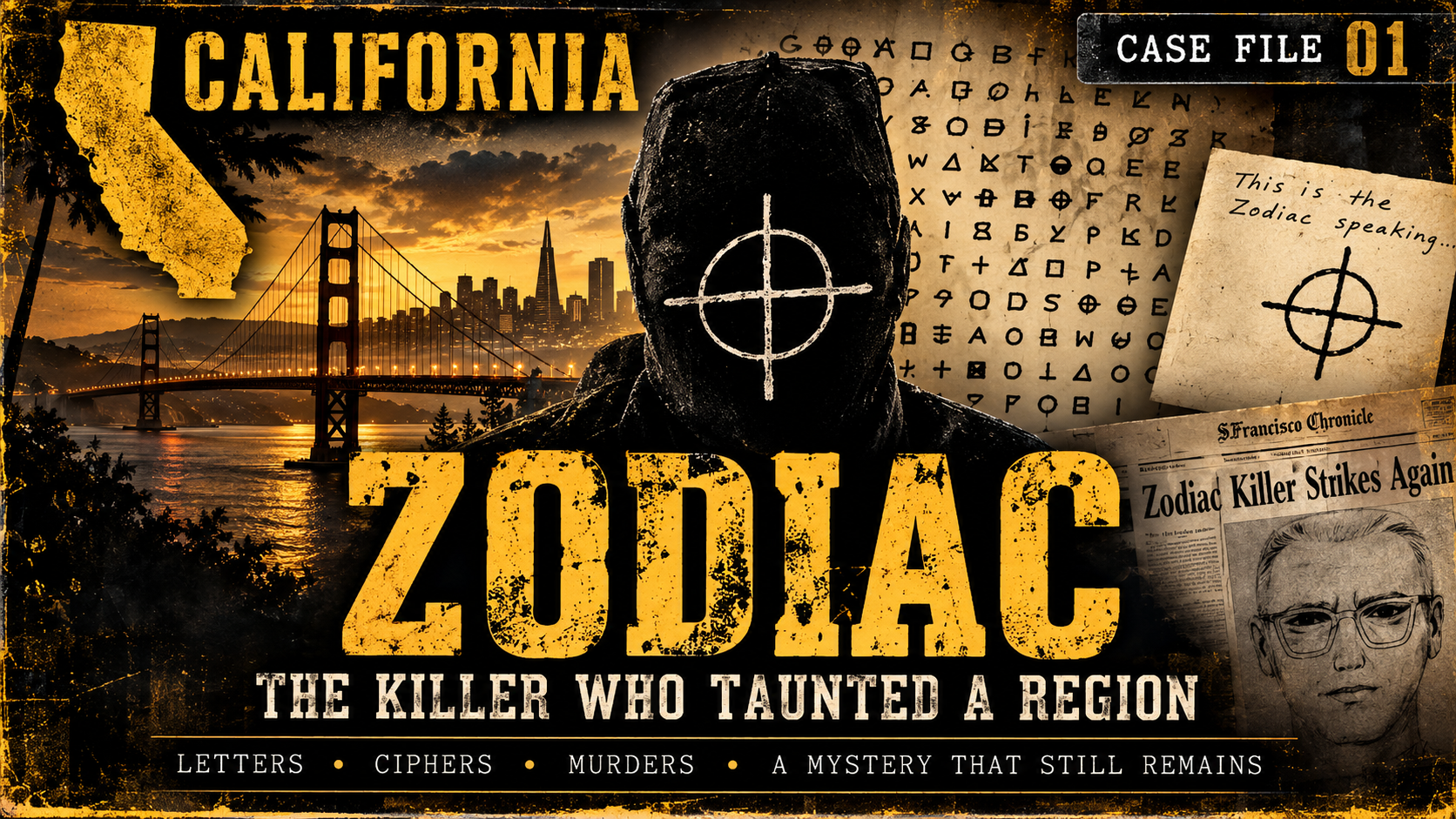
One of America’s Most Famous Unsolved Serial-Murder Cases
The Zodiac case is often remembered through a symbol, coded letters, and decades of suspect theories. But before the mythology came the victims.
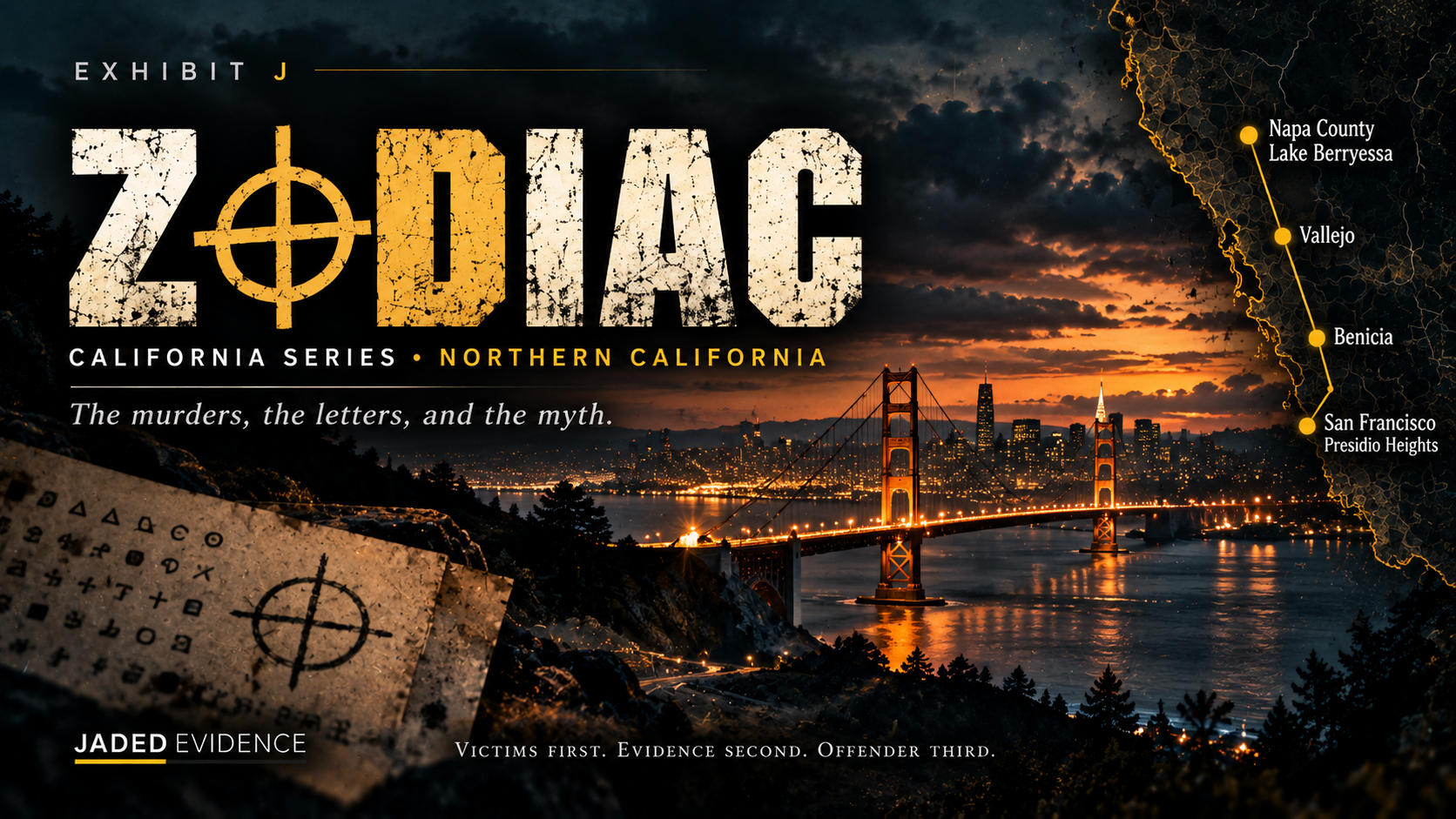
The strongest evidence centers on four attacks in Northern California between December 1968 and October 1969. Five people were killed and two survived. The person calling himself “Zodiac” later sent letters and ciphers to newspapers, sometimes including information that investigators believed demonstrated knowledge of the crimes.
The identity of the killer has never been judicially established.
The Canonical Attacks
Lake Herman Road — December 20, 1968
David Faraday, 17, and Betty Lou Jensen, 16, were attacked while parked on Lake Herman Road near Benicia, California. Both were killed.
Blue Rock Springs — July 4, 1969
Darlene Ferrin, 22, and Michael Mageau, 19, were shot while sitting in a vehicle at Blue Rock Springs Park in Vallejo. Ferrin died. Mageau survived.
Shortly afterward, a man called police and claimed responsibility for the attack and for the Lake Herman Road murders.
Lake Berryessa — September 27, 1969
Bryan Hartnell, 20, and Cecelia Shepard, 22, were attacked near Lake Berryessa by a man wearing a hooded costume marked with the now-famous cross-circle symbol.
Hartnell survived. Shepard died from her injuries two days later.
Presidio Heights — October 11, 1969
San Francisco taxi driver Paul Stine, 29, was shot and killed in his cab in the Presidio Heights neighborhood.
The killer later mailed a piece of Stine’s bloodstained shirt with a letter, providing some of the strongest physical corroboration that the letter writer had direct involvement in the murder.
The Letters Begin
In 1969, newspapers in Northern California began receiving letters from a writer claiming responsibility for the murders. The letters demanded publication and included cryptograms.
The writer adopted the name “Zodiac” and the cross-circle symbol that became synonymous with the case.
The correspondence transformed the investigation. Police were no longer dealing only with crime scenes and witnesses. They were also dealing with an offender who was deliberately attempting to control public attention.
The Ciphers
The Zodiac letters included several coded messages.
The 408-symbol cipher was solved in 1969 by Donald and Bettye Harden. Another cipher, known as the Z340, remained unsolved for more than 50 years before an international team announced a solution in 2020.
Other short Zodiac ciphers remain disputed or unsolved.
A solved cipher does not necessarily identify the killer. The Z340 solution reinforced themes already present in the letters but did not reveal a verified name.
What the FBI Files Show
FBI records document substantial federal forensic assistance to local agencies, including handwriting examinations, fingerprint comparisons, document analysis, and evaluation of letters and other evidence.
Contemporaneous FBI correspondence also reflects an important jurisdictional point: the murders themselves were primarily local crimes, so the FBI’s role was generally supportive rather than that of the lead homicide agency.
Federal files from the period describe the writer known as Zodiac as a suspect in multiple unsolved California murders and note that some letters contained details investigators believed were not known to the general public.
Confirmed Does Not Mean Everything Zodiac Claimed
The Zodiac writer claimed responsibility for more crimes than investigators could conclusively link to the canonical series.
| Category | How Jaded Evidence Treats It |
|---|---|
| Canonical attacks | Lake Herman Road, Blue Rock Springs, Lake Berryessa, and Paul Stine’s murder. |
| Self-attributed claims | Crimes the letter writer claimed without enough independent evidence to establish responsibility. |
| Investigated possible connections | Cases examined by law enforcement because of timing, geography, similarities, or correspondence. |
| Popular suspect theories | Claims circulated by books, documentaries, online communities, or private groups that have not been proven in court. |
Cheri Jo Bates — Riverside, 1966
The 1966 murder of Cheri Jo Bates in Riverside, California, has long been discussed as a possible Zodiac connection.
Historical FBI records show that law enforcement considered Riverside in relation to the broader Zodiac investigation. But inclusion in investigative correspondence is not the same as proving the Zodiac killer murdered Bates.
Her case should therefore remain in the possible / investigated connection category unless stronger evidence establishes otherwise.
The Kathleen Johns Incident
Kathleen Johns reported that she and her infant daughter were picked up by a man in 1970 after her vehicle was disabled near Modesto.
She later associated the man with a Zodiac wanted poster.
The Zodiac writer subsequently referenced the incident in a letter, but the degree of connection remains debated. It belongs in the category of claimed or investigated links rather than the canonical victim list.
The Suspect Problem
Over the decades, dozens of men have been publicly proposed as the Zodiac killer.
Arthur Leigh Allen became the most famous suspect. Investigators examined him extensively, and his name has dominated books, films, and documentaries.
But being the best-known suspect is not the same as being identified as the killer.
Other men have been proposed by retired investigators, authors, family members, private groups, and online researchers. Those theories vary dramatically in evidentiary quality.
Jaded Evidence will not label any person the Zodiac killer unless law enforcement or a court establishes that identification.
The Media Was Part of the Crime Strategy
The Zodiac writer understood publicity.
He threatened additional violence, demanded that his communications be printed, mocked investigators, and built a public persona around a symbol and coded messages.
That strategy helped create a paradox: the offender became internationally famous while the victims were increasingly reduced to names in a timeline.
This series deliberately reverses that emphasis.
What Authorities Knew — And When
December 1968
David Faraday and Betty Lou Jensen are killed on Lake Herman Road.
July 1969
Darlene Ferrin is killed and Michael Mageau survives Blue Rock Springs. A caller claims responsibility for that attack and the Lake Herman Road murders.
Summer 1969
Newspapers receive letters and ciphers from a writer claiming responsibility. The “Zodiac” identity emerges publicly.
September 1969
Bryan Hartnell and Cecelia Shepard are attacked at Lake Berryessa. The attacker uses the cross-circle symbol.
October 1969
Paul Stine is murdered in San Francisco. A piece of his shirt is later mailed with a Zodiac letter.
1970s
Additional letters, claims, suspect investigations, handwriting examinations, and forensic comparisons expand the case while failing to produce a definitive identification.
2020
The Z340 cipher is publicly solved after more than five decades, but the solution does not identify the killer.
The Evidence Versus the Myth
The Zodiac case accumulated layers of folklore because the offender was never caught.
Every unsolved case invites speculation, but Zodiac has produced an unusually large ecosystem of competing suspects, code interpretations, handwriting theories, photographic comparisons, and retrospective claims.
For Jaded Evidence, every claim gets placed into one of four boxes:
- documented fact,
- supported investigative theory,
- unproven allegation, or
- unsupported speculation.
That is especially important here because a compelling theory can still be wrong.
Jaded Evidence: What This Case Is Really About
The Zodiac case is not simply a puzzle waiting for someone clever enough to solve it.
It is a homicide investigation involving real victims, surviving witnesses, physical evidence, questioned documents, multiple jurisdictions, evolving forensic techniques, and a suspect who deliberately used the press as part of his crime strategy.
The mystery is compelling.
But the mystery should never become more important than the people who were attacked.
Primary Source Archive
Jaded Evidence distinguishes confirmed attacks, offender claims, investigative links, and public suspect theories. No individual is identified here as the Zodiac killer because the offender’s identity has not been established in court.
Leave a Reply