

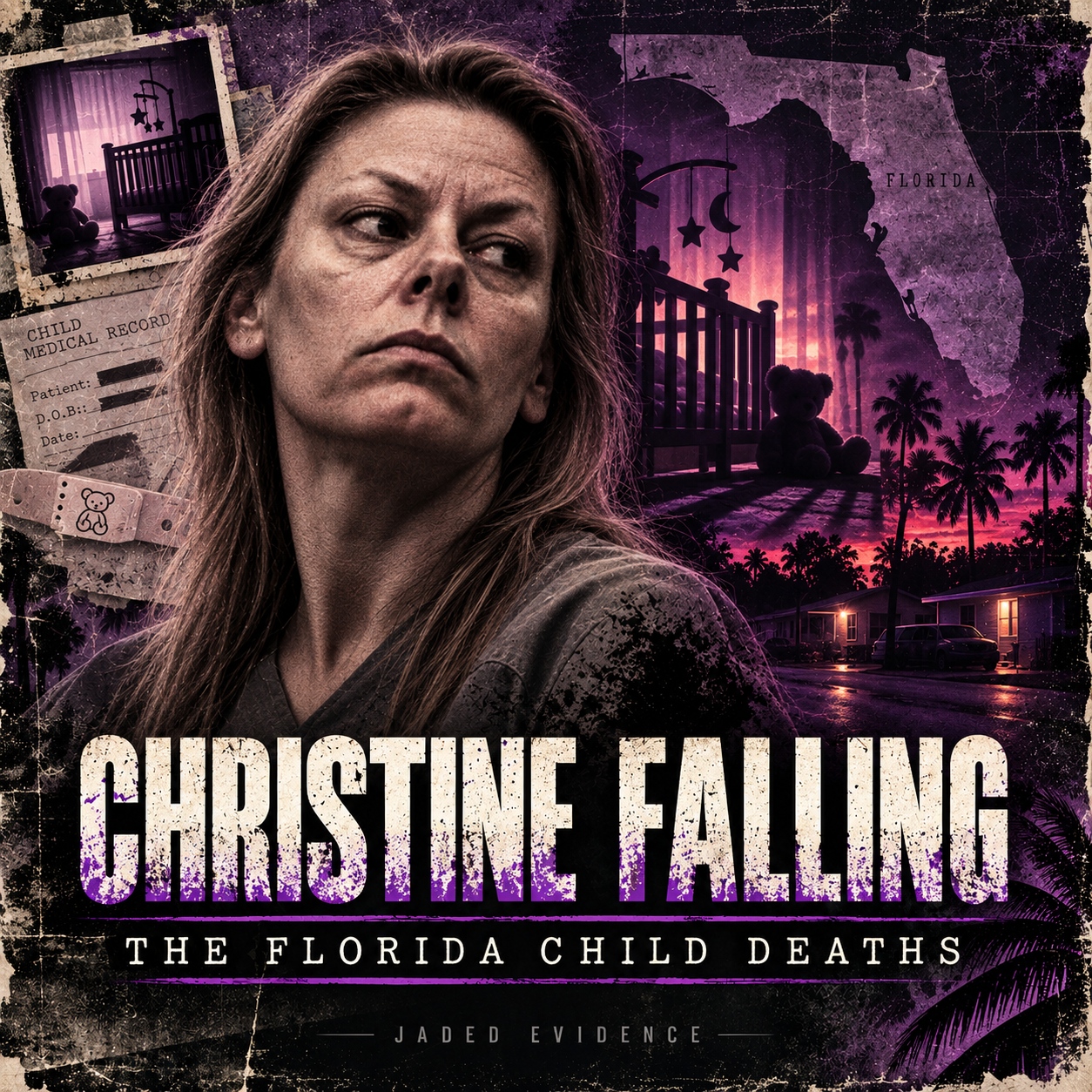

REGION: Southeast — Florida
CONTENT NOTE: This article discusses child homicide, suffocation, caregiver access, and historical forensic investigation.
Victims first. Evidence second. Offender third.
Case Overview
Christine Falling was convicted in Florida after a series of child deaths involving children in her care during the early 1980s.
Caregiver Access
The investigation focused on the repeated presence of Falling during sudden pediatric deaths that had initially appeared unrelated or medically unexplained.
Confession and Plea
Falling ultimately confessed to multiple killings and received a life sentence.
Why This Case Matters
The Falling case highlights the difficulty of recognizing serial homicide when victims are very young and deaths initially resemble natural or unexplained medical events.
Known Victims
Falling pleaded guilty to three child murders:
- Cassidy “Muffin” Johnson
- Jennifer Daniels
- Travis DeWayne Coleman
She was also investigated in the deaths of Jeffrey Michael Davis and Joseph Spring, both children who died while in her care, and in the death of elderly Wilbur G. Swindle. Those cases did not result in separate murder convictions and should remain clearly labeled as suspected/attributed.
Investigation Highlights
- Several deaths had initially been classified as medical events or unexplained pediatric deaths.
- The repeated circumstance—children dying while in the same caregiver’s custody—eventually became the linkage investigators focused on.
- After the 1982 death of Travis Coleman, law enforcement and medical scrutiny intensified and earlier cases were reexamined.
- Falling ultimately entered guilty pleas to three strangulation/suffocation murders and received concurrent life sentences.
Psychiatric and Psychological Record
Contemporary reporting states that Falling spent approximately a week in a psychiatric unit before her arrest. Later accounts have described statements about hearing voices. Those reports do not, by themselves, establish a court-adopted psychotic disorder or insanity finding. No single formal psychiatric diagnosis should be presented as proven unless supported by the underlying evaluation.
Modus Operandi vs. Signature
Modus operandi: Caregiver access to very young victims and suffocation/strangulation in circumstances that could initially resemble sudden natural death.
Signature: There is no well-established ritualistic signature in the public record. The repeated caregiver setting and suffocation method are linkage features and MO, not necessarily psychological signature behaviors.
Leave a Reply