

REGION: Southeast — Florida / Texas and multiple states
CONTENT NOTE: This article discusses homicide, child murder, sexual violence, false or disputed confessions, and multi-state investigations.
EVIDENTIARY NOTE: Many crimes claimed by Henry Lee Lucas and Ottis Toole were never proven and some confessions were later discredited.
Claims are not convictions. Confessions are not automatically facts.
Case Overview
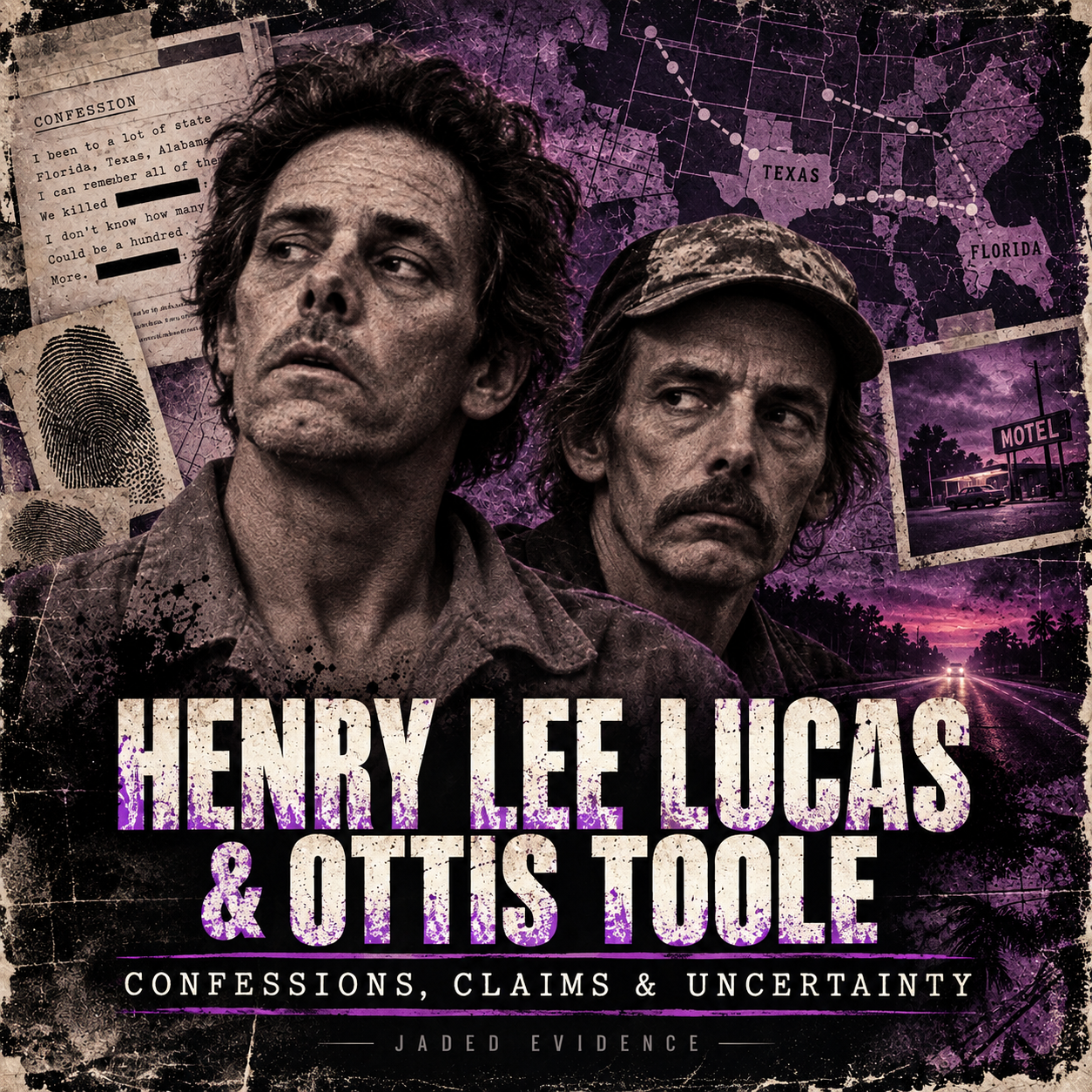
Henry Lee Lucas and Ottis Toole became associated with an extraordinary number of murder claims across the United States. Their admissions generated intense law-enforcement attention but also major controversy over false confession, case clearance practices, and evidentiary verification.
Florida Connection
Ottis Toole was a Florida offender and has long been associated with the 1981 abduction and murder of Adam Walsh, although no criminal trial established his guilt in that case.
The Confession Problem
Lucas confessed to hundreds of murders, but many claims were later contradicted by travel records, physical evidence, or case facts.
Why This Case Matters
This case is one of the clearest examples of why confession evidence must be independently corroborated and why institutional incentives to clear unsolved cases can distort an investigation.
Legally Established and Disputed Victims
Henry Lee Lucas: Legally established cases include the murder of his mother, Viola Lucas, and Texas convictions involving Frieda “Becky” Powell and Kate Rich. Lucas was also convicted in the “Orange Socks” case, but that conviction became deeply controversial after evidence showed that many of his confessions were impossible or contradicted by travel records; his death sentence was later commuted.
Ottis Toole: Toole was convicted in Florida in the arson murder of George Sonnenberg and in other violent offenses. Hollywood police formally closed the 1981 Adam Walsh case in 2008 by naming Toole as the killer, but Toole was never tried or convicted for Adam’s murder, and the evidentiary limitations must remain explicit.
Investigation Highlights
- Lucas and Toole gave an extraordinary volume of confessions to law-enforcement agencies around the country.
- Investigators later found that many Lucas confessions were contradicted by work records, travel records, geography, or facts showing he could not have been at the crime scene.
- The Texas “Lucas Task Force” became a major example of how case-clearance incentives and information leakage can contaminate confession evidence.
- The Lucas episode changed how many investigators and forensic psychologists think about corroboration, false confession, and offender-generated case inflation.
Psychiatric and Psychological Record
Texas court records document expert testimony that Lucas had an IQ in the low-average range and was diagnosed by one psychologist with chronic residual schizophrenia and an underlying schizotypal personality disorder. Other experts described psychosis and longstanding mental illness.
Florida court records concerning Toole describe borderline intellectual functioning, severe impulsivity, personality disorder, pyromania, and evidence relevant to extreme mental or emotional disturbance. These diagnoses do not validate any particular confession.
Modus Operandi vs. Signature
Critical caution: Because so many claimed murders were never corroborated, it is methodologically unsound to create a single “Lucas/Toole signature” from the confession catalogue.
Lucas’s legally established killings did not demonstrate one distinctive ritual across cases. Toole had a documented pattern of arson and impulsive violence, but even that should not be generalized to every murder he claimed. In this case, the most important forensic lesson is that confession consistency is not the same thing as behavioral linkage.
Leave a Reply