


CONTENT NOTE: This article discusses homicide, sexual violence, attempted murder, and the targeting of vulnerable women and girls. Jaded Evidence centers victims and survivors and distinguishes convictions, additional prosecutorial allegations, and unresolved questions.
Facts over speculation. Follow the evidence.
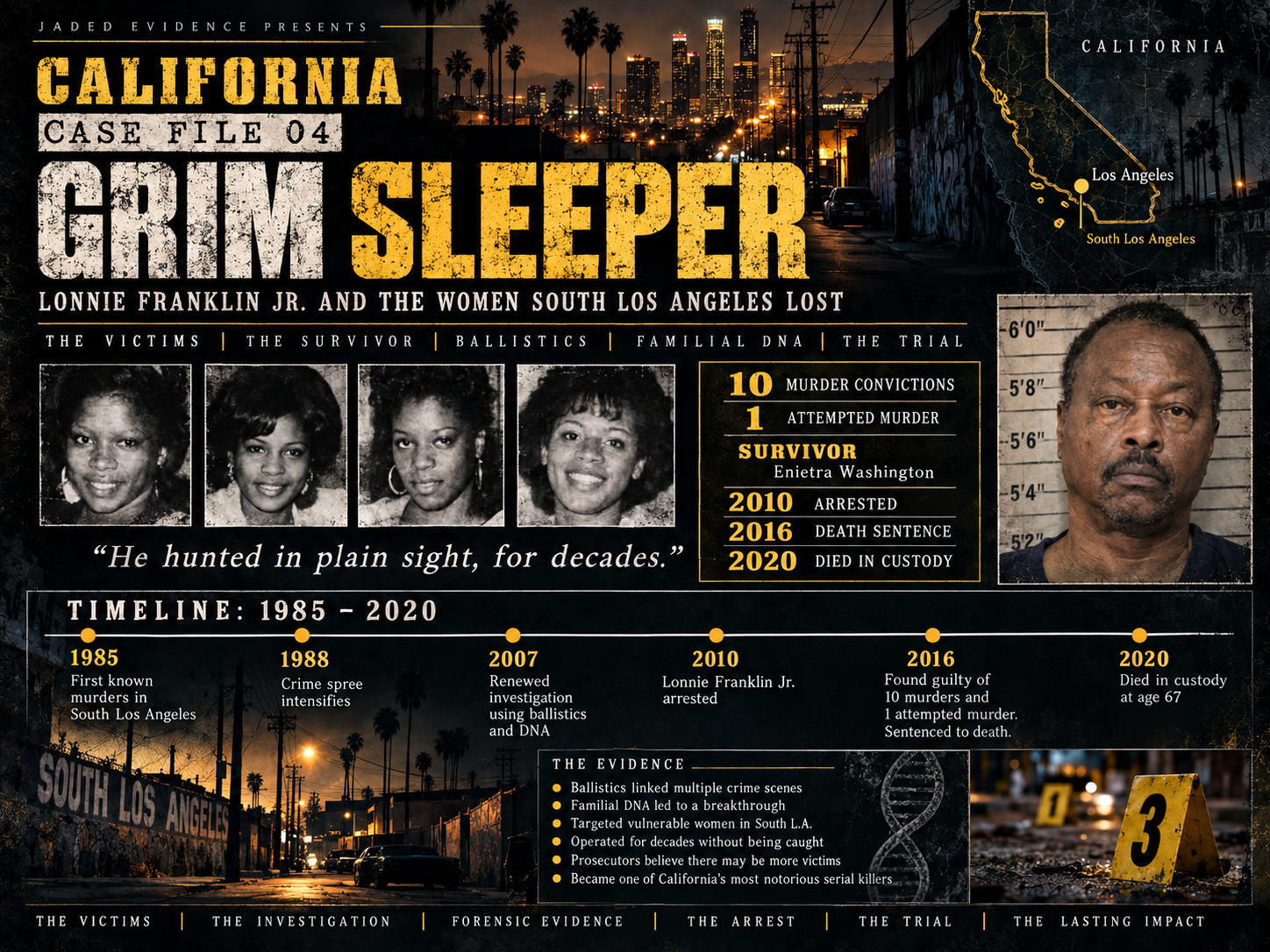
The Women South Los Angeles Lost
The case eventually known as the Grim Sleeper stretched across more than two decades in South Los Angeles.
Lonnie David Franklin Jr., a former city sanitation worker, was convicted in 2016 of murdering nine women and one teenage girl between 1985 and 2007. He was also convicted of the attempted murder of Enietra Washington, who survived being shot and thrown from his car in 1988.
The victims ranged in age from 15 to 35.
The “Sleeper” Label
Franklin was dubbed the “Grim Sleeper” because investigators initially believed there was a long pause in the killings between 1988 and 2002.
That label should be treated carefully.
An apparent gap in known murders does not prove an offender actually stopped killing. It may instead reflect undiscovered victims, crimes committed elsewhere, incomplete linkage, or a genuine period of inactivity.
The Victims
The 10 murder convictions involved young women and girls whose bodies were recovered in alleys, trash bins, bushes, and other locations around South Los Angeles.
The prosecution emphasized that Franklin targeted women from communities already facing poverty, addiction, unstable housing, and institutional neglect.
Those circumstances made some victims easier for an offender to approach and easier for society to overlook.
That distinction matters: vulnerability is not the same as disposability.
Enietra Washington — The Survivor
Enietra Washington survived an attack on November 19, 1988.
She testified that she accepted a ride from Franklin, was shot, and was then thrown from his vehicle.
Her survival gave investigators a living witness to the offender’s behavior and later became a critical part of the prosecution.
The Ballistics Pattern
Firearms evidence was one of the major links across the murder series.
At trial, prosecutors presented evidence that bullets recovered from multiple victims were fired from the same .25-caliber firearm.
The Los Angeles County District Attorney later summarized the case as one in which the victims were connected to the same offender through DNA evidence, firearms evidence, or both.
The DNA Breakthrough
The case became historically important because of familial DNA searching.
Investigators did not initially obtain a direct database match to Franklin.
Instead, a specialized search of California’s criminal-offender DNA database identified a partial familial relationship to DNA from Franklin’s son, who had been convicted of a felony weapons offense.
That lead pointed investigators toward Lonnie Franklin Jr.
Police then placed him under surveillance and collected discarded material containing his saliva—reported by prosecutors as DNA recovered from discarded pizza crust.
The resulting comparison matched crime-scene evidence and transformed a decades-old serial case into a prosecutable case against a named defendant.
Why Familial DNA Is Different From Genetic Genealogy
The Franklin investigation is often confused with the later Golden State Killer genealogy case, but the techniques are not identical.
Familial DNA searching uses a law-enforcement offender database to look for close genetic relatives of an unknown crime-scene profile.
Investigative genetic genealogy uses genealogy-style relationship matching and family-tree reconstruction, usually through databases that operate differently from CODIS-style criminal databases.
Both can identify relatives rather than the offender directly, but the investigative pathways are different.
Arrest — July 7, 2010
Franklin was arrested on July 7, 2010, after the DNA investigation narrowed to him.
The arrest ended a homicide investigation that had spanned decades and highlighted how forensic technology can reveal connections that older investigative methods could not resolve.
The Trial
Franklin went to trial in Los Angeles County in 2016.
Prosecutors relied heavily on DNA, firearms evidence, survivor testimony, and evidence connecting Franklin to the victims.
The defense challenged the reliability and interpretation of some DNA and ballistics evidence and argued that unidentified DNA from other people appeared in some case evidence.
After approximately a day and a half of deliberations, the jury convicted Franklin of all 10 first-degree murders and the attempted murder of Enietra Washington.
Additional Murder Evidence
During the penalty phase, prosecutors introduced evidence they said linked Franklin to four additional murders committed between 1984 and 2006.
Those cases were not part of the 10 murder convictions and therefore should not simply be added to his judicially established victim count.
For Jaded Evidence, they belong in a separate category: additional murders alleged and supported by prosecutors during sentencing, but not separately adjudicated as murder convictions in that trial.
The 2016 Death Sentence
On August 10, 2016, Franklin was sentenced to death after family members of victims addressed the court.
He was transferred to California’s death row later that month.
Death in Custody
Franklin died at San Quentin State Prison on March 28, 2020.
The California Department of Corrections and Rehabilitation later listed his death as due to natural causes.
Confirmed Versus Additional Allegations
| Category | Status |
|---|---|
| 10 murder convictions | Nine women and one teenage girl, proven in the 2016 trial. |
| 1 attempted-murder conviction | Enietra Washington, who survived the 1988 attack. |
| 4 additional murders presented at penalty phase | Evidence introduced by prosecutors during sentencing; not part of the 10 murder convictions. |
| Other suspected connections | Should be evaluated separately and not added to the confirmed victim count without sufficient evidence. |
What Authorities Knew — And When
1985–1988
Women are killed in South Los Angeles, with recurring firearms and victim-pattern evidence beginning to emerge.
November 1988
Enietra Washington survives being shot and provides investigators with a living account of the offender.
1990s–2000s
The case remains unresolved while additional victims are discovered and older crimes are re-examined.
2007
The last murder included in the eventual prosecution occurs.
2009–2010
A familial DNA search identifies a genetic relationship to Franklin’s son. Investigators narrow the lead to Franklin and obtain discarded DNA for comparison.
July 7, 2010
Franklin is arrested.
May 5, 2016
A jury convicts him of 10 murders and one attempted murder.
August 10, 2016
Franklin is sentenced to death.
March 28, 2020
Franklin dies in custody at San Quentin.
The Institutional Blind-Spot Question
The Grim Sleeper case also forces a larger question:
How quickly does a serial-homicide pattern become visible when many victims are poor, Black, involved in sex work, struggling with addiction, or otherwise marginalized?
Families and community advocates repeatedly argued that the victims did not receive the urgency or public attention afforded to other missing and murdered women.
That issue belongs at the center of this case—not as an afterthought.
The Forensic Lesson
The Franklin investigation is a major milestone in forensic DNA history.
The Los Angeles County District Attorney described the case as the nation’s first serial-killer case solved through a specialized familial search of a criminal-offender DNA database.
The science did not independently prove every element of the case.
It created the lead that allowed investigators to identify a suspect, obtain direct DNA, compare evidence, reconstruct the case, and present the totality of that evidence to a jury.
Jaded Evidence: Why the Grim Sleeper Case Matters
This is not simply another story about a prolific serial killer.
It is about women who were repeatedly described by what made them vulnerable rather than by who they were.
It is about a survivor whose testimony mattered.
It is about DNA science catching up with decades-old evidence.
And it is about the uncomfortable question of whether the investigation would have unfolded differently if the victims had come from communities with greater social power.
The forensic breakthrough identified Franklin. The larger case asks why it took so long for the women to receive the attention their deaths demanded.
Sources & Further Reading
- Los Angeles County District Attorney — Grim Sleeper Convicted of 10 Murders, One Attempted Murder
- Los Angeles County District Attorney — Grim Sleeper Sentenced to Death
- California Department of Corrections and Rehabilitation — Lonnie Franklin Dies
Jaded Evidence distinguishes convictions, penalty-phase evidence, suspected links, and unresolved cases. Victim counts are not expanded simply because a case resembles the known series.
Leave a Reply