

CONTENT NOTE: This article discusses kidnapping, sexual violence, homicide, missing persons, and crimes against adults and young people. Jaded Evidence distinguishes confirmed victims, admissions, investigative beliefs, and unresolved cases.
Facts over speculation. Follow the evidence.
A Serial Killer Whose Geography Was Part of the Method
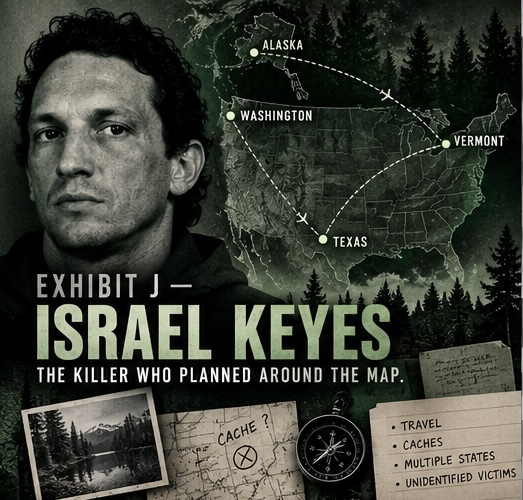
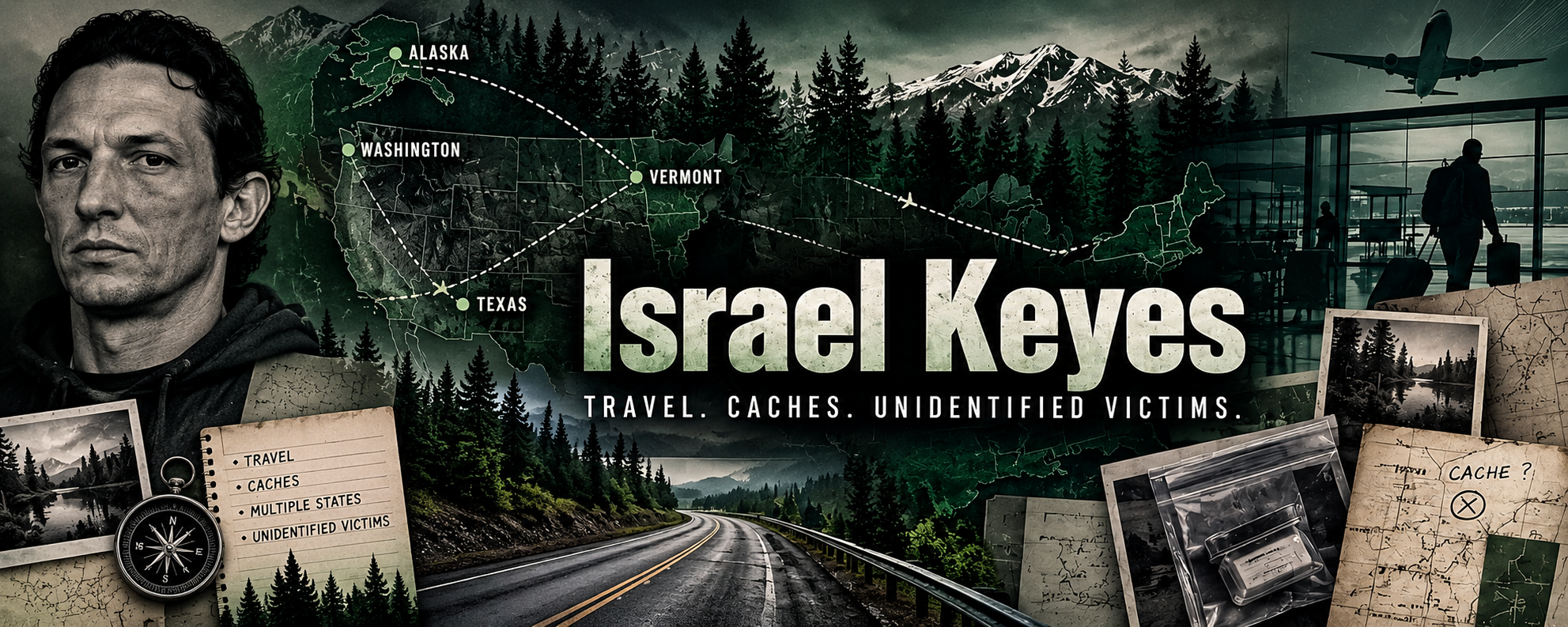
Israel Keyes does not fit neatly into one region. He lived for years in Washington, later moved to Alaska, traveled extensively across the United States, and deliberately used distance, rental cars, cash, and pre-positioned supplies to separate himself from the crimes he planned.
That makes him a natural bridge between the Pacific Northwest series and the broader national map.
The FBI has said Keyes committed kidnappings and murders between 2001 and March 2012 and later sought the public’s help reconstructing his travel history to identify additional victims. After his arrest for the 2012 abduction and murder of Samantha Koenig in Anchorage, investigators learned that Keyes had committed additional killings and had planned crimes across multiple states.
The Three Victims Publicly Identified by Investigators
Bill and Lorraine Currier — Essex, Vermont — June 2011
Bill and Lorraine Currier were a married couple living in Essex, Vermont. According to investigators, Keyes flew from Alaska to Chicago, rented a car, drove roughly 1,000 miles to Vermont, and selected the Curriers as victims.
The FBI has emphasized that Keyes chose them at random. Their bodies have never been recovered.
The Currier case is central to understanding how Keyes operated because it demonstrates the distance he was willing to travel and the extent to which he attempted to disconnect his identity, vehicle, residence, and immediate travel history from a crime scene.
Samantha Koenig — Anchorage, Alaska — February 2012
Samantha Koenig was 18 when she was abducted from the Common Grounds coffee stand in Anchorage on February 1, 2012.
Investigators later alleged that Keyes confined and killed her shortly afterward. He then left Alaska, traveled through the southern United States, and used her debit card during that trip.
Those ATM withdrawals became one of the most important investigative mistakes Keyes made. The transactions generated a trail that helped law enforcement track him.
He was arrested in Lufkin, Texas, on March 13, 2012.
The Arrest That Opened a Much Larger Case
After Keyes was arrested for Samantha Koenig’s murder, investigators began interviewing him about other crimes.
He admitted responsibility for the Currier murders and discussed additional victims whose identities he often refused to provide.
The FBI later stated that Keyes discussed “seven or eight other victims” beyond Koenig and the Curriers. In another FBI account, investigators said they believed he committed approximately 11 homicides across the United States between 2001 and 2012.
Those figures should not be treated as a judicially proven victim count. Keyes died before most of those cases could be fully resolved.
Washington State Matters
Keyes lived in Washington State for years before moving to Alaska, and investigators have examined multiple missing-person and homicide cases in the Pacific Northwest for possible connections.
According to the FBI, Keyes told investigators about a couple in Washington State, another possible victim in the area, and potentially additional crimes in surrounding states.
Those statements are investigative leads—not convictions.
For Jaded Evidence, Washington-linked cases should remain clearly separated into:
- cases Keyes specifically discussed,
- cases law enforcement investigated for possible connection, and
- internet theories that lack sufficient evidentiary support.
The Murder Kits
One of the most unusual features of the Keyes investigation was his use of hidden caches—sometimes described as “murder kits.”
According to the FBI, Keyes buried or concealed containers containing weapons, tools, ammunition, money, and other supplies in different parts of the country.
The purpose was operational separation.
By placing supplies in advance, Keyes could travel without carrying obvious weapons or tools through airports and could avoid leaving a straightforward purchase trail immediately before a crime.
The caches also show why the Keyes case cannot be understood simply by mapping where he lived. Investigators had to reconstruct where he traveled, where he rented vehicles, where he stayed, and where he may have staged equipment years earlier.
Travel as Evidence
The FBI released a detailed timeline of Keyes’s known movements because investigators believed travel reconstruction could identify additional victims.
Examples include:
- Flights between Alaska and the lower 48.
- Rental cars driven hundreds or thousands of miles beyond the airport where they were obtained.
- Hotel stays that placed him near areas of interest.
- Bank robberies used to fund travel and criminal activity.
- Road trips that crossed several states before and after known crimes.
This makes Keyes a useful example of why geographic profiling can become much more complicated when the offender deliberately creates false distance between his residence and the crime.
The 2009 Upstate New York Lead
The FBI has stated that investigators believe Keyes killed and buried a victim in upstate New York in April 2009.
That victim has not been publicly identified.
The statement is significant because it demonstrates that the unresolved portion of Keyes’s case is not simply speculative folklore. Federal investigators publicly identified specific geographic and temporal leads they believed could correspond to unknown victims.
The Investigation Was a Negotiation
Keyes’s jail interviews were not ordinary confessions.
Investigators described him as highly controlling about what information he would provide. He wanted to limit public disclosure and avoid multiple prosecutions in different jurisdictions. According to the FBI, he wanted the death penalty quickly rather than spending years moving through multiple trials.
That dynamic meant investigators were attempting to extract information about unknown victims from someone who was deliberately rationing what he revealed.
December 2, 2012
Keyes died by suicide in his Anchorage jail cell on December 2, 2012.
His death ended the possibility of future prosecution and cut off the primary source of information about his unidentified victims.
The FBI later released portions of his interviews, writings, travel history, vehicle rentals, and other investigative information in hopes that the public might recognize a connection to an unresolved disappearance.
Confirmed, Admitted, and Unresolved
| Category | Status |
|---|---|
| Samantha Koenig | Keyes was federally charged in connection with her kidnapping and murder; he admitted responsibility. |
| Bill and Lorraine Currier | Keyes admitted killing them; their bodies have never been recovered. |
| Additional victims | Keyes discussed multiple additional homicides, but most identities remain unresolved. |
| Washington-linked cases | Investigative leads exist, but responsibility must not be assumed without evidence. |
| Upstate New York, 2009 | The FBI publicly stated investigators believe Keyes killed and buried an unidentified victim there. |
What Authorities Knew — And When
Before 2012
Keyes traveled extensively, committed robberies and other crimes, and later admitted to multiple killings. The crimes were not recognized as one national serial pattern while they were occurring.
February 1, 2012
Samantha Koenig is abducted from her workplace in Anchorage.
February–March 2012
Keyes travels through the United States and uses Koenig’s debit card at multiple ATMs, creating an investigative trail.
March 13, 2012
Keyes is arrested in Lufkin, Texas.
Spring–Fall 2012
Interviews reveal responsibility for the Currier murders and clues suggesting numerous additional victims.
December 2, 2012
Keyes dies in custody before investigators can identify most of the victims he discussed.
2013 and after
The FBI releases travel timelines, interviews, vehicle information, and other case material to generate new leads in unresolved disappearances and homicides.
The “Mastermind” Problem
Keyes is frequently portrayed as uniquely sophisticated because he traveled long distances, used cash, rented vehicles, and hid supplies.
Those behaviors did make detection more difficult.
But the evidence also shows that he made consequential mistakes. Most importantly, he used Samantha Koenig’s debit card repeatedly after her murder. That behavior helped investigators track him across the country and ultimately arrest him.
Calling an offender a “mastermind” can obscure both the investigative reality and the victims.
Planning does not equal infallibility.
Jaded Evidence: Why Israel Keyes Matters
The Keyes case is not compelling because of mythology about hidden kill kits or cross-country travel.
It matters because multiple families may still not know that their missing loved one crossed paths with him.
It also shows why serial-homicide investigations increasingly rely on travel data, financial records, vehicle rentals, DNA, old missing-person files, and interagency cooperation across state lines.
Most importantly, the unresolved victims remain more important than the mythology surrounding the offender.
Sources & Further Reading
- FBI — New Information Released in Serial Killer Case
- FBI — Seeking Information Regarding Serial Killer Case
Jaded Evidence distinguishes charged crimes, admissions, investigative beliefs, and unresolved cases. A possible geographic or temporal connection is not treated as proof.
Leave a Reply