
Exhibit J: Serial Killers
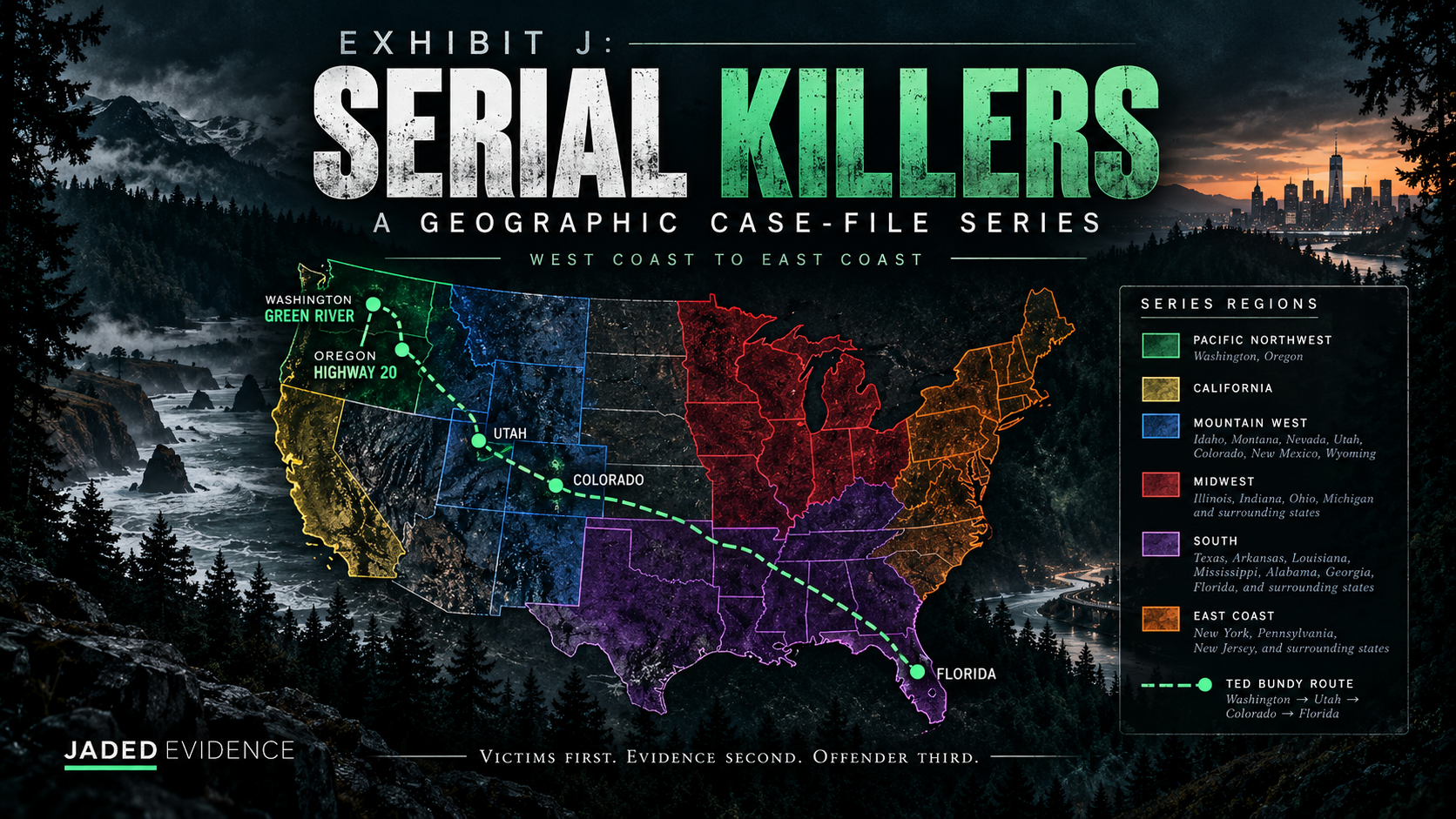
This series follows serial-murder investigations region by region, beginning on the West Coast and moving east. Each case file centers the victims, separates proven facts from allegations and confessions, and tracks the evidence that moved the investigation forward.
Victims first. Evidence second. Offender third.
How to use this hub
- Choose a region.
- Open any case file for the full deep dive.
- Use the regional case-file sections as we continue expanding the series eastward.
Pacific Northwest
Regional color: green. Washington and Oregon open the series with highway disappearances, serial homicide, and investigations that shaped the region.
The Lost Women of Highway 20 — John Arthur Ackroyd
Five women connected to an Oregon highway corridor, a surviving victim, and decades of questions about missed opportunities to stop him.
The Green River Killer — Gary Ridgway
The women of Pacific Highway South, the Green River Task Force, preserved biological evidence, and the DNA breakthrough that finally led to arrest.
Ted Bundy — Before the Myth, Washington Was Looking for “Ted”
A Washington-first reconstruction of the victims, Lake Sammamish, the multi-state investigation, escapes, and Florida prosecutions.
Robert Lee Yates Jr. — Spokane’s Serial Killer
The East Sprague Avenue victim community, the Spokane investigation, and the separate plea and Pierce County murder convictions.
Israel Keyes — The Killer Who Planned Around the Map
A Pacific Northwest and Alaska crossover case built around Samantha Koenig, Bill and Lorraine Currier, hidden caches, deliberate cross-country travel, and unidentified victims investigators are still trying to connect.
California
Regional color: amber/gold. California expands the series into unsolved identity cases, forensic genealogy, public manhunts, marginalized-victim investigations, and multi-jurisdiction prosecutions.
Zodiac — The Murders, the Letters, and the Myth
The four canonical attacks, surviving witnesses, letters and ciphers, suspect theories, and the evidence that still does not identify the killer.
Golden State Killer — Joseph DeAngelo and the DNA Breakthrough
The East Area Rapist and Original Night Stalker cases, preserved DNA, investigative genetic genealogy, arrest, guilty pleas, and life-without-parole sentencing.
Richard Ramirez — The Night Stalker and a City Under Siege
The Southern California home-invasion spree, survivor testimony, fingerprint breakthrough, public manhunt, trial, and 13 murder convictions.
Grim Sleeper — Lonnie Franklin Jr. and the Women South Los Angeles Lost
The South Los Angeles murders, Enietra Washington’s survival, familial DNA, 10 murder convictions, and the larger question of why marginalized victims were overlooked.
William Suff — The Riverside Prostitute Killer
The Riverside County murders, the investigation, convictions, death sentence, and the recurring problem of offenders exploiting vulnerable victims.
Leonard Lake & Charles Ng — The Wilseyville Murders
The remote Calaveras County property, the bunker and videotaped evidence, Lake’s death before trial, Ng’s extradition fight, and the uncertain total victim count.
Randy Steven Kraft — The Scorecard Killer
The freeway murders, 16 first-degree murder convictions, the cryptic scorecard, and the unresolved question of how many additional victims may be connected.
Southwest
Regional color: desert rust. Arizona and New Mexico bring the series into urban serial predation, random-shooter investigations, vulnerable missing women, and one of the most haunting unidentified-offender cases in the country.
Southwest Case Files
Mark Goudeau — The Baseline Killer. Thirty-three victims in the prosecution, nine murder convictions, DNA evidence, and a massive Phoenix capital case.
The Phoenix Serial Shooters — Dale Hausner & Samuel Dieteman. Random late-night shootings, surveillance, a Silent Witness tip, wiretaps, and six murder convictions against Hausner.
The West Mesa Murders. Eleven women and one unborn child recovered from Albuquerque’s West Mesa, additional missing women, and an offender who remains unidentified.
Mountain West / Rockies
Regional color: slate blue / mountain gray. Utah, Colorado, and Idaho bring the series into child-victim serial murder, cold-case DNA attribution, and multiple prosecutions arising from a compressed series of killings.
Mountain West / Rockies Case Files
Arthur Gary Bishop — Five Boys Murdered in Utah. Five murder convictions, five aggravated kidnappings, confession evidence, recovery of victims, and a 1988 execution.
Vincent Groves — DNA and Denver’s Unsolved Murders. A murder conviction, an earlier confessed homicide, and four cold-case murders later linked to Groves through DNA after his death.
Paul Ezra Rhoades — Three Idaho Murders in Three Weeks. Three victims, separate prosecutions, firearm evidence, death sentences, an Alford plea in one case, and execution in 2011.
Ted Bundy — Mountain West crossover. The existing Bundy deep dive will also be cross-linked here so his Utah, Colorado, and Idaho victims are not lost in the regional progression. Utah investigators tied Bundy to Nancy Wilcox, Melissa Smith, Laura Aime, Debra Kent, and Susan Curtis; Colorado records document Caryn Campbell and Bundy’s confession to Julie Cunningham, while Denise Oliverson remains an attributed/suspected Bundy case; in Idaho, Lynnette Culver is widely treated as a likely Bundy victim based on his confession, but the case remains unsolved.
Midwest
Regional color: brown / rust. Illinois, Wisconsin, Indiana, and Ohio bring the series into suburban concealment, victim marginalization, interstate highway murders, healthcare homicide, cold-case identification, and one of America’s oldest unidentified serial-killer investigations.
Case Files
John Wayne Gacy — The Chicago-Area Murders. Thirty-three murder convictions, the 1978 Robert Piest investigation, recovery of remains from Gacy’s property, and decades of victim-identification work.
Jeffrey Dahmer — The Milwaukee Murders. Seventeen victims, the 1991 escape of Tracy Edwards, evidence recovered from Dahmer’s apartment, and the failures surrounding Konerak Sinthasomphone.
Herb Baumeister — Fox Hollow Farm and the I-70 Connection. Missing men, extensive human remains recovered from an Indiana property, ongoing identification work, and a suspect who died before trial.
Donald Harvey — The Hospital ‘Angel of Death’. Healthcare-associated homicide in Ohio and Kentucky, poisoning and suffocation allegations, plea agreements, and the distinction between admitted and judicially established victims.
Anthony Sowell — The Cleveland Strangler. Eleven murder convictions, women found in and around a Cleveland home, and the consequences of repeated disappearances among marginalized victims.
Larry Eyler — The Highway Killer. Young male victims, interstate geography, an Illinois murder conviction, and additional killings confessed through counsel before Eyler’s death.
The Cleveland Torso Murders. Depression-era dismemberment cases, unidentified victims, Eliot Ness, decades of suspect theories, and an offender who remains unidentified.
Great Plains / Central
Regional color: yellow-gold. Kansas, Missouri, Nebraska, Oklahoma, and surrounding central states. This completed section covers offender communications, digital evidence, cold-case DNA, revenge-driven homicide, internet-facilitated targeting, and historical poisonings.
Case Files
Dennis Rader — BTK. Ten murders, repeated communications with police and media, decades of evasion, and the floppy-disk metadata mistake that helped identify him.
Robert Berdella — The Kansas City Butcher. Kidnapping, torture, extensive offender documentation, and a survivor escape that exposed the crimes.
Maury Travis — The St. Louis Serial Murders. Digital tracing, an online map, multiple suspected victims, and a suspect who died before trial.
Anthony Garcia — The Omaha Revenge Murders. Four murder convictions tied by prosecutors to professional grievance and retaliation.
John Edward Robinson — Internet-Era Serial Killer. Kansas and Missouri murders, early internet targeting, fraud, and remains concealed in barrels.
Terry Blair — The Kansas City Serial Murders. Multiple murder convictions involving women killed in Kansas City.
Lorenzo Gilyard — The Kansas City Strangler. Multiple murder convictions with cold-case DNA playing a central role.
Nannie Doss — The Giggling Granny. Historical family and intimate-partner poisonings across several states, with Oklahoma central to her prosecution.
South / Southeast
Regional color: purple. Texas, Florida, Louisiana, Arkansas, Mississippi, Alabama, Georgia, Tennessee, Kentucky, the Carolinas, Virginia, and West Virginia make up this South / Southeast region, with cross-state cases included where offender mobility overlaps regional boundaries.
Case Files
Aileen Wuornos — Florida Highway Murders. Multiple Florida murder convictions, self-defense claims, sex-work context, and capital punishment.
Danny Rolling — The Gainesville Ripper. Five student murders in Gainesville, a terrified college community, and a prosecution built from converging forensic and behavioral evidence.
Bobby Joe Long — The Tampa Bay Serial Murders. Serial sexual violence, kidnapping, homicide, survivor testimony, and execution in Florida.
Judy Buenoano — The Black Widow. Poisoning, family homicide, attempted murder, insurance motive, and execution in Florida.
Christine Falling — The Florida Child Deaths. Repeated pediatric deaths involving children in her care, confession evidence, and a life sentence.
Henry Lee Lucas & Ottis Toole — Confessions, Claims, and Uncertainty. Multi-state murder claims, disputed confessions, false-clearing concerns, and the Florida connection through Toole.
Tommy Lynn Sells — Cross-State Serial Killer. A highly mobile offender, survivor identification, numerous claimed murders, and the challenge of separating verified cases from confession claims.
Dean Corll — The Houston Mass Murders. Abduction and murder of boys and young men in the Houston area, accomplice testimony, burial-site recovery, and enduring victim-identification questions.
Ángel Maturino Reséndiz — The Railroad Killer. Cross-state murders near railroad corridors, offender mobility, multi-jurisdiction investigation, and surrender in 1999.
Genene Jones — Pediatric Healthcare Homicide. Texas pediatric deaths and injuries, medication access, healthcare-system failures, and later prosecution of an older case.
Coral Eugene Watts — The Sunday Morning Slasher. Texas and multi-state murders, survivor evidence, numerous offender admissions, and the need to distinguish proven cases from claims.
Kenneth McDuff — The Broomstick Killer. Texas murder convictions, parole, additional killings after release, and the criminal-justice controversy surrounding his return to violence.

Northeast / New England
Regional color: orange. New York, New Jersey, Pennsylvania, Connecticut, Massachusetts, Rhode Island, Vermont, New Hampshire, and Maine bring the series into metropolitan manhunts, Long Island investigations, healthcare homicide, historical poisoning cases, disputed attribution, and unidentified offenders.
Case Files
David Berkowitz — Son of Sam. Six murders, multiple shootings, ballistics, a parking-ticket lead, and one of New York City’s largest manhunts.
Joel Rifkin — The Long Island Serial Murders. New York-area victims, a traffic-stop arrest, nine murder convictions, and additional admissions kept separate from the judicial count.
Richard Cottingham — The Torso Killer. New York and New Jersey murders, multiple convictions, cold-case admissions, and decades of reopened investigations.
Rex Heuermann — The Gilgo Beach Prosecution. Accused, not convicted. An active prosecution involving multiple homicide charges, DNA litigation, and continuing court proceedings.
Charles Cullen — A Healthcare Serial Killer. New Jersey and Pennsylvania hospital murders, medication access, guilty pleas, and institutional accountability.
Arthur Shawcross — The Genesee River Killer. Rochester-area murders, prior child-killing convictions, parole history, and later serial-homicide convictions.
Michael Ross — Connecticut Serial Killer. Multiple murder convictions involving young women and girls, competency litigation, and execution in 2005.
Jane Toppan — The New England Nurse Killer. Historical poisoning, healthcare homicide, confession evidence, and an insanity verdict.
The Boston Strangler. Albert DeSalvo’s confession, a confirmed DNA link to Mary Sullivan, and unresolved questions about whether every murder belongs to one offender.
The Connecticut River Valley Killer. Unidentified offender. New Hampshire/Vermont cold cases, exhumation and DNA efforts, and unresolved serial-pattern questions.
What Every Case File Examines
- The victims and who they were beyond the circumstances of their deaths
- A chronological reconstruction of the crimes and investigation
- What authorities knew — and when they knew it
- Confirmed, admitted, suspected, and unresolved victims
- Forensic evidence and investigative breakthroughs
- Missed opportunities and institutional failures where supported by the record
- Arrest, prosecution, plea or trial, sentencing, and appeals
- Unresolved evidence, unidentified victims, and open questions
Where the Series Goes Next
After the Pacific Northwest and California, Exhibit J will continue progressively east across the United States. Special evidence episodes will also examine CODIS, forensic genetic genealogy, victim identification, geographic patterns, investigative tunnel vision, and the difference between confirmed, confessed, and suspected victim counts.
Follow the evidence.